Hardware and physical integration guideline A1 PCR sensors
Page 20 of 30
© 2024 by Acconeer – All rights reserved 2024-02-07
4 Dielectric lenses
Dielectric lenses are a cost-effective way of shaping the radiation patterns, especially for millimeter
wave applications where the size of the lens becomes small enough. Although it is most common to
design lenses for increasing the gain and to narrow the beamwidth, lenses can also be used for
increasing the beamwidth, tilted beams as well as to suppress side lobes to reject unwanted reflections.
Since many common thermoplastics used in product design also have low permittivity and low loss, a
lens can often be incorporated into the same encapsulation material with little additional cost. 3D
printing technology allows for rapid prototyping and can often resemble the performance of the final
product. Dielectric lenses are also more compact and cheaper to fabricate than corresponding horn
antennas and reflectors.
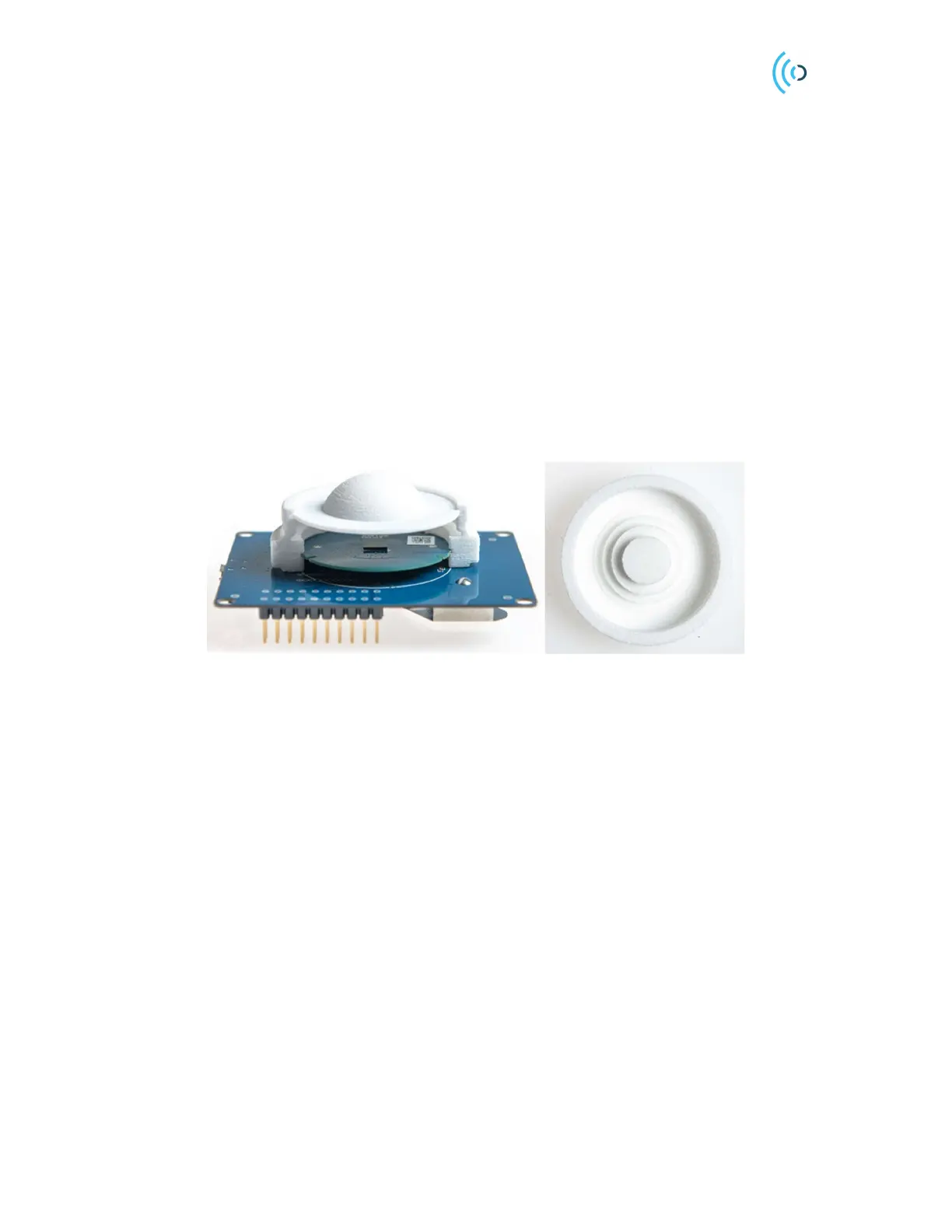
To quickly get started using a lens, Acconeer provides two example lenses, one plano-convex and one
FZP type lens, see Figure 17. Both lenses can be used with all module evaluation kits. The FZP lens is
similar to the example lens in Ch. 4.3.1. The user guide and performance of these lenses can be found
in [6].
Figure 17. Plano-convex (left) and Fresnel Zone Plate lens (right) from Acconeer lens kit [6].
4.1 Refracting lenses
4.1.1 Design principles
Figure 18a shows a spherical wavefront from the A111/A121 sensor feeding a converging lens of
refractive index 𝑛=√𝜖
. The lens refracts the spherical waves to produce parallel waves for
increasing the directivity. Figure 18b shows the corresponding ray optics model where rays propagate
from the source as diverging straight lines until hitting the first surface and refracting into parallel
rays. Ray optics doesn’t account for interference, diffraction, and polarization but it does give us a
basic understanding of dielectric lenses, and most importantly, allows us to quickly construct
analytical lens shapes for many applications.
In the following we assume that all lens profiles are axial symmetric, although asymmetrical lenses
can be designed for customized radiation patterns. For a converging lens, two criteria need to be
fulfilled: (1) Refraction at one or both surfaces to produce parallel rays at the output, and (2), the rays
just outside the outer surface have to be coherent (in-phase). One of the lens surfaces can be chosen
arbitrarily, for example planar or spherical. Next, we will provide design equations for constructing
converging lenses fulfilling these criteria.



 To Next Page
 Loading...