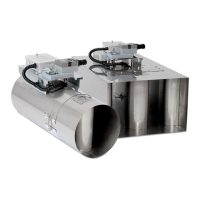
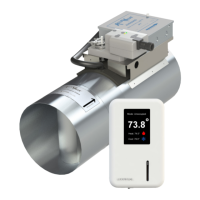
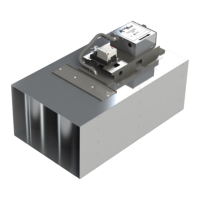
The AccuValve Model AVR6000 is a high-performance airflow and temperature control valve designed for critical laboratory applications, including those with numerous VAV fume hoods. It integrates advanced airflow and temperature control capabilities, making it a reliable and intuitive system for managing room environments.
Function Description
The core of the AVR6000 is the AccuValve, which divides airflow into two equal chambers using an airfoil-shaped compression section. Each chamber contains a vortex shedding airflow sensor, a modulating control blade, and a static regain section. As air accelerates and compresses within these chambers, the vortex shedding sensors generate a highly repeatable digital pulse-train, with a frequency directly proportional to the airflow velocity. This digital signal provides a direct measurement of the volumetric flow rate in each chamber. The AVR6000's ePI® controller uses this airflow measurement as closed-loop feedback to modulate the valve actuator, maintaining the desired airflow setpoint.
When combined with an Accutrol Room Temperature Sensor (ARS or ADS), the AVR6000 forms a comprehensive airflow and temperature control system. It communicates with building automation networks via EIA-485 supporting BACnet MS/TP as a Full Master Node. Field programming and configuration are accomplished through the AccuValve Insight user-interface software, which runs on a Windows 10 computer or tablet, connecting via USB or an optional wireless Bluetooth connection.
The AVR6000 supports various application types (APPs), including supply-only, supply with general exhaust/return, supply with fume hood/other exhaust, and supply with AccuNet exhaust. It can also incorporate discharge temperature control and dual maximum control logic for enhanced energy efficiency and comfort. The system can operate in multiple setpoint modes (e.g., occupied, unoccupied, decontamination, override), activated locally via dry-contact inputs or through BACnet.
Important Technical Specifications
- Accuracy: +/- 5% of reading or 5 CFM, whichever is greater.
- Speed of Response: < 1 second control signal response (full stroke cycle time based on actuator type).
- Shut-off Leakage Rate: Standard: < 1.5% FS at max operating pressure. "S" Option: < 0.5% FS round valves, < 1% FS rectangular valves @ max operating pressure.
- Max Operating Pressure: 3"wc Differential Pressure Across Valve.
- Failure Mode: Open, Closed, or Last Position (based on actuator type selection).
- Temperature:
- Airstream: -20 to 165 deg. F (Standard Valve Models), -20 to 375 deg. F (High Temp SS Valve Models).
- Ambient: -20 to 125 deg. F.
- Storage: -40 to 165 deg. F.
- Humidity: 0 to 90% non-condensing.
- Input Power: 24VAC +/- 20% 50-60Hz or 24 VDC +/- 10%.
- Max Power (Size 06-24): 30VA/17W (actuator type 3 & 5), 13VA/7W (actuator type 7).
- Max Power (Size 36, 48): 53VA/30W (actuator type 3 & 5), 19VA/12W (actuator type 7).
- Analog Inputs (3 Dedicated):
- AI-1 (DTS): Supply Air Discharge Temperature Signal.
- AI-2 (GEV/RET): GEX/Return Airflow Volume Signal.
- AI-3 (FHV): Fume Hood(s) Airflow Volume Signal.
- Signal Types: Voltage (0-10V, 100K ohms impedance) or Current (0-20mA, 500 ohms impedance) or Resistance (0-20K ohm, 500uA internal current source).
- Digital Inputs (2 Dedicated): Dry Contact Only for Setpoint Mode Selectors.
- Analog Outputs (2 Dedicated):
- AO-1 (RHV): Reheat Valve Control Signal.
- AO-2 (GEX/RET): GE/RET Valve Control Signal.
- Signal Types: Voltage (0-10V, 100K ohms impedance) or Current (0-20mA, 500 ohms impedance).
- Alarm Output: DPDT Relay, NC/NO Contacts, 1A @ 30vDC or 0.3A @ 125VAC. Max operating voltage 125VAC/60 VDC. Max carry current 1A, Max switching capacity 37 VA, 30W.
- Network: BACnet MS/TP (EIA 485 2-wire, Full Master Node, Data Rates 9600-115200).
- Configuration: USB 2.0 (Type C Connector, Isolated), Optional Bluetooth (Ver 4.2 or later).
- Compliance: CE, ROHS, FCC Part 15, KCC South Korea, Australia and New Zealand regulatory compliance.
- Valve Material Options: 304ss (20 Ga.), 316ss (20 Ga.), Aluminum (16 Ga.), High Temp 304ss (20 Ga.).
- Valve Sizes: Round (6" to 14" Diameter), Rectangular (12"h x 18"w to 12"h x 48"w).
- Actuator Options: Fail Last Position (FLP) 2-sec or 21-sec full cycle, Fail Open/Closed (FSP) 2-sec full cycle.
Usage Features
The AVR6000 is designed for ease of configuration and monitoring through the AccuValve Insight software.
- Configuration Software: AccuValve Insight provides a user-friendly interface for setting up the valve. It requires a Windows 10 device with a USB 2.0 port (or Bluetooth v4.2+ for wireless option). The software guides users through APP configuration, setpoint definition, ARS/ADS sensor selection, GE/Return and other exhaust valve configurations, and reheat control settings.
- Setpoint Configuration: Users can define up to four different setpoint modes (e.g., occupied, unoccupied, decontamination) with customizable parameters like minimum/maximum supply airflow, room offset airflow, and room temperature heating/cooling setpoints. These modes can be switched via dry-contact inputs or BACnet.
- Real-time Monitoring (Dashboard): The Insight Dashboard provides real-time information on airflow, temperature, and system status. It displays current operating mode, room temperature, supply air temperature, airflow measurements, and exhaust volumes.
- Tuning Parameters: The tuning window in Insight displays a logic diagram of the control system, allowing access to key parameters for monitoring, evaluating, and troubleshooting. Factory default tuning parameters are suitable for most applications, but can be adjusted for optimization.
- Calibration Adjustments: The software allows for field calibration adjustments for supply and exhaust airflow, room temperature, room humidity, and supply discharge temperature to correlate AVR measurements with field measurements.
- Control Overrides: Users can manually override the automatic control loop outputs for supply valve, exhaust valve, and reheat valve, setting values between 0 and 100%. This is useful for testing and troubleshooting.
- Constant Airflow Configuration: For rooms with unmeasured airflows (e.g., CAV exhaust snorkels, transfer grills), constant supply and exhaust airflow values can be entered to be included in the room offset calculation.
- BACnet Integration: The AVR6000 is fully BACnet MS/TP compliant, allowing seamless integration with building automation systems. Key BACnet parameters like MAC address, baud rate, and device object instance can be configured via Insight.
- Power Source Flexibility: The control module features a Power Source Switch, allowing configuration via USB power when 24V field power is unavailable, a convenient feature for pre-installation setup.
Maintenance Features
The AVR6000 is designed with maintenance in mind, providing accessible components and diagnostic tools.
- Access Covers: Both round and rectangular AccuValves feature easily removable access covers to allow inspection of the airflow sensors. For round valves, a 3/8" bolt secures the access door. For rectangular valves, four #2 blunt-head Phillips head screws secure the cover.
- Sensor Inspection: Once the access cover is removed, the vortex shedding airflow sensors are accessible for visual inspection.
- Actuator Replacement: The manual provides detailed instructions for replacing the actuator, including tools required and step-by-step procedures for securing the actuator to the shaft and mounting plate, as well as setting the first and second stop positions.
- Actuator Adaption Routine: After actuator replacement or maintenance, an actuator adaption routine can be initiated via Insight to calibrate the valve's full range of motion.
- Diagnostic Tools: The AccuValve Insight software includes an "Airflow Measurement" window that displays real-time vortex shedding frequency measurements for each chamber, which can be a valuable troubleshooting tool for diagnosing airflow issues.
- Hardware Status: The "Hardware Status" window in Insight provides indicators for 24V power, USB power, Bluetooth module installation, ARS/ADS sensor connection, and real-time status of dry contact inputs and alarm relay output, aiding in quick diagnosis of hardware-related issues.
- Flash Memory Management: The controller limits the number of flash write cycles to 10,000 to protect the microcontroller from damage, with the remaining write cycles available via BACnet Object AI7, allowing for monitoring of flash memory health.

 Need help?
 General

 To Next Page