
 Need help?
Do you have a question about the Acer CB314-2H and is the answer not in the manual?
Instructions on powering on the device for the first time. A "Welcome" screen appears on boot.
Guide to choosing the default language and keyboard input method from a drop-down list.
Steps to connect the Chromebook to the internet by selecting a network and entering a password.
Process of agreeing to terms and conditions to receive system updates and new features.
Guidance for initial login procedures after setup is complete.
How to set up a new Google Account for Chromebook access and Google services.
Option to use the Chromebook without signing in with a Google Account.
Instructions for enrolling the Chromebook in an enterprise environment.
Steps for logging in with an existing Google Account, setting it as the owner.
Identification and description of components visible on the front view of the Chromebook.
Overview of the keyboard layout, including keys and the touchpad.
Details on dedicated function keys and key combinations for controls.
Explanation of touchpad gestures for pointing, clicking, and scrolling.
Description of ports and indicators on the left side of the Chromebook.
Details on USB Type-C capabilities, including DisplayPort and charging specifications.
Description of ports and slots on the right side of the Chromebook.
Description of components located on the bottom of the Chromebook, such as speakers.
Information on software compatibility and sources like Google Play Store.
Guidance on downloading applications from the Google Play Store.
Information on using Microsoft Office applications on the Chromebook.
Location of files within the Files app and how to access them.
Methods for transferring local files using external storage devices.
Explanation of how the Google Account is used for sign-in and services.
Steps for setting up parental controls using a child's Google Account.
How to access help documentation and support via the Explore app.
Official online resources and support links for Chrome OS.
The Acer Chromebook 314 is a portable computing device designed for ease of use and cloud-centric operations, leveraging the Chrome OS ecosystem. This user manual provides essential information for getting started, understanding the device's physical layout, and addressing common queries.
Upon first use, the Chromebook guides the user through an initial setup process. This begins with powering on the device via the dedicated power button, which brings up a "Welcome" screen. The user is prompted to select their preferred language settings from a drop-down list, with an option to choose a keyboard input method if multiple are available for the selected language. A crucial step involves connecting to a network; the device displays a list of available networks, and if a network is protected, a password will be required for access. Once connected, the user must accept the Terms of Service, after which the Chromebook automatically downloads any available system updates, ensuring the latest Chrome OS features are installed.
For first-time sign-in, users have several options. They can create a new Google Account, which grants access to various Google web services like Gmail, Google Drive, and Google Calendar. Alternatively, users can browse as a guest, allowing them to use the Chromebook without a Google Account. For those who already possess a Google Account, signing in involves entering their username and password. Enterprise users have an additional option for enterprise enrollment, accessible through "More options" during sign-in if the device is a Chromebook Enterprise. It is important to note that the primary Google Account used for sign-in will be designated as the owner, and only this account can modify certain Chrome settings.
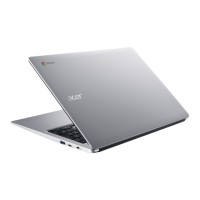
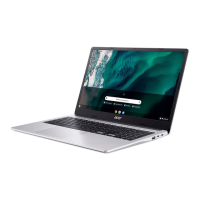
The physical design of the Acer Chromebook 314 is straightforward, featuring a front view that includes a microphone, webcam, and screen. The internal microphone is used for sound recording, while the webcam facilitates video communication, indicated by an adjacent light when active. The screen displays computer output and may support touch or non-touch functionality.
The keyboard view highlights key components for interaction. The keyboard itself is used for data entry. Below the keyboard is a touch-sensitive pointing device, the touchpad, which functions like a computer mouse. Pressing down anywhere on the touchpad acts as a left-click, while pressing down with two fingers simulates a right-click. Tapping the touchpad with two fingers or pressing and holding Alt on the keyboard while tapping with one finger also performs a right-click. Two-finger swiping allows for vertical and horizontal scrolling. The drag-and-drop gesture involves selecting an item with one finger and moving it with a second finger before releasing both; this gesture is primarily for files, not windows or icons. A power button is also integrated into the keyboard area for turning the computer on and off.
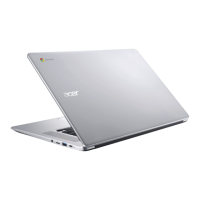
The left side of the Chromebook features a USB Type-C port with DC-in, a headset/speaker jack, and a battery indicator. The USB Type-C port serves multiple functions: it connects to the provided USB Type-C power adapter for charging, connects to USB devices with a USB Type-C connector, and supports DisplayPort™ over USB-C™ for audio/video output. It also delivers up to 3 A at 5 V DC for USB charging and requires a power adapter or source providing 45 W at 5~20 V for DC-in. The headset/speaker jack connects to audio devices such as speakers, headphones, or a headset with a microphone. The battery indicator light shows amber when the battery is charging and turns blue when fully charged in AC mode.
On the right side, the Chromebook includes a USB 2.0 port for connecting to USB devices and a Kensington lock slot, which allows for connection to a Kensington-compatible security lock. The bottom view of the device reveals speakers, which deliver stereo audio output.
The manual also addresses frequently asked questions. Chromebooks primarily utilize apps from the Google Play Store and web applications, rather than traditional software. Users can download apps by clicking the Launcher icon and searching for "Play Store." Microsoft Office software (Word, Excel, PowerPoint) can be used on Chromebooks either by downloading the apps from the Google Play Store or by accessing them via the web, with additional functionality available through a Microsoft 365 subscription. Files are stored in the Files app, accessible by clicking the Launcher icon and searching for "Files." Local files can be transferred using compatible storage devices like USB thumb drives or removable hard drives. The Chromebook requires Google Account information for sign-in, as it uses this account to automatically sign the user into Google services such as Gmail and Drive. For parental controls, it is advised to sign in with the child's personal Google Account, which can be created during the sign-in process if needed, allowing for the addition of a school account after device onboarding.
For further assistance, users can access Chromebook Help through the Explore app on their device or visit google.com/support/chromebook/ for Chrome OS information. This comprehensive guide ensures users can effectively set up, operate, and maintain their Acer Chromebook 314.
 General
| Display Size | 14 inches |
|---|---|
| RAM | 4GB |
| Operating System | Chrome OS |
| Weight | 1.5 kg |
| Color | Silver |
| Processor | Intel Celeron N4020 |
| Storage | 64GB eMMC |
| Wireless | 802.11ac Wi-Fi |
| Ports | 2 x USB 3.1 |


 To Next Page