
 Need help?
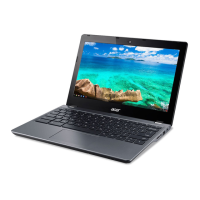
Do you have a question about the Acer Chromebook 11 C733 and is the answer not in the manual?
Remove twelve (12) screws securing the base cover.
Carefully pry open the base cover starting from the gap near the LCD hinge.
Lift the base cover from the left side and remove it from the system.
Disconnect the battery cable from the motherboard.
Disconnect the WLAN antenna cables from the WLAN module.
Remove the screw securing the WLAN module and then remove the module.
Insert the new WLAN module into the mainboard connector.
Connect the MAIN (black) and AUX (white) antenna cables to the WLAN module.
Place a square rubber on the WiFi connector area and connect the battery cable.
Place the base cover, engage latches, and install twelve (12) screws.
This document outlines the procedures for disassembling, maintaining, and reassembling a portable computing device, focusing on the replacement of its Wireless Local Area Network (WLAN) module and the general handling of its internal components. The device appears to be a laptop or similar portable computer, designed for user-level maintenance or repair by trained technicians.
The device is a portable computer, indicated by its internal components such as a mainboard, WLAN module, battery, and a base cover that encloses these elements. Its primary function is to provide computing capabilities, which are supported by its various internal modules. The WLAN module, a key component addressed in this manual, enables wireless internet connectivity, allowing the device to communicate with networks without physical cables. The battery provides portable power, ensuring the device can operate untethered from a power outlet. The overall design suggests a focus on portability and ease of access for certain maintenance tasks.
While the manual primarily focuses on maintenance, it implicitly highlights several usage features. The presence of a WLAN module indicates that the device is designed for wireless connectivity, a crucial feature for modern portable computing. This allows users to access the internet, connect to local networks, and utilize cloud services from various locations. The battery system ensures mobility, allowing the device to be used on the go without constant access to a power source. The modular design, particularly for components like the WLAN module, suggests a degree of future-proofing and repairability, which can extend the device's lifespan and enhance user satisfaction by allowing for component upgrades or replacements. The base cover, which is removed and reinstalled, protects the internal components from dust, spills, and physical damage during normal use, while also providing a stable surface for the device. The careful instructions for prying open the base cover and handling internal cables emphasize the precision required for maintaining the device, which in turn contributes to its reliable operation during usage. The device's design, with screws and latches, ensures that the components are securely held in place during everyday use, preventing accidental disconnections or damage.
The manual provides a detailed guide for specific maintenance procedures, making it a valuable resource for servicing the device.
The initial steps involve the removal of the base cover, which is secured by twelve screws. This systematic approach ensures that the cover can be safely detached without damaging the internal components or the cover itself. The instruction to use a scribe to carefully pry open the base cover, starting from a specific point near the LCD hinge, is critical for avoiding damage to the latches and the casing. The visual cues, such as the yellow indication for the starting point and the red arrows for the direction of sliding the scribe, are excellent maintenance features that guide the user through a delicate process. This method ensures that all latches are released progressively, preventing undue stress on any single point. The final step of lifting the base cover from the left side and removing it in the indicated direction further emphasizes a controlled and safe removal process.
A crucial safety and maintenance step is the disconnection of the battery cable. This is highlighted as the first internal component to be addressed after the base cover is removed. Disconnecting the battery prevents accidental power surges or short circuits during subsequent maintenance tasks, protecting both the device and the technician. The clear visual of the battery cable and its connector makes this step straightforward.
The core maintenance feature detailed in the manual is the replacement of the WLAN module. This process is broken down into several precise steps:
An interesting and specific maintenance feature is the instruction to place a square rubber (PN: GAZHR009010) on the WiFi connector area of the mainboard. This rubber is to be aligned with the pin of the WiFi connector and placed between the solder pin of the WiFi connector and a component. This suggests a design improvement or a corrective measure to prevent potential issues, such as short circuits or mechanical stress, enhancing the long-term reliability of the WiFi connection. This detail highlights a proactive approach to maintenance and component protection.
After the WLAN module replacement and rubber placement, the battery cable is reconnected. This step, reversing the initial disconnection, ensures that the device is ready to receive power once reassembled.
The final maintenance steps involve reassembling the device:
The note regarding the handling of replaced WLAN modules for Quanta and Asplex (for EMEA) is an important logistical maintenance feature. It ensures proper inventory management, potential recycling, or further analysis of faulty components, contributing to quality control and supply chain efficiency. This indicates a structured approach to component replacement beyond just the physical act of swapping parts.
Overall, the manual provides a comprehensive and visually guided approach to maintaining the device, particularly for WLAN module replacement, emphasizing precision, safety, and proper component handling.
 General
| Operating System | Chrome OS |
|---|---|
| Processor | Intel Celeron N3350 |
| RAM | 4 GB |
| Display Size | 11.6 inches |
| Display Resolution | 1366 x 768 |
| Graphics | Intel HD Graphics 500 |
| Battery Life | 10 hours |
| Wireless | 802.11ac Wi-Fi |
| Bluetooth | Bluetooth 4.2 |
| Color | Black |
| Processor Speed | 1.1 GHz |
| Ports | USB Type-C, USB 3.0, headphone/microphone combo |
| Weight | 1.26 kg (2.78 lbs) |


 To Next Page