
 Need help?
Do you have a question about the ACR Electronics Cobham ResQLink PLB-375 and is the answer not in the manual?
Explains the necessity of beacon registration for SAR response and legal compliance.
Details the process of beacon registration and how the Unique Identifier Number (UIN) is used.
Covers the specific steps and authorities for registering the beacon in the United States.
Provides guidance for registering the beacon in countries outside the US and Canada.
Explains how the beacon transmits distress signals to search and rescue (SAR) organizations.
Describes the satellite network that detects and relays distress signals globally.
Details how onboard GPS improves location accuracy for faster SAR response.
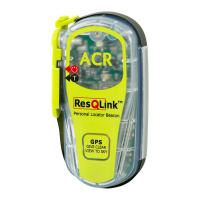
Identifies and describes the key physical parts of the beacon.
Details the function of the antenna latch and the antenna deployment.
Explains the operation and function of the beacon's primary control buttons.
Explains when and why to activate the beacon in a life-threatening situation.
Provides step-by-step instructions for activating the beacon in distress.
Describes the LED and strobe signals indicating beacon activation status.
Details how the GPS receiver integrates with the 406 MHz signal for location transmission.
Stresses the importance of a clear sky view for optimal GPS performance.
Provides visual guidance on correct handling and antenna orientation for activation.
Explains how to deactivate the beacon by pressing the ON/OFF button.
Provides steps to take if the beacon fails to deactivate properly.
Encourages users to contact ACR after a rescue to improve products.
Introduces the two types of tests available to ensure beacon functionality.
Details the procedure for performing a basic self-test without GPS data.
Explains the meaning of the amber light during self-test, indicating battery status.
Details the procedure for performing a GPS self-test to verify receiver function.
Explains the meaning of LED indicators during the GPS self-test process.
Introduces subscription-based satellite testing and beacon management services.
Describes extended services like confirmation messages and friend/family check-ins.
Information about a 2-day free trial for testing beacon functionality via satellite.
Provides advice on how to avoid accidental or intentional false beacon activations.
Outlines the procedures for reporting false alarms to the relevant authorities.
Lists the details necessary when reporting a false alert to authorities.
Guidance on regularly inspecting the beacon case for cracks or damage.
Instructions on how to safely clean the beacon using a damp cloth.
Details on when and how the beacon's battery should be replaced.
How to update registration information when ownership or contact details change.
Procedures to follow if the Personal Locator Beacon is lost or stolen.
Covers physical dimensions, material, color, waterproof rating, and approvals.
Technical details for the 406 MHz transmitter, including frequency and output power.
Technical details for the 121.5 MHz homing transmitter, including frequency and output power.
Information on battery type, operational life, and replacement guidelines.
Outlines the one-year warranty period for material and workmanship defects.
Details conditions under which the product warranty does not apply.
Instructions on how to place the warranty in effect by registering online.
 General
| Product Type | Personal Locator Beacon (PLB) |
|---|---|
| Manufacturer | ACR Electronics |
| Model | ResQLink PLB-375 |
| GPS | Yes |
| GPS Accuracy | Within 100 meters |
| Battery Type | Lithium |
| Operating Temperature | -4°F to 131°F (-20°C to 55°C) |
| Activation | Manual |
| Warranty | 5 years |
| Frequency | 406 MHz |
| Battery Life at -4°F (-20°C) | Minimum 24 hours |
| Registration Required | Yes |
| Battery Life | 24+ hours in operation, 5-year shelf life |

 To Next Page
