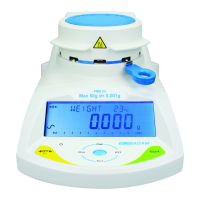
The PMB Moisture Analyzer is a laboratory instrument designed for the determination of moisture content in various materials. It offers a range of features and specifications that make it suitable for diverse applications.
Function Description:
The PMB Moisture Analyzer operates by heating a sample to dry it, and then measuring the mass loss to determine the moisture content. It supports various drying methods, including single temperature, ramp to temperature, and step temperature, allowing for flexibility in testing different sample types. The analyzer can store up to 99 test results and settings, which can be recalled for repeated tests or analysis. It also features a USB host connection for memory devices, enabling the storage and transfer of test data. The device can be connected to a PC via RS-232 or USB for data collection and control using AdamDU Data Collection software.
Important Technical Specifications:
The PMB Moisture Analyzer comes in two models: PMB 53 and PMB 202.
- Capacity: PMB 53 has a capacity of 50g, while PMB 202 has a capacity of 200g.
- Readability: PMB 53 offers a readability of 0.001g / 0.01%, and PMB 202 offers 0.01g / 0.05%.
- Repeatability Weighing: PMB 53 has a repeatability of 0.002g s.d., and PMB 202 has 0.02g s.d.
- Stabilisation Time: Both models have a stabilization time of approximately 3-4 seconds.
- Suggested Minimum Sample Size: PMB 53 suggests 2g, and PMB 202 suggests 5g.
- Repeatability Determination (Sample is sodium tartrate dihydrate):
- PMB 53: 3g sample 0.15%, 10g sample 0.05%
- PMB 202: 3g sample 0.4%, 10g sample 0.2%
- Pan Size: Both models have a 90mm pan.
- Test Method: %moisture / %solids, %moisture / dry weight, %solid / dry weight.
- End Criteria: Manual stop, Auto Stop with time, Auto stop change < set amount/time.
- Maximum Test Time: 99 minutes (1.5+ hours).
- Heaters: Custom Halogen Lamp, 400W, 230VAC or 115VAC 50/60Hz.
- Temperature Chamber: 50 - 160°C, set in 1°C steps.
- Temperature Profile: Standard (one step), Step (up to 3 temperatures), Ramp (vs. time), Rapid option for Single and Step methods, 130% target for 3 minutes at start of test.
- I/O: RS-232 Bi-directional Serial port, USB Serial Output, USB HUB Serial interface.
- Stored Test Setting: 1 Default setting, 49 User Settings, stored by number and alpha/numeric name.
- Stored Test Results: Up to 99 test results stored by name.
- Data Output: Ability to send data out via RS232 or USB Serial port. Ability to store test results and test settings to USB memory device using USB Host interface.
- Beeper: To sound when keys are pressed or to announce end of a test, independently enable/disable.
- Language: English, German, French or Spanish.
- RTC: Real Time Clock, Date formats: YMD, DMY, MDY.
- Calibration: Time 24 hour clock, Manual calibration using external mass (20 or 50g | 100 or 200g).
- Power: Factory set, 115VAC or 230VAC, 50-60Hz., 400 watt.
- Fuse: 5A, time lag, High Breaking capacity, 5 x20mm.
- Environment: 0°C to 40°C, up to 90% RH. non-condensing.
Usage Features:
- Easy-to-read LCD display with backlight: Provides clear visibility of test parameters and results.
- Bi-directional RS-232 interface and USB interface: Facilitates connectivity with external devices for data transfer and control.
- USB Host connection for memory device: Allows for convenient storage and retrieval of test data and settings.
- GLP Compliant report: Can be configured to print a GLP Compliant report after each calibration, including time, date, analyzer number, and verification of calibration.
- 400 watt Halogen Heater: Ensures rapid and efficient drying of samples.
- Rapid heat Function: Speeds up the drying process.
- Capacity tracker: Monitors the remaining capacity of the analyzer.
- Date and time: Keeps track of test timestamps.
- Easy to use, sealed keypad: Provides a user-friendly interface and protects against spills.
- Password protection: Secures access to settings and data.
- Security locking point: Prevents unauthorized movement or theft of the analyzer.
- Multiple languages for display and printing: Offers versatility for users in different regions.
- Numeric Entry Method: Allows users to set values for various parameters using a combination of display, print, PST, and setup/enter keys.
- Rear Panel Interfaces: Includes USB, I/O, Fuse, and RS-232 ports for power supply and data communication.
- Basic Operation: The PMB operates as a basic balance, showing grams weight on the display. A passcode can be set to limit access to weighing functions.
- Setup Method: The PMB is set to perform a drying test using a method determined by the user. The drying method can be input from a number of different sources, including using the keyboard, recalled from internal memory, recalled from a memory stick plugged into the USB host connector, or entered from a PC using RS232 or USB interface.
- Heat Control: Options for single temperature, ramp to temperature, and step temperature.
- Interval: Sets the time interval at which results are computed and printed.
- Rapid Heat: Sets the rapid heat function to be on, off, or under user control.
- End Point Determination: Manual stop active in all tests, stable result, or time/stable result.
- Start Criteria: Start manually or automatically when the cover is lowered.
- Print Settings: Allows printing and storing of results.
- Storing Test Results: The analyzer can store up to 99 test results in its internal memory.
- Recalling Test Results: Stored test results can be recalled and displayed.
- Deleting Test Results: Individual or all test results can be deleted from memory.
- Storing Results in USB Memory: Test results can be stored on a USB memory device.
- Analyzer Menus: Includes passcodes, PMB analyzer settings, serial I/O, and calibration.
- Sample Preparation: Emphasizes the importance of proper sample preparation for accurate results, including grinding, mixing, and ensuring uniform moisture distribution.
- Guidance Notes: Provides recommendations for temperature, display update time, and expected results when drying various substances.
Maintenance Features:
- Cleaning: The analyzers should be cleaned regularly, and spills in the weighing chamber should be cleaned up before they become baked on.
- Protection: Avoid extreme temperatures, direct sunlight, or near air conditioning vents. Ensure the analyzer is on a strong, stable, and vibration-free table. Avoid unstable power sources and large users of electricity. Keep the analyzer free from vibration. Avoid high humidity and direct contact with water. Do not spray or immerse the analyzer in water.
- Safety: The PMB Moisture Analyzer complies with European Council Directives and international standards for electromagnetic compatibility and safety requirements. Users are advised to read operating instructions thoroughly. Improper use or handling can result in damage or injury. The moisture analyzer must be operated by trained personnel.
- Hot Surfaces: The heating chamber can become very hot. Keep all material away from the vent area. Do not touch hot surfaces. Leave 20 cm (about 8 inches) around the moisture analyzer and 1 m (3 ft.) above. Samples will be hot after a test. Do not use bare fingers to pick up any samples pans or touch the materials.
- Materials: The PMB Moisture Analyzer is not suitable for all materials. Drying process samples will be heated to high temperatures. Materials that are flammable or explosive should not be tested. Materials that emit toxic, caustic, or noxious fumes should only be tested in suitable fume hoods or with other ventilation. Materials that will have a film on the surface during drying may cause high internal pressures to be present. These materials should not be tested using this method. Materials that emit aggressive or corrosive fumes (such as acids) should be tested using small quantities of material in an area with good ventilation.
- Troubleshooting: The manual provides guidance on troubleshooting common issues, such as error messages during calibration or loading configuration files.
- Warranty: Adam Equipment offers a limited warranty for components failed due to defects in materials or workmanship. The warranty statement outlines the terms and conditions of sale.

 Need help?
 General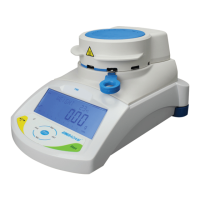

 To Next Page