Need help?
Do you have a question about the ADWA AD12 and is the answer not in the manual?
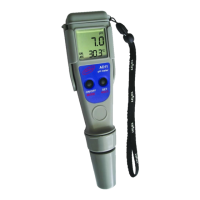
Identifies key components of the pH tester's front panel and display, including LCD, buttons, and electrode connector.
Details the pH and temperature measurement ranges and their respective resolutions for accurate readings.
Specifies the accuracy of pH and temperature measurements and the automatic calibration process.
Outlines operating environment, dimensions, weight, and battery life for the pH testers.
Describes the included AD11P pH electrode, its automatic temperature compensation, and calibration features.
Instructions for powering the pH tester on and off, including visual indicators.
How to freeze the current measurement reading on the LCD and return to normal mode.
Steps for correctly measuring pH, including submerging the electrode and waiting for stability.
Detailed steps for calibrating the pH meter, including single-point and two-point methods.
Procedures to quit calibration mode or reset the meter to default calibration values.
Guide on selecting between Celsius (°C) and Fahrenheit (°F) for temperature display.
Instructions for choosing the calibration buffer set (e.g., 4.01/7.01/10.01 or NIST).
Best practices for storing and maintaining the pH electrode to ensure longevity and accuracy.
Steps for replacing the meter's batteries, emphasizing proper sealing for water resistance.
The Adwa AD11 and AD12 are waterproof pH and temperature testers designed for accurate and reliable measurements in various environments. These compact and robust devices are fully sealed against humidity, ensuring durability and consistent performance even in challenging conditions.
The primary function of the AD11 and AD12 is to measure pH and temperature. They feature automatic temperature compensation (ATC) for pH readings, which means the pH measurements are automatically adjusted based on the sample's temperature, ensuring high accuracy. Users can choose to display temperature values in either Celsius (°C) or Fahrenheit (°F) units.
The testers are equipped with a dual-line LCD, which simultaneously displays the primary pH reading and the secondary temperature reading. A unique stability indicator, represented by an hourglass symbol, appears on the LCD to inform the user when the measurement is stable and ready to be recorded. This feature helps ensure reliable and consistent results.
For calibration, the meters offer both one-point and two-point automatic calibration options. They can recognize two sets of memorized pH buffer values: pH 4.01, 7.01, 10.01, or pH 4.01, 6.86, 9.18 (NIST buffers). This flexibility allows users to choose the buffer set most appropriate for their application. The calibration mode is clearly indicated on the display, guiding the user through the process.
The AD11 and AD12 are designed for ease of use, with a simple two-button interface. The "ON/OFF/MODE" button controls power and navigates through different modes (measurement, calibration, setup). The "SET/HOLD" button is used to freeze the display during measurement or to select options within the setup and calibration modes.
Turning the Meter On/Off: To turn on the meter, press and hold the "ON/OFF/MODE" button until the LCD lights up. All segments will be visible for a second, or as long as the button is pressed. To turn off the meter, press the "ON/OFF/MODE" button while in measurement mode; "OFF" will appear on the secondary display before the meter powers down.
Taking Measurements: To take a measurement, submerge the pH electrode in the solution to be tested and stir gently. Wait for the stability indicator (hourglass symbol) to disappear before recording the pH value. The primary LCD level will show the temperature-compensated pH value, while the secondary level will display the sample temperature. It is crucial to ensure the meter has been calibrated (indicated by the "CAL" tag on the display) before taking any pH measurements for accuracy.
Freezing the Display: During measurement, the "SET/HOLD" button can be pressed to freeze the current reading on the LCD. Pressing any button again will return the meter to normal measurement mode.
Calibration Procedure: Frequent calibration is recommended for better accuracy, especially after testing aggressive chemicals, when high accuracy is required, or at least once a month. The calibration process is initiated by pressing and holding the "ON/OFF/MODE" button until "CAL" replaces "OFF" on the secondary LCD. The meter will then prompt the user to use specific buffer solutions. The meter automatically recognizes valid buffers and indicates "REC" on the secondary display. If an invalid buffer is detected, "WRNG" will be displayed. For single-point calibration, the meter accepts the reading once stable. For two-point calibration, the meter guides the user through two buffer points (e.g., pH 7.01/6.86 followed by pH 4.01/10.01/9.18). The "CAL" tag will appear on the display once calibration is complete.
Quitting Calibration and Resetting to Default Values: Users can exit the calibration procedure before the first point is accepted by pressing the "ON/OFF/MODE" button, which will display "ESC" and return the meter to normal mode. To reset to default calibration values, press "SET/HOLD" after entering calibration mode but before the first point is accepted; "CLR" will be displayed, and the "CAL" tag will disappear.
Setup Mode: The setup mode allows users to select the temperature unit (°C or °F) and the pH buffer set (4.01/7.01/10.01 or NIST 4.01/6.86/9.18). To enter setup, press the "ON/OFF/MODE" button until "TEMP" replaces "CAL" on the secondary display. The "SET/HOLD" button is used to toggle between options, and the "ON/OFF/MODE" button is used to confirm selections and exit setup mode.
Interchangeable pH Electrode: The AD11P pH electrode, supplied with the meter, is interchangeable. This allows users to easily replace the electrode when needed, extending the life of the device. The encapsulated temperature sensor within the electrode ensures fast and accurate temperature measurement and compensation.
Low Battery Warning: A low battery symbol on the LCD alerts the user when the batteries need to be replaced, preventing unexpected power loss during measurements. The auto-off feature, which activates after 8 minutes of non-use, helps conserve battery life.
Electrode Maintenance: Proper electrode maintenance is crucial for ensuring the longevity and accuracy of the pH tester.
Battery Replacement: When the low battery symbol appears on the LCD, the batteries should be replaced promptly. To do this, unscrew and release the electrode body. Carefully remove the battery compartment and replace all four 1.5V button-type batteries, paying attention to their polarity. After replacing the batteries, reattach and tighten the electrode body properly to ensure a watertight seal and maintain the device's waterproof integrity.
General Care: When taking successive measurements in different samples, rinse the probe thoroughly between samples to eliminate cross-contamination. After cleaning, rinse the probe with some of the sample to be measured to ensure accurate readings.
 General
| pH Range | 0.00 to 14.00 pH |
|---|---|
| pH Resolution | 0.01 pH |
| pH Accuracy | ±0.01 pH |
| mV Resolution | 1 mV |
| Battery Type | 4 x 1.5V AAA |
| Display | LCD |
| Temperature Range | -5.0 to 105.0 °C |
| Temperature Resolution | 0.1 °C/°F |
| Temperature Accuracy | ±0.5 °C |
| pH Calibration | Up to 3 points |
| Temperature Compensation | Automatic from -5.0 to 105.0°C (23 to 221°F) |
| Electrode | Included |
| Temperature Probe | AD7662, included |
| Battery Life | Approx. 200 hours |
| Environment | 0 to 50 °C, RH max 95% |


 To Next Page