Need help?
Do you have a question about the AEC IST5 Series and is the answer not in the manual?
Essential warnings for UPS installation and operation, including hazards.
Specifies minimum space needed around the UPS for ventilation and service access.
Instructions for proper storage of the UPS before installation to prevent damage.
Guidelines for safely transporting the UPS unit, including handling precautions.
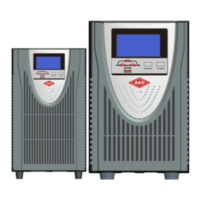
Overview of different UPS models with visual representations and dimensions.
Detailed identification of components on the front panel for 10-40KVA models.
Detailed identification of components on the front panel for 60-300KVA models.
Detailed view of the internal components accessible from the front.
Visual inspection of the internal layout from the side of the UPS.
Identification of rear panel connectors and components for 10-40KVA models.
Diagram and explanation of the UPS electrical connection points.
Explains the overall operating topology and functional principles of the IST5 series UPS.
Describes how the static transfer switch manages power flow between mains and inverter.
Explains how the UPS monitors and adjusts charging based on battery temperature.
Lists and briefly describes the different operational modes of the IST5 series UPS.
Details the operation when the UPS is powered by AC mains and supplying the load.
Explains UPS operation using battery power during mains failure.
Describes how the UPS transfers load to the bypass line under specific conditions.
Details the UPS's behavior for automatic restart after mains restoration.
Describes the mode allowing UPS servicing without power interruption to loads.
Covers charging methods, float charge, and battery health monitoring.
Explains constant current and float charging techniques for batteries.
Details auto battery test, deep discharge protection, and low battery warnings.
Describes the components and functions of the UPS front panel control interface.
Information shown on the UPS screen when it is first powered on.
How to access and navigate the main menu options from the opening screen.
Guides on using keys to move through menus and select options.
Explains access to menus requiring a password for security.
Details operations like start, stop, switch to bypass, and battery tests via the control menu.
Describes how to view system status for mains, output, battery, and alarms.
Covers settings for date, time, battery installation, screen, and communication.
How to view logged events and detailed information about UPS operations.
Information on accessing the service menu, which is password protected.
Comprehensive guide for installing a single UPS module, including safety and preparation.
Critical safety warnings and precautions that must be followed during UPS installation.
Essential control actions to ensure accurate product operation before installation.
Recommendations for placing the UPS to ensure optimal performance and cooling.
Details on air intake/exit spots and environmental protection for UPS placement.
Guidelines for setting up external battery cabinets, including safety and ventilation.
Details on configuring internal batteries for specific UPS models and fuses.
Precautions for moving UPS and battery cabinets, emphasizing careful handling.
Instructions on connecting power, loads, and batteries, including distribution board recommendations.
Specific instructions for making cable connections for 10-40KVA UPS models.
Specific instructions for making cable connections for 60-300KVA UPS models.
Detailed steps for connecting internal and external batteries to the UPS.
Step-by-step guide for connecting internal batteries within the UPS unit.
Guide for connecting external battery cabinets to the UPS.
Information on connecting RS232, expansion slots, and parallel ports for various UPS models.
Details on communication and control connections for 10-20 KVA models.
Details on communication and control connections for 30-40 KVA models.
Details on communication and control connections for 60-80 KVA models.
Details on communication and control connections for 100-300 KVA models.
Information on the optional feature to operate UPS units in parallel for redundancy or increased capacity.
Steps to configure UPS units for parallel operation, including settings and connections.
Specific connection and setup procedures for 10-20 KVA models in parallel.
Specific connection and setup procedures for 30-40 KVA models in parallel.
Specific connection and setup procedures for 60-80 KVA models in parallel.
Specific connection and setup procedures for 100-120 KVA models in parallel.
Detailed steps for connecting multiple UPS units in parallel, including checks and electrical connections.
Verifying that all UPS units are compatible for parallel operation (series, firmware).
Guidelines for physically placing UPS units close to each other for parallel connection.
Step-by-step instructions for wiring multiple UPS units in parallel.
Configuring the UPS software to establish Master/Slave roles for parallel operation.
Procedures for starting, switching, and managing UPS units operating in a parallel system.
Steps to safely initiate and start a parallel UPS system.
How to manually or automatically switch parallel units to static bypass mode.
Procedures for safely removing one UPS from a parallel configuration for maintenance.
Method for shutting down all UPS units simultaneously in a parallel system.
Detailed guide covering circuit breakers, start-up, modes, shutdown, and communication.
Explanation of the purpose and operation of the four main circuit breakers on the UPS.
Step-by-step instructions for the initial power-on and startup of the UPS.
Procedures for testing various UPS operational modes like Online, Battery, and Bypass.
How to transition the UPS from normal AC power to battery operation.
Procedure for switching the UPS from normal mode to static bypass.
How to return the UPS from bypass mode back to normal online operation.
Steps for engaging maintenance bypass mode to service the UPS safely.
Detailed steps for safely powering down the UPS completely.
How to use the EPO button to immediately shut down all UPS functions.
Instructions for installing and using the RS232 interface for remote monitoring.
Description and testing instructions for the DC-DC SMPS board.
Details the main board's role in controlling UPS operations and parameters.
Explains the function of the by-pass board in controlling thyristors and readings.
Describes the IGBT driver board's function in controlling IGBTs for rectifier and inverter units.
Details the purpose and testing of the relay board.
Describes the EPO board's function and testing procedures.
Information on testing the bridge rectifier board for functionality.
Details the DC bus feeding board's role and testing requirements.
Guide for installing the dry contact board and its operational features.
Information on testing the EMI filter board.
Details regarding the Power Factor Correction (PFC) board and its testing.
Describes a second relay board, potentially for different functions or models.
Guide to updating UPS firmware using the C2000 programmer software.
Instructions for installing the RS335 Dry Contact module into the UPS.
Explains the operational aspects of the dry contact module, including relay outputs.
Details the function of each I/O pin on the dry contact module.
Lists default and assignable functions for the dry contact relays.
Illustrates how output relays can be wired for different control necessities.
Interpretation of various log events displayed by the UPS for troubleshooting.


 To Next Page
 General