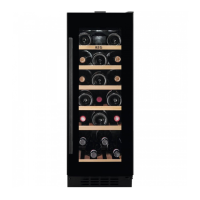
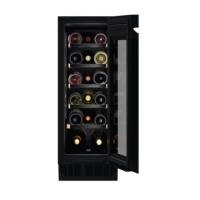
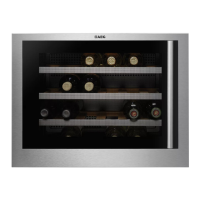
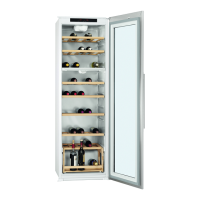
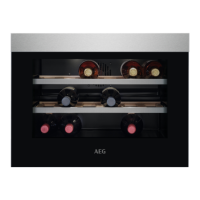
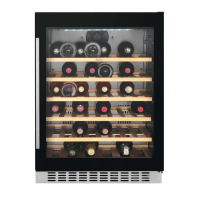
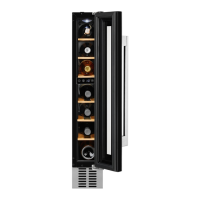
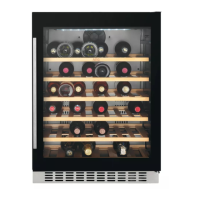
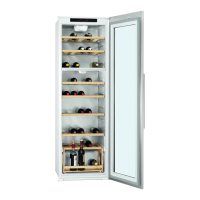
This document is a user manual for an AEG wine cabinet, model AWUS052B5B. It provides comprehensive instructions for installation, operation, maintenance, and troubleshooting, ensuring optimal performance and safety.
Function Description
The AEG wine cabinet is designed exclusively for storing wine, maintaining specific temperature and humidity levels to preserve its quality. It is suitable for single household domestic use in indoor environments, and can also be used in offices, hotel guest rooms, bed & breakfast guest rooms, farm guest houses, and similar accommodations, provided usage levels do not exceed average domestic use. The appliance features a control panel for easy temperature regulation and lighting control, and includes multiple shelves for organized storage of wine bottles. It is equipped with a cooling unit that uses isobutane (R600a) as a refrigerant, a natural gas with high environmental compatibility.
Usage Features
The wine cabinet offers several features to enhance the user experience and ensure optimal wine storage:
- Temperature Regulation: The appliance allows users to set the temperature between +5°C and +18°C using dedicated "warmer" and "colder" buttons on the control panel. The default set temperature for the wine cabinet is 12°C. The display shows the currently set temperature, enabling precise control over the storage environment.
- Recommended Storage Temperatures: The manual provides specific temperature recommendations for different types of wine:
- Champagne and sparkling wines: +6°C to +8°C
- White wines: +10°C to +12°C
- Rosé and light red wines: +12°C to +16°C
- Aged red wines: +14°C to +16°C
- Lighting Control: A dedicated light button on the control panel allows users to turn the interior light on and off. The manual states that the light has no negative effect on the quality of the wine, providing visibility without compromising storage conditions.
- Storage Capacity: The appliance is designed to store up to 52 Bordeaux bottles (0.75 cl). The shelves are configured to accommodate different quantities: 6 bottles on level 1, 8 bottles on levels 2, 3, 4, and 5, and 14 bottles on level 6.
- Humid Box: A detachable humid box is located on the top shelf. Users can pour water into this box to prevent excessively low air humidity levels, which is crucial for preserving wine corks and preventing oxidation.
- Adjustable Shelves: The wooden shelves can be easily removed and reinstalled. To remove a shelf, the user needs to open the door completely, pull the shelf until its notch is under the plastic post, and then lift the front slightly to detach it. Reinstallation follows the reverse order.
- Door Reversibility: The door's hinge can be reversed, allowing the user to change the opening direction to suit their kitchen layout. This process requires specific tools (cross-shaped screwdriver, putty knife or thin-blade screwdriver) and involves unscrewing and re-attaching hinges and covers. It is emphasized that the appliance must be unplugged before performing this operation.
- Levelling: The appliance is equipped with two adjustable feet at the bottom front, allowing users to ensure it stands level, which is important for proper operation and stability.
Maintenance Features
The manual outlines several maintenance procedures to ensure the longevity and efficient operation of the wine cabinet:
- General Cleaning:
- The interior should be cleaned with lukewarm water and a baking soda solution (approximately 2 tablespoons of baking soda to a quart of water).
- The exterior can be cleaned with warm water and a neutral soap.
- Users are advised to wring out excess water from sponges or cloths when cleaning near controls or electrical parts.
- Door seals should be regularly checked and wiped clean to ensure they are free from debris.
- Abrasive products, powders, chlorine, or oil-based cleaners should not be used as they can damage the finish.
- Drain Cleaning: The drain of the appliance should be regularly examined and cleaned if necessary. A blocked drain can lead to defrosted water collecting at the bottom of the appliance.
- Periods of Non-Operation: For long periods of non-use, users should disconnect the appliance from the electricity supply, remove all items, clean the appliance and accessories, and leave the door open to prevent unpleasant smells and mold development.
- Power Failure Precautions: In case of a power failure, users are advised to minimize door opening to maintain temperature. If the power outage is prolonged, the same steps as for periods of non-operation should be followed.
- Refrigerant Circuit Maintenance: The appliance contains hydrocarbons in its cooling unit. Any maintenance or recharging of the cooling unit must only be carried out by authorized technicians to ensure safety and proper functioning.
- Lamp Replacement: The appliance is equipped with a long-life LED interior light. If the lamp needs replacement, only authorized service personnel should perform this task.
- Door Gasket Maintenance: Regular cleaning of door gaskets is recommended. If necessary, the door can be adjusted, or defective door gaskets can be replaced by contacting an Authorized Service Centre.


 To Next Page
 General