Need help?
Do you have a question about the AEG FEE53610ZM and is the answer not in the manual?
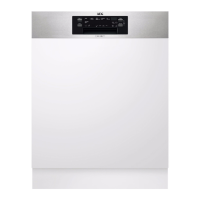
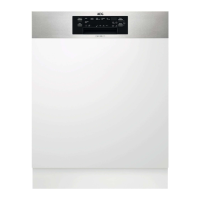
This document is a user manual for an AEG dishwasher, model FEE53610ZM. It provides comprehensive instructions for installation, safe operation, maintenance, and troubleshooting, aiming to ensure optimal performance and longevity of the appliance.
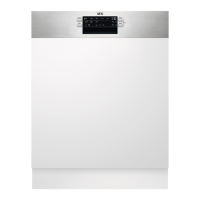
The AEG FEE53610ZM is a dishwasher designed for household use, capable of washing up to 13 place settings. It features a water softener system that removes minerals from the water supply, crucial for effective washing and preventing limescale buildup. The appliance offers various wash programs tailored to different load types and soil degrees, including an ECO program for efficient water and energy consumption, and an AUTO program that automatically adjusts settings based on soil level and load quantity. A dedicated program is also available for cleaning the appliance's interior, removing limescale and grease buildup.
The dishwasher incorporates a rinse aid dispenser to aid in drying and prevent streaks, and a salt container for the water softener. It includes an AirDry function, which automatically opens the door during the drying phase to improve drying results and reduce energy consumption. The control panel features an on/off button, program selection, a display, delay start functionality, and options for enhanced washing and hygiene.
The dishwasher is activated by pressing the on/off button, after which users can select a program using the program button. The display shows the program duration and various indicators for salt, rinse aid, washing, rinsing, and drying phases, as well as for activated options like GlassCare, ExtraPower, and ExtraHygiene.
Program Selection and Start: To start a program, the user first activates the appliance, ensures it's in program selection mode, and then repeatedly presses the Program button until the desired program indicator is on. Applicable options can then be set. Finally, pressing the Start button initiates the program.
Delay Start: A delay start function allows users to postpone the program start from 1 to 24 hours. This is set by repeatedly pressing the Delay button until the desired time is shown, then pressing Start to begin the countdown.
Options: The appliance offers several options to customize wash cycles:
Water Softener and Rinse Aid Settings: The water softener level should be adjusted according to local water hardness for optimal washing results. The manual provides a table to guide this setting. The rinse aid empty notification can be activated or deactivated, though using rinse aid is recommended for best drying performance.
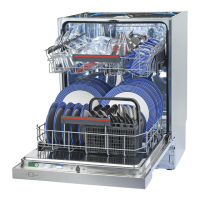
Loading: Dishes should be loaded to utilize the full space of the baskets, with hollow items facing downwards and glass items not touching each other. Cutlery and small items go in the cutlery basket, and the upper basket can be moved to accommodate larger items below. Pre-rinsing dishes by hand is discouraged to save water and energy; instead, programs with a prewash phase can be selected.
Detergent Use: Only dishwasher-specific detergent should be used. For normal soil, 20-25 ml of gel detergent is typically sufficient. If a program includes a prewash phase, a small quantity of detergent can be placed on the inner part of the appliance door. Multi-tabs may not fully dissolve in short programs, so long programs are recommended when using them.
AirDry Function: The AirDry function automatically opens the dishwasher door during the drying phase to improve drying and save energy. Users are cautioned not to close the door within 2 minutes of automatic opening to prevent damage. This function can be deactivated if desired.
Regular maintenance is crucial for the dishwasher's performance and longevity.
Filter Cleaning: The filter system, composed of three parts, should be checked and cleaned regularly. This involves turning and removing the filters, washing them, and then reassembling them, ensuring correct positioning to avoid poor washing results and appliance damage.
Spray Arm Cleaning: The lower spray arm should be regularly cleaned to prevent soil from clogging its holes, which can lead to unsatisfactory washing. It can be removed by pulling it upwards, washed under running water, and any remaining particles removed with a thin pointed tool. The upper spray arm should not be removed, but its openings can be cleaned similarly.
Internal Cleaning: The appliance interior should be cleaned with a soft damp cloth, avoiding abrasive products or strong chemicals. The door, including the rubber gasket, should be wiped clean weekly. To maintain performance and prevent grease and limescale buildup, a dishwasher cleaning product should be used at least once every two months, ideally with the automatic cleaning program. Running long-duration programs regularly also helps prevent buildup.
Foreign Object Removal: After each use, the filters and sump should be checked for foreign objects (e.g., glass pieces, plastic, bones). These should be manually removed to prevent damage to the drain pump and maintain cleaning performance. If foreign objects cannot be removed, an Authorized Service Centre should be contacted.
External Cleaning: The exterior of the appliance should be cleaned with a moist soft cloth and only neutral detergents.
Troubleshooting: The manual includes a comprehensive troubleshooting section with common problems, alarm codes (e.g., i10, i20, i30, iF1), and their possible causes and solutions. This allows users to address minor issues independently before contacting an Authorized Service Centre.
 General
| Product Type | Dishwasher |
|---|---|
| Appliance placement | Built-in |
| Number of Place Settings | 13 |
| Noise Level | 44 dB |
| Water Consumption | 9.9 L |
| Control panel colour | Black |
| Number of washing programs | 6 |
| Drying Class | A |
| Delay Start | Yes |
| Half Load | No |
| Child Lock | Yes |
| Washing programs | Eco, Quick, Intensive |

 To Next Page