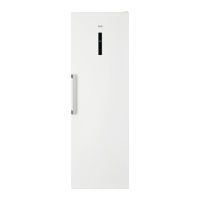
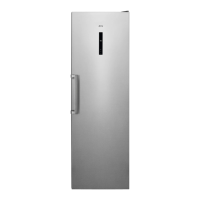
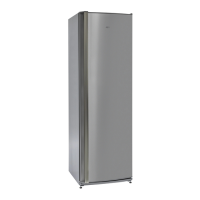
This document is a user manual for the AEG RKB738E3MX and RKB738E3MB refrigerator models. It provides comprehensive instructions for installation, operation, maintenance, and troubleshooting, ensuring optimal performance and user safety.
Function Description
The AEG refrigerator is designed for storing food and beverages in a domestic indoor environment. It utilizes No-Frost technology, which circulates dry, cold air homogeneously throughout the refrigerator compartment to prevent humidity and frost buildup. This eliminates the need for manual defrosting and ensures uniform cooling of all food items. The appliance is not intended for commercial or common use, nor for storing explosive or flammable substances.
Key functions and modes include:
- Cooler Temperature Settings: Users can adjust the cooler temperature between 8 °C, 6 °C, 5 °C, 4 °C, and 2 °C using the control panel.
- Super Cool Mode: This mode is designed for rapidly cooling large quantities of food in the fridge compartment or quickly chilling drinks. It can be activated via the control panel.
- Economy Mode: This energy-saving mode provides optimum temperature during periods of less frequent use, such as holidays, by reducing power consumption.
- Screen Saver Mode: To save energy, this mode switches off all control panel lighting when the panel is inactive for a certain period.
- Child Lock Function: This feature prevents accidental or unintentional changes to the appliance settings by locking the control panel.
- Door Open Alarm Function: If the refrigerator door remains open for more than 2 minutes, an audible alarm sounds, and a door open icon illuminates on the display.
- Turbo Fan (if available): This feature enhances air circulation within the refrigerator, ensuring even cooling. Users are advised not to block the air inlet and outlet openings to maintain its effectiveness.
- Extra Chill Drawer (in some models): This specialized drawer provides a lower temperature environment compared to the rest of the fridge, thanks to active cold air circulation, ideal for preserving the taste and texture of fresh cuts and cheese.
- The Fresh Dial (in some models): Located in front of the crisper, this dial allows users to control air circulation and humidity levels within the crisper, extending the life of stored food. It should be opened if condensation is observed on the glass shelf.
Usage Features
The refrigerator is designed for user convenience and efficient food storage.
- Installation: Before first use, the appliance should be kept in an upright position for at least 3 hours to ensure efficient operation and prevent compressor damage. It should be placed in a cool, well-ventilated room, away from direct sunlight and heat sources. Proper clearance (at least 50 cm from stoves/gas ovens/heater cores and 5 cm from electrical ovens) is required for optimal performance. The adjustable front legs allow for leveling and stability before food is placed inside. Rear spacers should be installed for freestanding installations against a wall to ensure maximum distance.
- Electrical Connection: The appliance requires a 220-240 V, 50Hz power supply with an efficient ground connection. A specially earthed plug is fitted, and if the socket does not match, an authorized electrician should install a suitable 16 or 10 ampere grounded socket. For UK type plugs, a 13A fuse (ASTA approved to BS1362) must be used.
- Food Storage Guidelines:
- Liquids should be stored in sealed containers to reduce humidity and frost formation.
- Warm food should be allowed to cool to room temperature before being placed in the refrigerator to ensure adequate air circulation.
- Items should not be in direct contact with the rear wall to prevent frost buildup.
- Meat and clean fish are best stored loosely wrapped on the glass shelf just above the vegetable bin.
- Loose fruit and vegetable items should be stored in the crisper containers, separated to prevent ethylene-sensitive vegetables from being affected by ethylene-releaser fruits.
- Wet vegetables should not be placed in the refrigerator.
- Meat products should be packaged to avoid cross-contamination.
- Food should not block the air flow passage.
- The appliance is suitable for storing pre-frozen food, ice cream, and making ice cubes in two-star frozen-food compartments. One-, two-, and three-star compartments are not suitable for freezing fresh food.
- Door Operation: A vacuum seal forms when the door is closed; waiting 1 minute before reopening is recommended. Frequent door openings should be avoided to prevent warm air from entering and increasing energy consumption.
- Control Panel: The display and control panel provide clear indicators for set values, super cooling, economy mode, child lock, and alarms. Buttons allow for easy adjustment of temperature settings and activation of various modes.
Maintenance Features
Regular cleaning and maintenance are crucial for the longevity and efficient operation of the AEG refrigerator.
- Cleaning:
- Always disconnect the appliance from the power supply before cleaning.
- Do not wash the appliance by pouring water directly onto it.
- Avoid using abrasive products, detergents, or soaps. Clean thoroughly with a solution of warm water and a teaspoon of sodium bicarbonate, then rinse with clean water and dry carefully.
- Ensure no water enters the lamp housing or other electrical components.
- Clean accessories separately by hand with soap and water; they are not suitable for dishwashers.
- Clean the condenser with a brush at least twice a year to maintain energy efficiency and productivity.
- Troubleshooting: The manual provides a guide for common issues and error codes (E01, E02, E03, E06, E07, E08, E10, E11). For instance, if the fridge compartment is not cold enough (E10), users are advised to set a colder temperature, activate Super Cool mode, or ensure food is not blocking air duct channels. For low voltage warnings (E08), the power supply needs to be increased.
- Gasket Maintenance: The door gasket should be kept clean and pliable. If worn and detachable, it should be replaced.
- LED Lighting: If the appliance has LED lighting, contact the help desk for replacement, as this should only be done by authorized personnel.
- Service and Spare Parts: For repairs, contact an Authorized Service Centre and use original spare parts. Self-repair or non-professional repair may void the guarantee. Specific spare parts (thermostats, temperature sensors, printed circuit boards, light sources, door handles, door hinges, trays, and baskets) will be available for 7 years after the model is discontinued. Door gaskets will be available for 10 years.
- Disposal: Old fridges and freezers contain isolation material and refrigerant with CFCs. They should be disposed of responsibly at applicable collection points for recycling electrical and electronic equipment to prevent environmental harm. Locks on old appliances should be broken or removed to prevent children from getting trapped.

 Need help?
 General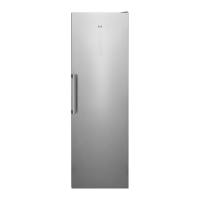

 To Next Page