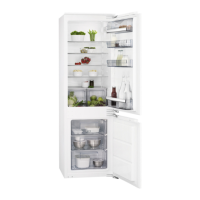
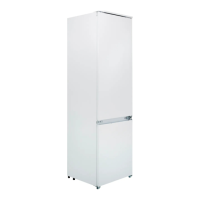
This document is a user manual for the AEG SCB6181VLS Fridge Freezer, providing comprehensive instructions for its installation, operation, maintenance, and troubleshooting.
Function Description
The AEG SCB6181VLS is a fridge freezer designed for household and similar applications. It features separate compartments for refrigeration and freezing, allowing for the storage of fresh food and the long-term preservation of frozen and deep-frozen food. The appliance utilizes a cooling unit containing flammable gas (isobutane R600a), which is environmentally compatible. The design includes a control panel for temperature regulation and activation of special functions.
Usage Features
The fridge freezer offers several features to optimize food storage and user convenience:
- Temperature Regulation: The appliance's temperature can be adjusted progressively from +2°C (coldest) to +8°C (warmest) using a temperature regulator button. A medium setting is generally recommended for optimal performance. The internal temperature is influenced by room temperature, door opening frequency, quantity of stored food, and appliance location.
- Frostmatic Function: This function can be activated via a dedicated button to accelerate the freezing process for fresh food. It is recommended to activate Frostmatic at least 24 hours before placing food to be frozen in the freezer compartment. The function automatically deactivates after 52 hours.
- Adjustable Door Shelves: The door shelves can be repositioned at different heights to accommodate various sizes of food packages, enhancing storage flexibility.
- Movable Shelves: The refrigerator compartment is equipped with runners, allowing shelves to be placed at desired heights. However, the glass shelf above the vegetable drawer should not be moved to ensure proper air circulation.
- Freezing Fresh Food: The freezer compartment is suitable for freezing fresh food. For efficient freezing and thawing, food should be divided into small portions and wrapped in airtight packaging (aluminium foil or polythene). To avoid increasing the temperature of already frozen food, fresh unfrozen food should not be placed directly next to it.
- Storage of Frozen Food: Commercially frozen food products should be adequately stored by the retailer and transferred to the freezer as quickly as possible. Once defrosted, food should not be refrozen and should be consumed rapidly or cooked immediately. The manual advises noting the freezing date on individual packs to track storage time.
- Thawing: Deep-frozen or frozen food can be thawed in the refrigerator compartment or at room temperature, depending on the available time. Small pieces can be cooked directly from frozen, though cooking time will be longer.
- Ice-cube Production: The appliance includes trays for ice-cube production. Users should fill these trays with water and place them in the freezer compartment. Metallic instruments should not be used to remove trays from the freezer.
- Energy Saving Hints: To save energy, users are advised not to open the door frequently or leave it open longer than necessary. If the ambient temperature is high, the temperature control is set to a low temperature, and the appliance is fully loaded, the compressor may run continuously, leading to frost or ice formation. In such cases, setting the temperature control to a higher temperature allows for automatic defrosting and energy saving.
- Fresh Food Refrigeration Hints: To maintain fresh food quality, warm food or evaporating liquids should not be stored in the refrigerator. Food should be covered or wrapped, especially if it has a strong flavour, and positioned to allow free air circulation. Specific advice is given for storing meat, cooked foods, fruit and vegetables, butter and cheese, and bottles. Bananas, potatoes, onions, and garlic should not be kept in the refrigerator unless packed.
Maintenance Features
Regular maintenance is crucial for the appliance's performance and longevity:
- Initial Cleaning: Before first use, the interior and all internal accessories should be washed with lukewarm water and a neutral soap to remove any new product smell, then thoroughly dried. Abrasive powders, chlorine, or oil-based cleaners should not be used as they can damage the finish.
- Periodic Cleaning: The appliance should be cleaned regularly. The inside and accessories should be cleaned with lukewarm water and neutral soap. Door seals should be checked and wiped clean to ensure they are free from debris. The condenser and compressor at the back of the appliance should be cleaned with a brush if accessible, to improve performance and save electricity.
- Defrosting the Refrigerator: Frost is automatically eliminated from the refrigerator compartment's evaporator during normal use. Defrost water drains into a special container at the back of the appliance, where it evaporates. The defrost water drain hole in the middle of the refrigerator compartment channel should be periodically cleaned to prevent water overflow onto food.
- Defrosting the Freezer: The freezer should be defrosted when the frost layer reaches a thickness of about 3-5 mm. To defrost, the appliance should be switched off or unplugged, and stored food removed and wrapped in newspaper in a cool place. The door should be left open, and a cloth or flat vessel used to protect the floor from defrosting water. Placing a pot of warm water in the freezer compartment can speed up the process. Once defrosting is complete, the interior should be dried thoroughly before switching the appliance back on and setting the temperature regulator to maximum coldness for two to three hours before returning food. Sharp metal tools or mechanical devices other than those recommended by the manufacturer should not be used to scrape off frost.
- Periods of Non-Operation: If the appliance will not be used for long periods, it should be disconnected from the electricity supply, all food removed, defrosted (if necessary), cleaned, and the door(s) left open to prevent unpleasant smells.
- Replacing the Lamp: The appliance is equipped with a long-life LED interior light. Only authorized service personnel are permitted to replace the lighting device.
- Closing the Door: To ensure proper door closure, door gaskets should be cleaned. If necessary, the door should be adjusted according to assembly instructions, or defective door gaskets should be replaced by an Authorized Service Centre.
- Troubleshooting: The manual provides a comprehensive troubleshooting guide for common issues such as the appliance not operating, the lamp not working, continuous compressor operation, water flow, excessive frost, and temperature regulation problems. It offers possible causes and solutions, often directing users to specific sections of the manual or to contact an Authorized Service Centre.
- Normal Operating Sounds: The manual describes normal operating sounds, including gurgling and bubbling from coils, whirring and pulsating from the compressor, sudden cracking noises from thermic dilatation, and faint clicks from the temperature regulator.

 Need help?
 General

 To Next Page