
 Need help?
Do you have a question about the Aeotec Z-Stick 7 and is the answer not in the manual?
Keep product and batteries away from flames and extreme heat. Avoid direct sunlight exposure. Improper battery use may damage the product.
Z-Stick 7 is intended for indoor use in dry locations only. Do not use in damp, moist, or wet locations.
Steps to connect Z-Stick 7 to a host controller (PC, Mac, RPi) and identify it via device manager or command prompt.
Instructions for opening third-party software and connecting the Z-Wave USB adapter, including device detection.
Initiating SerialAPI-Mode by plugging the Z-Stick into the host, enabling it to act as a Z-Wave adapter.
Utilizing PC Controller 5 or Zensys Tools for debugging and testing Z-Wave devices and communication.
Information on software compatible with Z-Stick 7, requiring a Z-Wave bridge library for setup.
Procedure to add Z-Stick to an existing Z-Wave network via host software using SerialAPI-Mode.
Steps to reset Z-Stick to factory default settings using the host software's reset option.
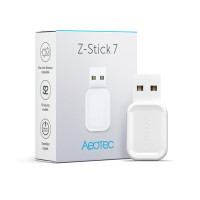
The Z-Stick 7 is a self-powered Z-Wave® USB Adapter designed to control actuators and sensors within a Z-Wave Plus Network. It leverages Series 700 and Gen7 technology, incorporating SmartStart native integration and S2 security for enhanced functionality and safety. This device is intended for indoor use in dry locations only, emphasizing the importance of avoiding damp, moist, or wet environments to ensure proper operation and longevity.
The primary function of the Z-Stick 7 is to act as a primary controller within a Z-Wave network when connected to a host controller, such as a PC, Mac, or Raspberry Pi. It facilitates communication between the host software and various Z-Wave devices, allowing users to manage and automate their smart home ecosystem. The device operates in SerialAPI-Mode, where it constantly listens for instructions from the host software, acting as a Z-Wave adapter and responding to commands sent via USB. This mode ensures that the Z-Stick 7 is always awake and in RX receive mode, ready to process commands and maintain network stability.
The Z-Stick 7 supports the latest Z-Wave Plus standards, including SmartStart and S2 security. SmartStart simplifies the inclusion process for new devices, allowing for quick and easy setup by scanning a QR code. S2 security provides advanced encryption and authentication, protecting the Z-Wave network from unauthorized access and ensuring the privacy and integrity of data transmissions. This makes the Z-Stick 7 a robust and secure foundation for any Z-Wave smart home system.
Getting started with the Z-Stick 7 involves plugging it into a host controller. The device typically installs the necessary USB drivers automatically. However, if manual installation is required, drivers can be downloaded from the manufacturer's website. Once connected, the Z-Stick 7 will appear as a COM device on Windows (e.g., COMX), a ttyUSB0 device on Linux, or a USBModem device (e.g., /dev/cu.usbmodem) on OSX. This broad compatibility ensures that it can be integrated into various computing environments.
After connecting the Z-Stick 7, users need to open their chosen third-party Z-Wave software and select the corresponding COM or virtual port associated with the Z-Stick 7. The software then takes control of the Z-Stick 7, allowing users to manage their Z-Wave network. In most cases, any devices already paired with the Z-Stick 7 network will automatically appear in the software's interface. If not, a rescan of the Z-Stick 7 may be necessary to detect previously missed devices.
The Z-Stick 7 can be added to a pre-existing Z-Wave network through the host software. This process, often referred to as "Learn," "Sync," or "Add as Secondary Controller," allows the Z-Stick 7 to integrate seamlessly into an established network, expanding its capabilities or serving as a backup controller. This function is exclusively performed via the host software, highlighting the device's reliance on a controlling application for advanced network management.
For developers and advanced users, the Z-Stick 7 can be utilized with tools like PC Controller 5 (formerly Zensys Tools). This software provides a basic interface for debugging and testing Z-Wave devices, offering insights into Z-Wave communication protocols and allowing for the control and testing of specific device functions. To access public development tools, users can download the Z-Wave development environment Simplicity Studio.
Maintaining the Z-Stick 7 primarily involves ensuring its proper environmental conditions and utilizing the host software for any necessary resets. The device is designed for indoor use in dry locations only. It is crucial to keep the product and any associated batteries away from open flames and extreme heat, and to avoid direct sunlight or prolonged heat exposure. Improper battery use can damage the product, emphasizing the need for careful handling and adherence to safety guidelines.
If a factory reset is required, the Z-Stick 7 can be reset to its default settings via the host software. This process involves the host software taking control of the Z-Stick USB adapter while it is in SerialAPI-Mode. Users then need to locate the "Reset Z-Wave controller" option, button, or function within their chosen software to initiate the reset. This feature allows users to troubleshoot network issues or prepare the Z-Stick 7 for a new setup by clearing all previous network configurations.
The Z-Stick 7's design focuses on simplicity and reliability, with minimal physical maintenance required beyond ensuring a suitable operating environment. Its reliance on software for configuration and management means that most "maintenance" tasks are performed digitally through the host controller, making it a user-friendly device for both novice and experienced smart home enthusiasts.
 General
| Category | Adapter |
|---|---|
| Interface | USB 2.0 |
| Model | Z-Stick 7 |
| Z-Wave Frequency | 868.4 MHz / 908.4 MHz |
| Wireless Range | Up to 100 meters |
| Power Supply | USB powered (5V DC) |
| Compatibility | Z-Wave devices |
| Operating Temperature | 0°C to 40°C / 32°F to 104°F |
| Encryption | AES-128 |
| Z-Wave Protocol Version | Z-Wave 700 Series |

 To Next Page

