Q&A
Q: What is blood pressure?
A: Blood pressure indicates the pressure borne by arterial vascular walls when
the blood flows through the arterial vascular walls. During cardiac cycle,
the blood pressure of the arterial vascular walls changes constantly.
o
The highest pressure during cardiac cycle is called high pressure value
(systolic pressure); the lowest pressure is called low pressure value (diastolic
pressure).
o
The high and low pressure values are a necessary basis for diagnosis of
blood pressure conditions of patients by doctors.
Q: What is irregular pulse wave?
A: Irregular pulse wave indicates instantaneous heartbeat rhythm is detected
to exceed 25% out of the range of average heartbeat rhythm when the
blood pressure monitor is used for measuring high and low pressure values.
If there is irregular pulse wave, please consult a doctor.
Q:
What is arrhythmia?
A: Arrhythmia indicates abnormal heartbeat rhythm due to flaws in the
bioelectric system that drives the heart. The classic symptoms are:
o
Palpitations (a feeling of skipped heart beats, fluttering or "flip-flops," or
feeling that your heart is "running away").
o
Pounding in your chest.
o Dizziness or feeling light-headed.
o Fainting.
o Shortness of breath.
o
Chest discomfort.
o
Weakness or fatigue (feeling very tired).
Q:Why it is good to measure blood pressure at home?
A: Your blood pressure will be affected by body movement, anxious motion
, md different time periods in the day. A single measuring result cannot show
.rccorote signs of blood pressure change. Therefore, it is the best to measure
I
ilooo
pressure at the same time of each day to obtain accurate signs of
blood
pressure change. Usually blood pressure measured in the morning is
lolalively low, and gradually rises from afternoon to the night. Additionally,
blood pressure is relatively low in summer, and relatively high in winter.
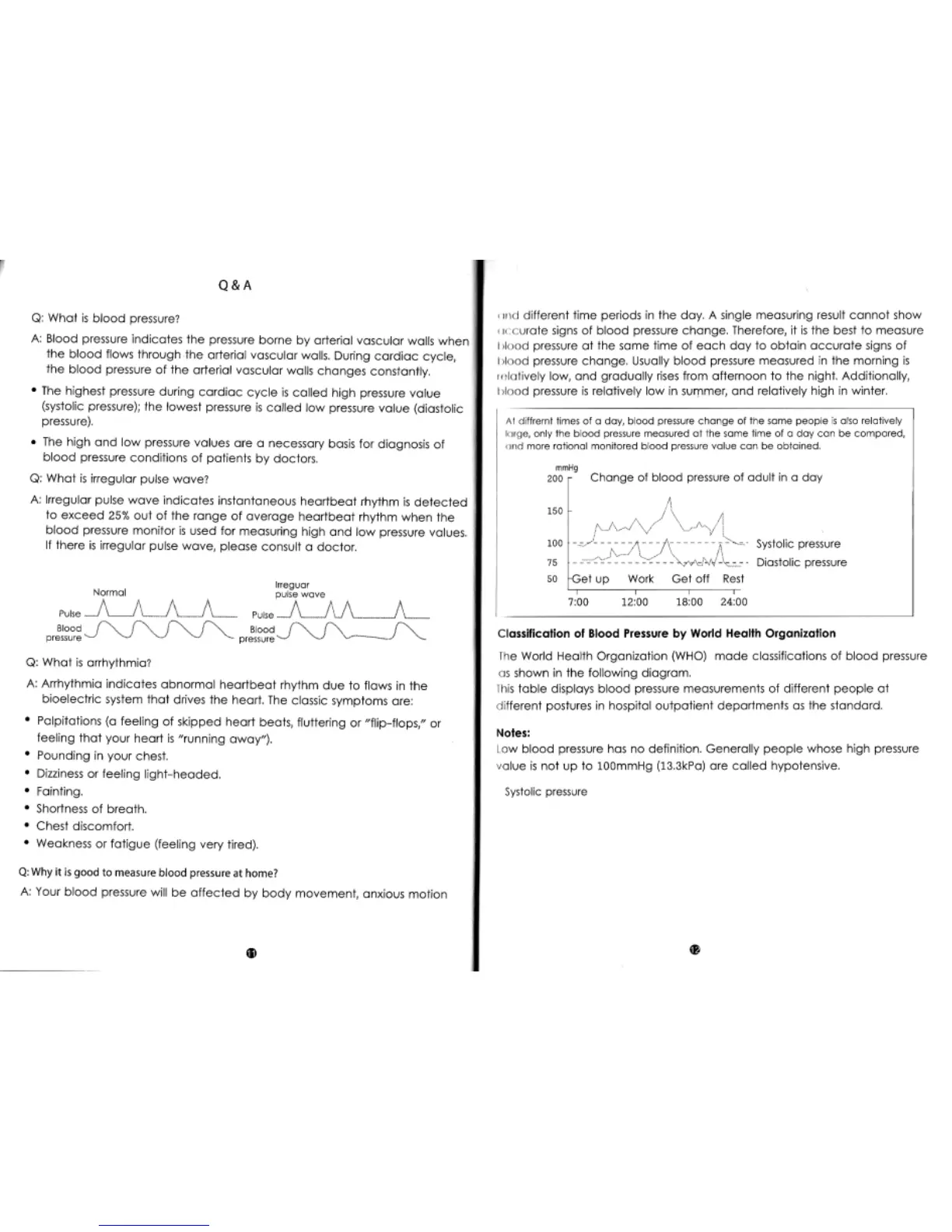
A
j
diffrernt times of a day, blood pressure change of the same people is also relotively
rorpe, only the blood pressure measured at the same time of a day can be compared,
ono more rational monitored blood pressure value can be obtained,
mmHg
200 Change of blood pressure of adult in a day
150
Systolic pressure
Diastolic pressure
100
75
50 Get up Work Get off Rest
7:00 12:00
18:00 24:00
Classification of Blood Pressure by World Health Organization
[he World Health Organization (WHO) made classifications of blood pressure
as shown in the following diagram.
This table displays blood pressure measurements of different people at
different postures in hospital outpatient departments as the standard.
Notes:
Low blood pressure has no definition. Generally people whose high pressure
value is not up to 100mmHg (13.3kPa) are called hypotensive.
Systolic pressure


 To Next Page
 Loading...