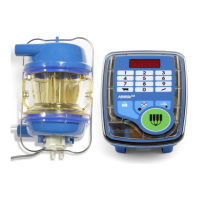
The AfiFree 155i is a milk meter and data-monitoring system designed for use in computerized flock management systems or as a standalone unit. It measures milk volume in real time and can be integrated into dairy operations to enhance profitability and efficiency.
Function Description:
In a computerized flock management system (like AfiSheep/AfiGoat), the AfiFree 155i provides real-time milk flow quantity, supplies milk yield data to the management system, and performs automatic cluster removal (ACR) when milk flow drops below a predetermined rate. It also monitors the quantity of milk provided by individual animals.
As a standalone system, the AfiFree 155i primarily offers real-time milk flow quantity display and automatic cluster removal based on factory-programmed default settings.
The system's main components include:
- AfiFree Body: This unit measures milk volume in real time. It consists of a milk chamber for collecting, measuring, and transferring milk, and an electronics compartment that manages its operation. The AfiFree Body must be mounted level to ensure accurate milk volume calculations, with the pipe connecting it to the milk line having a downward slope of 1.5° in the direction of milk flow.
- Terminal 155i: This is the user interface for the milk meter, featuring buttons for operation and an LCD display for data. It shows information such as health codes, conductivity, and milk yield. Inputs include an optional external start button and swing-over parlor detection. Programmable outputs control the vacuum shutoff valve, cluster remover, and pulsation (two outputs). It also has RS485 ports for PC communication and milk meter communication.
- AfiFree Wash Controller and Wash Control Valve: These components are integral to the parlor washing system. The Wash Controller operates the Wash Control Valve, which in turn controls the diaphragm of up to 20 AfiFree Bodies. This mechanism allows the AfiFree Body to alternately fill with cleaning liquid and drain, ensuring thorough cleaning. If more than 20 units are in the parlor, the cleaning system must be divided into sub-systems, each with its own Wash Control Valve. The Wash Controller can operate in either automatic mode (activated by the parlor wash system) or manual mode (activated by a button on the controller).
- Connection Boxes (AfiFree Connection Box or Plug-in Connection Box - PICB): These watertight junction boxes facilitate the interconnection of various components, including the AfiFree Body, 24 VAC power supply, milk cluster removal solenoid, vacuum shut-off sweep solenoid, communication with the computer, Terminal 155i, optional external start button, optional second input (e.g., side detector), and pulsator. The Plug-in Wiring System (PICB) is an improved alternative that uses ready-wired plugs and sockets, saving installation time and reducing wiring errors.
- Valve Installation Kit for AfiFree (optional): This kit provides parts for mounting the shut-off valve and connecting it to the AfiFree Body. It also includes a generic milk meter bracket for spacing the AfiFree Body from the parlor wall. Vertical installation of the shut-off valve is recommended to prevent water retention and potential freezing or bacterial growth.
Important Technical Specifications:
- Power Supply: The system requires a 24 ± 2.4 VAC power supply. Each milking point needs 50 VA, and the wash controller requires 75 VA. SAE recommends separate transformers and 24 VAC wiring for each side of the milking parlor for redundancy and easier troubleshooting. For Plug-in Wiring Systems, a 1,000 VA transformer is recommended for up to 18 stalls. Power cables must be adequately sized to prevent voltage drop.
- Wiring: Communication wiring uses 2-wire twisted 2x0.75 mm² (2x18 AWG) cable with an impedance of 100–120Ω. Solenoid wiring uses 2-wire double insulated 2x0.75 mm² (2x18 AWG) cable.
- Vacuum Line: A separate OD 50 mm PVC vacuum line is required for the AfiFree Wash Valve, positioned above the milk line with a 1.5-2.0° downward slope towards the drain valve.
- Washline: A separate OD 50 mm pipe is needed for washing the AfiFree 155i bodies, connected to a water source, washing sink, and drain.
- Computer Requirements: For computerized systems, AfiSheep/AfiGoat version 3.06 or higher is required, along with one RS485 port on AfiCom1 or AfiHub.
- Vacuum Pressure: The vacuum supply must be between 36-38 kPa for optimal performance.
- Milk Line Slope: The hose connecting the AfiFree Body to the milk line must maintain a 1.5° downward slope.
- Milk Meter Capacity: The AfiFree 155i milk meters can be assigned identification numbers from 1 to 64.
Usage Features:
- User Interface: The Terminal 155i features an LCD display and keyboard for monitoring and controlling milking events, including critical alerts, milking status, ACR cancellation, and washing mode.
- Automatic Cluster Removal (ACR): The system automatically removes clusters when milk flow drops below a preset rate. ACR can be manually canceled or reactivated.
- Stimulation: Rapid pulsation at the start of milking can be configured to stimulate milk let-down, controlled by parameters for duration, frequency, and ratio. Automatic or manual activation is possible.
- Milk Diversion: An optional feature that diverts milk from the main line to a secondary line, useful for managing milk from animals with health codes or if blood is detected.
- Milk Remainder Compensation: Automatically adds a set amount to the recorded milk quantity to compensate for milk remaining in the tube after milking.
- Sweep Function: Removes residual milk from the milking tube after each milking, with configurable pulse duration, number of pulses, and delay.
- Parameter Configuration: Various parameters, such as minimum milking time, minimum flow for ACR, and stimulation settings, can be configured via the Terminal 155i or the AfiSheep/AfiGoat software. The "G parameter" is used to calibrate milk volume measurements to account for parlor variations.
- Animal Type Configuration: Each milk meter can be configured for different animal types (Buffalo, Cow, Goat, Sheep).
- Group Retrieval: Allows raising or lowering clusters in groups when integrated with AfiSheep/AfiGoat.
- Health and Activity Monitoring: Displays health codes, days-in-milk (DIM), and activity/days from insemination.
- Software Upload: Software and parameter values can be uploaded to the milk meters automatically or manually via the AfiMen Real Time module.
Maintenance Features:
- Preventive Maintenance: Regular checks are recommended, including inspecting Terminal 155i and AfiFree Body for defects, ensuring proper assembly and leveling, checking for fat or milkstone residue, and verifying air bleeder and washing valve diaphragm functionality. Vacuum lines, main vacuum valve, clusters, liners, pulsators, vacuum level, and electricity supply should also be checked.
- Silicone and Rubber Component Replacement: Key components like the rubber gasket for the AfiFree Body lid, washing valve rubber diaphragm, and milk pipe section should be replaced annually.
- Acid Wash: To prevent limestone residue buildup on electrodes and maintain accuracy, an acid wash should be performed three times a week, or more frequently if needed. This involves circulating hot water with phosphoric and/or sulfuric acid for 10-12 minutes, followed by a cold water rinse.
- Cleaning Recommendations: Guidelines for cleaning include using chemical dispensing pumps, operating the vacuum pump throughout the cleaning cycle, ensuring sufficient liquid volume, and maintaining specific water temperatures during initial rinsing and hot soapy water circulation. Detergents should not be used on the exterior surfaces of the AfiFree Body or Terminal 155i; a moist cloth is recommended.
- Troubleshooting Guide: The manual provides a comprehensive troubleshooting guide for common issues, such as display panel not illuminating, incorrect animal identification, inaccurate milk measurements, and component faults, with probable causes and possible solutions.
- Parts Lists: Detailed parts lists are provided for the Vacuum Shut-Off Valve Installation, AfiFree Body, and Terminal 155i, including part names and catalog numbers, to facilitate replacement.

 Need help?
 General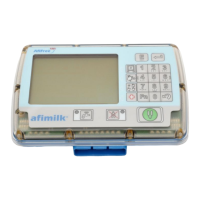

 To Next Page