EasyManua.ls Logo

Agilent Technologies RMSH–2 - User Manual

Agilent Technologies RMSH–2
2 pages
Print Icon
To Next Page IconTo Next Page
Loading...
Agilent Technologies
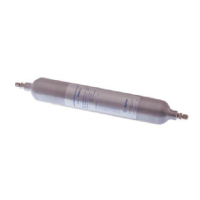
Big Universal Trap
Installation Sheet
Agilent Gas Purifiers
Maximum operating pressure is 250 PSIG.
Maximum operating temperature is 100 °C.
Maximum flow rate is 8 liters per minute.
Installing the Big Universal Trap
Before installing the trap, make sure the system is free of leaks, the GC inlet and MSD
vacuum chambers are clean (if using mass spectrometry detection), and the system is
generally in good working order.
1 Shut down your GC/MSD or reduce the GC heated zone temperatures.
2 Set the gas source supply pressure to 10–15 psi and maintain flow in the gas source
line before disconnecting it from the inlet of the old trap.
3 Remove the protective nut and plug from the INLET end of the new trap. DO NOT
open the plug on the OUTLET end.
4 Immediately attach the new trap to the gas source tubing using one of the included
ferrule sets.
5 Insert the tubing through the nut and ferrule set until the tubing rests firmly
against the shoulder in the fitting.
6 Finger-tighten the nut and then use a wrench to tighten the nut 3/4 turn for
1/8-inch tubing and 1-1/4 turn for 1/4-inch tubing (see Figure 1).
Part number Fitting Gas
RMSH–2 1/8-inch Helium
RMSH–4 1/4-inch Helium
RMSN–2 1/8-inch Nitrogen
RMSN–4 1/4-inch Nitrogen
RMSHY–2 1/8-inch Hydrogen
RMSHY–4 1/4-inch Hydrogen
CAUTION
Failure to immediately connect the trap may cause contamination of the adsorbents inside,
which will reduce its adsorption capacity and contribute to elevated levels of contaminants
observed by the detector. This may result in the need for additional purge time.
Figure 1 Outlet fitting closed
OUTLET
Outlet fitting closedInlet fitting
99.997 + % He, N
2
, or H
2
Question and Answer IconNeed help?

Do you have a question about the Agilent Technologies RMSH–2 and is the answer not in the manual?

Summary

Big Universal Trap Installation Sheet

Installing the Big Universal Trap

Step-by-step instructions for connecting the Big Universal Trap to gas lines and instrument.

Summary

Big Universal Trap Installation Sheet

Installing the Big Universal Trap

Step-by-step instructions for connecting the Big Universal Trap to gas lines and instrument.

Overview

The Agilent Big Universal Trap is a gas purifier designed to enhance the performance and longevity of analytical instruments, particularly Gas Chromatographs (GCs) and GC-Mass Spectrometers (GC-MSDs), by ensuring a clean and contaminant-free gas supply. It is part of the Agilent Gas Purifiers product line.

Function Description

The primary function of the Big Universal Trap is to remove impurities from the gas supply (Helium, Nitrogen, or Hydrogen) before it reaches the analytical instrument. Contaminants such as moisture, oxygen, and hydrocarbons can degrade instrument performance, reduce column lifetime, and interfere with analytical results, leading to irreproducible data. By providing highly purified gas, the trap helps maintain system stability, protect sensitive components like GC columns and detectors, and ensure accurate and reliable analytical measurements. The installation process involves connecting the trap to the gas source tubing, purging it to remove any air or initial contaminants, and then connecting it to the instrument.

Important Technical Specifications

The Agilent Big Universal Trap is available in various configurations to accommodate different gas types and tubing sizes:

  • Gas Types: Helium (He), Nitrogen (N2), and Hydrogen (H2).
  • Fitting Sizes: Available with 1/8-inch and 1/4-inch fittings.
    • RMSH-2: 1/8-inch fitting for Helium.
    • RMSH-4: 1/4-inch fitting for Helium.
    • RMSN-2: 1/8-inch fitting for Nitrogen.
    • RMSN-4: 1/4-inch fitting for Nitrogen.
    • RMSHY-2: 1/8-inch fitting for Hydrogen.
    • RMSHY-4: 1/4-inch fitting for Hydrogen.
  • Maximum Operating Pressure: 250 PSIG. This specification indicates the maximum pressure the trap can safely withstand during operation, ensuring robust performance under typical laboratory gas supply conditions.
  • Maximum Operating Temperature: 100 °C. This temperature limit ensures the integrity of the trap's internal adsorbents and overall structure, preventing degradation or failure due to excessive heat.
  • Maximum Flow Rate: 8 liters per minute. This flow rate capacity is suitable for most GC and GC-MSD applications, ensuring an adequate supply of purified gas without restricting instrument operation.

Usage Features

The installation and usage of the Big Universal Trap are designed to be straightforward, with specific steps to ensure optimal performance and prevent contamination:

  1. Pre-installation Checks: Before installing the trap, it is crucial to ensure the analytical system (GC/MSD) is free of leaks, the inlet and MSD vacuum chambers are clean (if applicable), and the system is generally in good working order. This minimizes the risk of introducing new contaminants or exacerbating existing issues.
  2. System Shutdown/Temperature Reduction: For safety and optimal installation, the GC/MSD should be shut down, or the GC heated zone temperatures should be reduced.
  3. Gas Source Preparation: The gas source supply pressure should be set to 10-15 psi, and flow should be maintained in the gas source line before disconnecting it from the old trap. This helps prevent back-diffusion of air into the gas lines.
  4. Immediate Connection: A critical step is to immediately attach the new trap to the gas source tubing after removing the protective nut and plug from the INLET end. Failure to do so can lead to contamination of the internal adsorbents by ambient air, which reduces the trap's adsorption capacity and may require extended purge times. The plug on the OUTLET end should not be opened at this stage.
  5. Fitting Tightening: The tubing is inserted through the nut and ferrule set until it rests firmly against the shoulder in the fitting. The nut is then finger-tightened, followed by a specific wrench tightening: 3/4 turn for 1/8-inch tubing and 1-1/4 turn for 1/4-inch tubing. This ensures a secure, leak-free connection.
  6. Pressure Stabilization and Purging (Initial): After connecting the inlet, the system should wait for 3 minutes to stabilize the gas pressure inside the new trap. The gas source pressure is then increased to 60 psi. The outlet fitting is then opened, and the trap is purged for 3 minutes. This initial purge helps remove any residual air or contaminants introduced during the connection process.
  7. Final Connection and Purging (Instrument): After the initial purge, the gas source pressure is adjusted to a normal working level. The outlet fitting of the trap is then connected to the instrument tubing using the same tightening procedure. A waiting time of at least 3 minutes is recommended to purge any air that may have entered the instrument tubing line.
  8. System Stabilization Time: Most instruments (GCs or GC-MSDs) require a significant waiting time (often 2 hours or longer) for the system to stabilize and self-clean after changing the gas source or gas trap. Performing analyses too soon after changing the trap may lead to irreproducible results. A longer wait time ensures greater system stability, protecting the instrument and column.

Maintenance Features

The Agilent Big Universal Trap is designed as a consumable item with a finite lifespan, determined by the amount of contaminants it can adsorb. It does not require active maintenance in terms of cleaning or regeneration by the user.

  • Contamination Warning: The manual explicitly warns that failure to immediately connect the trap during installation can contaminate the adsorbents, reducing its capacity and potentially requiring additional purge time. This highlights the importance of proper installation to maximize the trap's effective lifespan.
  • Replacement Indicator: While not explicitly detailed in the provided text, gas purifiers typically have a visual indicator or a recommended replacement schedule based on usage and gas quality. When the trap's adsorption capacity is exhausted, it must be replaced with a new one to maintain gas purity.
  • MSDS Information: For detailed safety and handling information, users are directed to the Agilent website for Material Safety Data Sheets (MSDS). This ensures users have access to necessary information regarding the materials within the trap and proper disposal procedures.

In summary, the Agilent Big Universal Trap is a crucial component for laboratories utilizing analytical instruments, providing a reliable solution for gas purification. Its robust design, clear installation guidelines, and specified technical parameters ensure consistent performance and contribute significantly to the accuracy and longevity of sensitive analytical systems.

Agilent Technologies RMSH–2 Specifications

General IconGeneral
BrandAgilent Technologies
ModelRMSH–2
CategoryIndustrial Equipment
LanguageEnglish

Related product manuals