Need help?
Do you have a question about the Ai-Thinker Technology ESP32-A1S and is the answer not in the manual?
Visual representation of the module's physical dimensions and pinout.
Lists key features including connectivity, CPU, memory, audio, and power modes.
Visual representation of the module's pin layout.
Detailed description of each pin's function and associated GPIO.
Details on the Xtensa LX6 MCUs, ROM, and on-chip/RTC SRAM.
Information on external QSPI Flash and SRAM support and mapping.
Description of the AC101 audio codec chip and its capabilities.
Information on supported crystal oscillator frequencies and capacitor selection.
Details on the ESP32's power management and various sleep modes.
Specifies storage, welding, and supply voltage limits for the module.
Defines recommended operating temperature and supply voltage ranges.
Defines logic level characteristics for digital ports.
Details input frequency, power, and sensitivity for Wi-Fi RF.
Specifies sensitivity and selectivity parameters for BLE receivers.
Details RF transmit characteristics for BLE transmitters.
Provides schematic diagrams for typical application circuits.
Recommends placement and layout guidelines for the antenna.
Advises on voltage, current, LDO/DC-DC usage, and ESD protection.
Provides recommendations for using GPIO ports, including series resistors and level conversion.
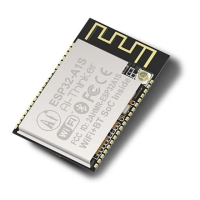
The ESP32-A1S is an ultra-small, powerful SoC module designed for a wide range of IoT applications, including home smart devices, smart audio, and story machine solutions. It features a built-in advanced low-power dual-core 32-bit CPU and a CodeC audio decoding chip, making it an ideal solution for various IoT applications requiring audio capabilities and connectivity. The module adopts an SMD package, allowing for direct integration onto a bottom plate, which facilitates rapid product production and ensures high reliability.
The ESP32-A1S module is highly integrated and supports a variety of peripherals, enabling secondary development and product differentiation. Its core components include two low-power Xtensa®32-bit LX6 MCUs. On-chip storage comprises 448KBytes of ROM for program startup and kernel function calls, 520 KB of on-chip SRAM for data and instruction storage, and 8KBytes of SRAM in RTC (both slow and fast memory) for coprocessor access in Deep-sleep mode and main CPU access during RTC startup, respectively. Additionally, it includes 1kbit of EFUSE, with 256 bits dedicated to system settings (MAC address and chip settings) and 768 bits reserved for user applications, including Flash encryption and chip ID.
The module supports up to four 16 MBytes of external QSPI Flash and static random access memory (SRAM), with hardware encryption based on AES to protect developer programs and data. External Flash is mapped to the CPU code space (up to 16 MBytes) for 8-bit, 16-bit, and 32-bit access and executable code. Up to 8M Bytes of external Flash and SRAM are mapped to the CPU data space, supporting 8-bit, 16-bit, and 32-bit access. Flash supports read operations, while SRAM supports both read and write operations.
The integrated AC101 audio codec chip features high mixed-signal integration, including a digital phase-locked loop that supports a wide range of input/output frequencies. It can generate the audio clock from standard audio crystal rates of 22.5792MHz and 24.576MHz. The codec includes 2 ADCs and 2 DACs @ 24 bits with interphase locked loop processing and a flexible clocking scheme. It boasts a signal-to-noise ratio of up to 100dB during playback and 95dB during recording. Other audio features include a capacitor-free stereo headphone driver (18mW@1.8V), two stereo differential speaker outputs, and two low-noise analog microphone offsets. It also supports a TWI/RSB control interface, a 24-bit 8KHz~192KHz I2S/PCM interface, digital copyright control for DAC playback output, and a soft mute circuit to suppress popping sounds.
 General
| Brand | Ai-Thinker Technology |
|---|---|
| Model | ESP32-A1S |
| Category | Control Unit |
| Language | English |

 To Next Page