Need help?
Do you have a question about the Ailunce HA1G and is the answer not in the manual?
Critical warnings and guidelines for safe use, charging, and storage of Li-ion batteries.
Important warnings and guidelines to prevent hazards during the charging process.
Guides on how to configure display, band, backlight, and key functions.
Configure transmit/receive frequencies and CTCSS/DCS tone settings.
Setting up emergency alarm types, modes, and revert channels.
Configuration and operation of DTMF decoding, encoding, and fast call lists.
Configuring emergency system settings, types, modes, and custom key assignment.
Information on safe usage, RF energy awareness, and controlling exposure to comply with standards.
Guidelines for safe operation, including body-worn accessories and transmission limits.
Safety warnings related to damaged antennas, battery handling, and electrical hazards.
Information on obtaining and maintaining a GMRS radio license from the FCC.
Device compliance with FCC Part 15 rules and Class B digital device limits.
Situations requiring the radio to be turned off for safety, including hazardous environments.
Guidelines for safe charger use, including environmental conditions and maintenance.
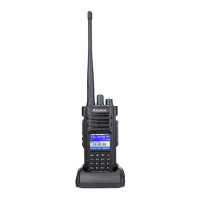
The Ailunce HA1G is a GMRS (General Mobile Radio Service) two-way radio designed for enthusiasts, offering robust features and a durable, waterproof design. This radio is IP67 rated, ensuring it can withstand harsh environments, and is capable of GMRS repeater operation, extending its communication range. With a 2800mAh Lithium-Ion battery, it provides long standby times, and features convenient Type-C charging.
The HA1G radio serves as a versatile communication tool, supporting 30 GMRS channels and up to 250 custom channels, allowing users to tailor their communication setup. It integrates NOAA weather channels and weather alerts, providing crucial information for outdoor activities. An FM radio function is also included for entertainment or news.
For secure and clear communication, the radio supports standard CTCSS/DCS tones, as well as splitting CTCSS/DCS tones. Users can select between high and low transmit power settings to optimize battery life or range. The radio features channel scan and priority scan capabilities, enabling efficient monitoring of multiple channels. A selectable wide/narrow bandwidth option allows for flexibility in different operating conditions.
The device is equipped with a 1.77-inch color backlight LCD dual display, which can show channel names, numbers, or frequencies, providing clear visual feedback. A backlight keypad enhances usability in low-light conditions. The busy channel lockout feature prevents transmission on an occupied channel, avoiding interference. Additional functions include a low battery alert, two programmable function keys for quick access to frequently used features, and IP67 waterproofing for durability.
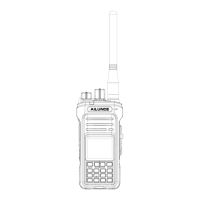
The radio's interface is designed for ease of use. The Power/VOL knob controls power and volume, while the Channel knob allows for channel selection. The PTT (Push-to-Talk) button is prominently located for easy transmission. Two programmable side keys (SK1 and SK2) can be customized for functions like high/low power switching, scan on/off, FM radio, VOX, zone selection, or sub PTT.
The menu system is intuitive, accessed via the MENU key. Users can navigate through settings using the UP/DOWN keys and confirm selections with the MENU key. A long press of the EXIT key switches between MR (Memory) and VFO (Variable Frequency Oscillator) modes. The [*scan] key initiates a scan with a long press and switches between Band A/B with a short press. The [0SQL] key quickly enters squelch level settings, and the [#Lock] key toggles between single/dual band display and locks/unlocks the keypad.
Display modes can be customized to show channel frequency, name, or number. The backlight brightness is adjustable via the channel knob, and the backlight time can be set from 5 seconds up to 1 hour, or kept always on. Key lock settings offer options to lock the keyboard, channel knob, side keys, or all of them, preventing accidental changes.
The radio's audio settings include transmit permit tone, key beep, and voice broadcast. Mic gain can be adjusted (Normal, Strengthen, Low) to optimize audio input. The VOX (Voice Operated eXchange) function allows for hands-free transmission, with adjustable threshold levels (1-15) and delay times (up to 2000ms).
Power save modes (None, 1:4, 1:6, 1:8) help conserve battery life, with an adjustable delay time. The menu exit time can also be configured, with a maximum of 255 seconds or no limit. Radio information, including model, software, and hardware versions, is accessible through the menu.
Zone settings allow for organization of channels. The radio supports 16 zones, each containing 16 channels, in addition to an "All Channels" option. Channels can be edited within zones, and users can select which zone to display.
Channel settings offer detailed customization. Channel aliases can be set using the keypad, allowing for easy identification. Bandwidth can be selected (Wide or Narrow), with default settings for GMRS channels. RX and TX frequencies can be manually input, with automatic fallback to default GMRS frequencies if out of range. CTCSS/DCS tones for both receiving and transmitting can be set, with a comprehensive table of tone frequencies provided.
Squelch level is adjustable from 0 to 9, with a default of 5, to mute background noise and reduce battery consumption. TX power can be set to high or low, with default settings for different GMRS channels. TX permission settings include CTC/CDC Match, Channel free, Receive only, and Always allow, along with an adjustable TOT (Time-Out Timer). Signaling systems and scan lists can be chosen for the current channel, as well as emergency lists. The "Talk around" feature enables direct communication without a repeater. VOX can be enabled or disabled for specific channels.
Scan settings allow for the creation and management of scan lists, defining scan conditions (carrier or CTCSS/DCS match), scan modes (Carrier, Time, Search), and TX modes (Selected, Last Active channel, Designated Channel). Priority scan channels can also be set.
Signaling features include PTT ID settings (All, BOT, EOT) to transmit an identification code at the beginning or end of transmission. DTMF (Dual-Tone Multi-Frequency) decoding and encoding are supported, with options for Stun Type (Rx or TX/RX), Revive ID, Call ID, and Show ANI. DTMF system settings allow for system aliases, group codes, code length, and fast call lists.
Emergency settings provide various alarm types (Siren Only, Regular, Silent, Silent w/Voice) and alarm modes (Emergency alarm, Emergency with call, Emergency Alarm w/call). An alarm revert channel can be chosen, and local alarm can be enabled. Ten call tones are available, and a long press of [6TONE] sends an automatic call to the receiver.
Weather settings include a NOAA Weather Alarm and a NOAA Channel List, allowing users to select and view information for weather channels. The FM radio operates from 76-108 MHz, with frequency adjustment via UP/DOWN keys (2MHz steps) or the Channel knob (0.1MHz steps). Long pressing UP/DOWN keys initiates an automatic channel search.
A factory reset option is available through the menu, requiring three confirmations to prevent accidental data erasure.
The manual emphasizes several important attentions for battery care to extend its lifetime and ensure safety. Users are advised to charge the battery before first use and turn off the radio when not in use, storing it in a cool, dry place. Misuse of Li-ion batteries, such as incineration, physical impact, or exposure to high temperatures (above 60°C/140°F), can lead to hazards like smoke, fire, or rupture.
Specific warnings include never placing battery packs near fire, avoiding soldering terminals, and preventing fluid contact with eyes or body. Deteriorated battery packs should not be used. The battery pack should not be exposed to rain, snow, saltwater, or other liquids, and wet packs must be dried before use. Any abnormal odor, heating, discoloration, or deformation of the battery requires immediate contact with the dealer. The radio should not be operated outside the specified temperature range (-10°C to +45°C) to maintain performance and battery life.
For charging, users are warned against charging in high-temperature areas, during lightning storms, or for more than 8 hours. The battery pack condition should be observed during charging, and any abnormal conditions should lead to immediate cessation of charging. The transceiver should not be inserted into the charger if wet or soiled, as the charger is not waterproof. Charging should occur within the specified temperature range (10°C to 40°C), with 25°C being recommended.
The manual provides instructions for installing and removing the battery and belt clip. The battery slides into grooves and locks with a "click," while removal requires sliding up the release latch. The belt clip is screwed into place.
Troubleshooting guidance is provided for common issues such as the transceiver not turning on (check battery, connections), no sound from the speaker (volume, squelch, external speaker, CTCSS tone compatibility), unresponsive keypad (keypad lock), lower than expected battery life (charging, battery degradation), and impossible transmission (PTT Lock, Busy Lockout, frequency range).
The manual also includes RF energy exposure and product safety guidelines, emphasizing the importance of reading the guide for safe usage and compliance with RF exposure limits. It highlights that unauthorized modifications void user authority and that transmitter adjustments should only be performed by certified personnel. FCC requirements are detailed, including compliance with Part 15 rules and the need for a GMRS radio license. Proper disposal of electrical and electronic products and batteries is also covered.
Exposure compliance and control guidelines advise users to adhere to procedures for occupational/controlled environment exposure limits. This includes using Ailunce-approved body-worn accessories, transmitting no more than 50% of the time, and ensuring a proper antenna is attached. Warnings are given against operating the radio without an antenna, transmitting for extended periods, or in areas sensitive to electromagnetic radiation (hospitals, aircraft, blasting sites).
For hand-held use, maintaining a separation distance of at least 2.5 cm from the nose or lips is crucial. Choking hazards for small parts are noted. Users are instructed to turn off the radio before removing/installing batteries or accessories, in potentially hazardous environments (blasting areas, explosive atmospheres), or while fueling. Warnings about electromagnetic interference and protecting hearing by using the lowest necessary volume and limiting high-volume use are also provided.
The manual concludes with a guarantee card template, outlining warranty coverage and exclusions, and directing users to contact the seller or repair center for service.
 General
| Antenna Impedance | 50Ω |
|---|---|
| Frequency Stability | ±2.5ppm |
| Audio Distortion | ≤5% |
| Intermediation | ≥65dB |
| Selectivity | ≥65dB |
| Frequency Range | 136-174MHz, 400-470MHz |
| Operating Temperature | -20℃~+60℃ |
| Operating Voltage | 7.4V |
| Modulation Type | FM |
| Maximum Frequency Deviation | ±5KHz |
| Receiver Sensitivity | ≤0.25μV |

 To Next Page