EasyManua.ls Logo

Aircast XP DIABETIC WALKER - User Manual

Aircast XP DIABETIC WALKER
2 pages
Print Icon
To Next Page IconTo Next Page
Loading...
XP DIABETIC WALKER
PATIENT GUIDE
Your healthcare professional will advise you on how to fit the Aircast XP Diabetic Walker
correctly. The steps outlined in this booklet will ensure you are able to fit the boot so that it
fits correctly and comfortably, but please contact your healthcare professional in the event
of any queries.
CLEANING INSTRUCTIONS
The shell of the boot can be wiped with a damp cloth and a mild soap.
The foam liner may be hand-washed in 30°C water with mild detergent and air-dried.
The sock supplied with the XP Diabetic Walker can be hand or machine washed up to 60°C
and tumble dried if required.
© 2014 DJO - GFX000660-EN - Rev A
XP DIABETIC WALKER
PATIENT GUIDE
PATIENT NOTES
Always consult your healthcare professional if you intend to make changes to the walker boot or
its use.
This product is to be used under the supervision of a medical professional and is not intended for
unsupervised public use.
If you experience any pain, swelling, sensation changes or any unusual reaction while using this
product, consult your healthcare professional.
DJO Global
|
1a Guildford Business Park
|
Guildford
Surrey
|
GU2 8XG
|
UNITED KINGDOM
UK Tel: 0800 587 0857
|
ROI Tel: 1 800 804 333
www.DJOglobal.co.uk
Question and Answer IconNeed help?

Do you have a question about the Aircast XP DIABETIC WALKER and is the answer not in the manual?

Summary

Walker Usage and Care

Cleaning Instructions

Details on how to clean the boot shell, foam liner, and sock for hygiene.

Patient Usage Notes

General advice on consulting healthcare professionals and product supervision for safe use.

Fitting and Removal Instructions

Fitting the Aircast XP Diabetic Walker

Step-by-step guide on how to correctly fit the walker boot for comfort and support.

Removing the Aircast XP Diabetic Walker

Instructions for deflating aircells and safely removing the walker boot.

Safety and Additional Information

Precautions for Use

Warnings about over-inflation, skin irritation, and consulting a doctor for any concerns.

Usage Notes and Insoles

Guidance on pressure adjustment, air travel, slippery surfaces, and insole selection.

Overview

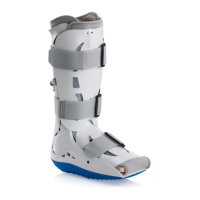
The Aircast XP Diabetic Walker is a medical device designed to provide support and aid in the recovery of patients with diabetic neuropathy or other foot and ankle conditions requiring immobilization. It is intended for supervised use under the guidance of a medical professional.

Function Description:

The XP Diabetic Walker is a walker boot system that immobilizes the foot and ankle, providing stability and protection. A key feature is its adjustable aircell compression system, which allows for customized pressure distribution to enhance support and comfort. This is particularly important for patients with diabetic neuropathy, where proper pressure management is crucial to prevent skin irritation and complications. The boot is designed to accommodate different insoles, including a pink Plastazote Insole (pre-installed) and an Impax Grid Insole (provided in an accessory bag), allowing healthcare professionals to select the most appropriate option for pressure relief, especially around wound sites. The Impax Grid Insole features pre-cut foam cubes that can be removed to offload pressure from specific areas.

Important Technical Specifications:

The device incorporates a multi-chamber aircell system that can be inflated and deflated using a hand bulb. The inflation process involves three distinct valves: one for the front panel (valve 1), one for the inside and outside of the leg (valve 2, located on both sides), and one for the back of the brace (valve 3). A pressure gauge indicator is used to monitor the inflation levels, with recommended ranges for optimal compression:

  • Front Panel (valve 1): Bottom edge of the black pressure gauge indicator should be between 10 and 20 after inflation.
  • Inside/Outside of Leg (valve 2): Pressure gauge indicator should be between 20 and 30.
  • Back of Brace (valve 3): Pressure gauge indicator should be between 10 and 20. The boot is secured with three adjustable straps (A, B, and C) that fasten from bottom to top, ensuring a snug and comfortable fit.

Usage Features:

  • Fitting: The fitting process should always be performed while seated. It begins by ensuring all aircells are deflated, unfastening straps, removing the front panel, and opening the toe cover and foot flaps. The heel is positioned against the back of the boot, and foot flaps are wrapped over the foot, with the toe cover over the toes. The front panel is then replaced, ensuring the foot panel is inside the boot and the upper part remains outside. Straps are secured from bottom to top (A, B, C) and tightened for a snug fit.
  • Aircell Adjustment: Inflation is performed in a specific order: front panel (valve 1), then inside/outside of leg (valve 2), and finally the back of the brace (valve 3). The hand bulb's "inflate" tip is inserted into the valve, and the bulb is squeezed until the pressure gauge indicator reaches the recommended range. The air tube is then removed. To deflate, the "deflate" tip of the hand bulb is inserted into the valve, and the bulb is squeezed.
  • Insole Selection: The walker comes with two insoles: a pink Plastazote Insole (pre-installed) and an Impax Grid Insole (in the accessory bag). The healthcare professional will advise which sole to use. If using the Impax Grid Insole, pre-cut foam cubes can be removed from its underside to relieve pressure around wound sites. The Impax Grid Insole should be placed with the pink side down, so the blue side is against the sole of the foot.
  • Pressure Adjustment: Higher aircell pressure provides more support during walking, while lower pressure is more comfortable for sitting or reclining. Pressure can also be adjusted by tightening or loosening the straps.
  • Airline Travel: If flying, it is recommended to deflate the aircells and loosen the straps.
  • Precautions: Over-inflating aircells can cause skin irritation, especially in patients with diabetic neuropathy. Users should frequently check their skin for "hot spots" or irritation and reduce aircell compression if discomfort occurs. The boot should not be used if the user cannot feel sensations in the foot due to anesthesia, nerve conditions, or other reasons. Caution should be exercised when walking on slippery or wet surfaces. Any changes to the boot or its use should be discussed with a healthcare professional.

Maintenance Features:

  • Shell Cleaning: The shell of the boot can be wiped clean with a damp cloth and mild soap.
  • Foam Liner Cleaning: The foam liner may be hand-washed in 30°C water with mild detergent and air-dried.
  • Sock Cleaning: The supplied sock can be hand or machine washed up to 60°C and tumble dried as needed.

Aircast XP DIABETIC WALKER Specifications

General IconGeneral
BrandAircast
ModelXP DIABETIC WALKER
CategoryMedical Equipment
LanguageEnglish

Related product manuals