Need help?
Do you have a question about the Airofog AR-9 and is the answer not in the manual?
Procedure to verify the correct operation of the emergency cut-off device.
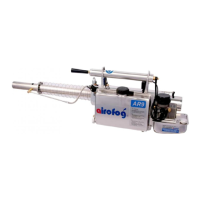
The AIROFOG thermal fogger is a pulse-jet system designed for efficient application of various solutions as a fine aerosol fog. It operates on the principle of a one-sided open jet-tube, known as a resonator, with a valve at the inlet (carburetor) and an open outlet for the fog. This system, which has no moving parts, comprises a carburetor, mixer tube, combustion chamber, and resonator, forming an acoustical oscillation system that operates at an optimal frequency.
At the end of the resonator, the fogging solution is injected into a high-velocity air stream, dispersing it into extremely fine aerosol droplets that are then distributed as a lightly suspended fog. The temperature at the point of solution injection ranges from 40°C to 60°C, with the solution exposed to heat for a very brief period (4 to 5 milliseconds). This allows for the use of heat-sensitive substances without degradation.
The device is designed for both indoor and outdoor use. For outdoor applications, it is recommended to fog in the direction of the wind. For indoor use, operators should fog in a way that allows them to exit the treated areas through untreated paths, avoiding excessive spraying that could impair visibility for a quick exit. The appliance should be carried with the fog tube pointing rearwards for portable use, held horizontally or slightly inclined downwards, and the user should walk only forward. For stationary operation, the appliance must be properly supported on a horizontal surface.
The thermal fogger is prepared for use by first fitting the fog tube (either oil-based or water-based, depending on the solution) into the cooling jacket, aligning it with the resonator thread. Next, the fog solution socket is screwed in by hand, and the dosage nozzle is joined to the solution tube with copper gaskets. Batteries are then inserted, ensuring correct polarity. Before operation, the ignition coil should be checked by pressing the starter button; a buzzing sound indicates it is functioning correctly. The fuel tank is filled with normal-grade gasoline without additives, using a funnel with a filter. The gasoline cap must be tightened firmly, and the gasoline stop button pushed fully into the stop position. Finally, the solution tank is filled with the required amount of solution, the tank cap is closed tightly, and the air intake valve and swirl vane are tightened.
The device can fog preparations from the chemical industry and biological products, which can be mixed with either water or oily carrying mediums. For water-based solutions, nozzles up to Ø1.0 mm are recommended, along with a special fog tube and solution socket for optimal performance. For oil-based solutions, nozzles Ø 0.8 and above are recommended, using the standard oil-based fog tube. Smaller nozzles produce a finer droplet spectrum, while larger nozzles may result in an unsatisfactory one. It is crucial not to operate the appliance with a water-based fog tube when applying oil-based fogging mixtures with flammable carriers.
To start the appliance, the gasoline stop button is pulled outwards. The starter button is then pressed while actuating the air pump regularly and evenly. After the first explosion is audible, one or two more strokes of the pump are recommended. Once started, the appliance should warm up for about one minute before the solution tap is opened to begin fogging. To stop fogging, the solution tap is closed. If the appliance stops unexpectedly due to lack of fuel or mechanical failure, the solution tap must be closed immediately to prevent the fogging mixture from reaching the hot resonator, which could ignite. The appliance should then be held with the fog mixing tube pointing downwards to drain any chemical solution residue.
The appliance is equipped with an emergency cut-off device (EC) for enhanced safety. This device allows for immediate cessation of fogging. To engage it, the operating lever is pulled and locked into position. To stop fogging with the EC engaged, the solution tap is closed. If the appliance stops unexpectedly, the EC automatically releases and stops the solution flow. After any operation, the solution tap should be closed completely, and pressure released from the solution tank by loosening the tank cap to prevent accidental solution leakage.
Maintenance is crucial for ensuring the appliance is always ready for use. Before storage, the empty solution tank should be rinsed and cleaned by fogging approximately 1/4 liter of water to clear the pipe system. The appliance's exterior should be cleaned of any dirt. The diaphragm in the air intake valve should be removed, checked for damage, and cleaned, along with the valve body, spacer plate, and silencer, using a soft cloth and gasoline. Residue in the resonator end, solution socket, dosage nozzle, and fog tube should be removed using a scraper and wire brush. The mixing pipe of the resonator and the mixing chamber of the carburetor should also be cleaned. The swirl vane should be cleaned with a wire brush. When storing the appliance for a longer period, the batteries should be removed, and the fuel tank emptied when the appliance is cold, leaving the tank cap loose.
Regular adjustment of the appliance is necessary due to variations in climate and sea-level, even though each unit is checked before delivery. The fuel tank should be at least two-thirds full for adjustment. The regulating needle is turned counter-clockwise approximately halfway, then the appliance is started and allowed to warm up for at least one minute. The flame at the resonator end is checked by looking obliquely into the resonator from a safe distance, wearing safety glasses. For fine adjustment, the regulating needle is cautiously screwed clockwise or counter-clockwise until the flame is no longer visible, indicating correct adjustment and steady, strong running without flame from the resonator. Over-adjustment, which causes high-frequency sound and flame from the fog tube, should be avoided as it leads to power loss, overheating, and fire hazards. If the carburetor overflows due to vigorous pumping, the fuel stop button should be closed, the starter button pressed, and the air pump actuated until no more explosions are audible, then restarted normally.
Troubleshooting covers issues such as the appliance not starting or running unevenly, and running but not fogging or fogging irregularly. Common causes for starting issues include weak batteries, clogged fuel supply, water in gasoline, or dirty carburetor/resonator components. If the appliance runs but does not fog, it could be due to insufficient pressure in the solution tank, blocked solution conveying parts, or a defective solution tap or nozzle. Repairs should only be carried out by qualified personnel using original spare parts. Before any repair, the appliance must be stopped, allowed to cool, and the spark plug socket removed from the swirl vane. During repairs, electrically live components should be avoided. After repairs, all safety devices must be reassembled, and a functional fogging test with neat water should be performed. Regular checks by a qualified technician are recommended.
 General
| Type | Thermal Fogger |
|---|---|
| Model | AR-9 |
| Brand | Airofog |
| Usage | Insect Control |
| Solution Tank Capacity | 9 liters |
| Tank Capacity | 9 liters |
| Dimensions | 550 x 290 x 330 mm |

 To Next Page