This document provides study notes and operational guidelines for the Bendi - Pivot - Steer forklift, also referred to as an Aisle-Master. It covers aspects of load handling, stability, and specific procedures for retrieving and unloading loads in narrow aisle environments.
Function Description
The Bendi - Pivot - Steer forklift is designed for efficient material handling, particularly in narrow aisles. Its key feature is the articulated steering mechanism, which allows the front mast and forks to pivot independently of the main chassis. This articulation enables the forklift to operate in confined spaces, such as narrow warehouse aisles, where traditional counterbalance or reach trucks might struggle. The "Pivot - Steer" aspect refers to this ability to pivot the mast and steer simultaneously, optimizing maneuverability.
The forklift's primary function is to lift, transport, and place loads, typically on pallets, within a warehouse or storage facility. It is capable of both straight-line travel and articulated movement, adapting to different operational requirements.
Important Technical Specifications
The document highlights several critical technical specifications related to load handling and stability:
- Rated Capacity: This refers to the maximum weight the forklift can safely lift under specific conditions. The illustrations show a rated capacity of 2000KG.
- Load Centre: This is a crucial factor in forklift stability. The document distinguishes between:
- Horizontal Load Centre (item 1) [4]: Equal to one-half the depth of the load when weight is evenly distributed. An example given is a 122 cm (48 in) long load having a horizontal load centre of 61 cm (24 in).
- Vertical Load Centre (item 4) [4]: Equal to one-half the height of the load when weight is evenly distributed. An example given is a 122 cm (48 in) high load having a vertical load centre of 61 cm (24 in).
- Fulcrum Point: This is the pivot point around which the forklift's stability is assessed. The document illustrates how the "Combined C.O.G. (Centre of Gravity) gets closer to the fulcrum point" in an articulated position, which can affect stability.
- Load Centre Distance (600): The illustrations consistently show a load centre distance of "600" (presumably 600mm or 60cm) for the rated capacity. When the load centre is increased beyond this (e.g., "> 600"), the forklift is considered "OVER-LOADED," even if the load weight remains the same, due to increased leverage on the fulcrum point.
- Fork Clearance: When transporting a load, the forks should be lifted 100 to 150mm (4 to 6 inches) off the ground for stability and to clear obstructions.
- Aisle Width: For narrow aisles, the operator should maintain a distance of approximately 150mm (6 inches) between the side of the truck and the side of the aisle. For wider aisles, the truck should stay in the centre.
Usage Features
The document emphasizes safe and efficient operation through various usage features and guidelines:
- Articulated Position: This is the primary mode for maneuvering in narrow aisles. The illustrations demonstrate how the forklift pivots its mast, allowing it to turn and position the forks for loading/unloading in tight spaces.
- Straight Position: Used for travel, where the combined C.O.G. is further from the fulcrum point, providing greater stability.
- Load Placement: Always ensure the load is flush against the front vertical face of the forks (item 3) [4] or the load backrest. For unbalanced loads, the heaviest end should be nearest to the truck.
- Tilting Considerations: The amount of forward and rearward tilt should be governed by the application. When traveling with a load, tilt the mast back and keep the load low for stability. When loading at high elevations, tilt the load back to seat it against the forks/backrest. When unloading, use just enough tilt to place the load.
- Side Shift: The forklift is equipped with a side shift feature, used to centre the forks with the load or adjacent pallets, enhancing precision during stacking and retrieving.
- Steering and Drive Controls: The document provides detailed instructions on coordinating steering wheel turns (clockwise/anticlockwise) with truck drive and mast carrier/fork directions (indicated by black and grey arrows) for precise load handling in aisles.
- Speed Control: Operators are advised not to speed and to use the brake pedal to control speed when traveling down inclines.
- Warning Systems: Use the horn to warn others of danger.
- Visibility: Be alert to overhead obstructions. If vision is obscured, a "spotter" should guide the operator.
- Incline Travel: When carrying a load, travel with the forks facing uphill. When not carrying a load, travel with the forks facing downhill (meaning backing up an incline). Never travel across a slope, as this can cause tip-over.
- Load Weight Determination: Operators must determine the load's weight before lifting. Methods include checking pallet wrappers, bills of lading, or calculating from individual container weights. If in doubt, ask a supervisor.
Maintenance Features
While the document primarily focuses on operational aspects, it briefly touches upon components and their location, which implies maintenance considerations:
- Component Identification: Page 4 and 5 illustrate various components of the Aisle-Master forklift with numbered labels (e.g., 1-14). Although specific maintenance tasks are not detailed, identifying these components is fundamental for inspection, troubleshooting, and maintenance procedures. For instance, "Number 8 is located behind the side pan," suggesting access for maintenance.
- Data Plate: The importance of the data plate is highlighted, stating that it contains maximum load centres. This plate is crucial for operators to verify safe operating parameters and for maintenance personnel to ensure the forklift is operated within its design limits. Any attachments installed should have an additional identification plate indicating changes in load centres and rated capacity.
The document serves as a comprehensive guide for operators to safely and effectively use the Bendi - Pivot - Steer Aisle-Master forklift, with a strong emphasis on load stability and precise maneuvering in narrow aisle environments.

 Need help?
 General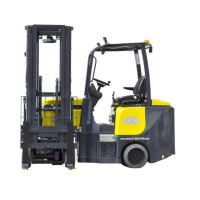

 To Next Page