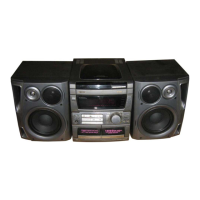
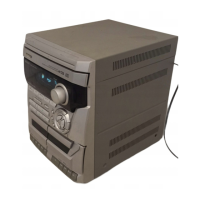
This document describes the service and maintenance procedures for the Aiwa NSX-S222, NSX-S229, and NSX-S333 compact disc/stereo cassette receiver models. It serves as a comprehensive guide for technicians, covering electrical and mechanical parts, schematic diagrams, and general service information.
Function Description
The Aiwa NSX-S222, NSX-S229, and NSX-S333 are integrated audio systems designed to provide a versatile listening experience. Their primary functions include:
- Compact Disc Playback: These models feature a built-in CD player, allowing users to enjoy audio from compact discs. The CD mechanism is designed for reliable playback, with components like the CD mechanism and associated control circuitry ensuring smooth operation.
- Stereo Cassette Receiver: The devices incorporate a stereo cassette deck, enabling playback and recording of audio cassettes. This includes features for tape transport control, such as play, record, fast forward, rewind, and pause. The receiver aspect integrates an AM/FM tuner, allowing users to listen to radio broadcasts.
- Audio Amplification and Output: The core of these systems includes an audio amplifier that processes and amplifies audio signals from various sources (CD, cassette, tuner, external inputs) for output through connected speakers. This ensures a robust and clear sound experience.
- Input/Output Connectivity: The receivers offer various input and output options, such as auxiliary inputs for connecting external audio devices, and speaker outputs for connecting passive speakers. Some models may also include headphone jacks for private listening and remote control sensor inputs for convenient operation.
- User Interface and Control: The front panel of the device features a user-friendly interface with buttons, knobs, and a display for controlling various functions. This includes controls for power, volume, source selection (CD, tuner, tape, auxiliary), tuning, and cassette deck operations. The display provides visual feedback on the current mode, track information, radio frequency, and other relevant data.
Usage Features
The Aiwa NSX-S222, NSX-S229, and NSX-S333 models are designed for ease of use and offer several features to enhance the user experience:
- Integrated Design: The combination of a CD player, cassette deck, and AM/FM tuner into a single unit provides a compact and convenient audio solution, ideal for home entertainment setups where space might be a consideration.
- Remote Control Capability: Many functions of the receiver can be operated via a remote control, offering convenience and flexibility, allowing users to manage their audio experience from a distance.
- Display Feedback: The front panel display provides clear and concise information, making it easy for users to navigate through different modes and settings. This includes indicators for stereo reception, CD track numbers, and radio frequencies.
- Versatile Source Selection: Users can easily switch between different audio sources, whether it's their favorite CD, a radio station, or a cassette tape, providing a wide range of listening options.
- Recording Functionality: The cassette deck allows users to record audio from the radio or external inputs onto cassette tapes, adding a layer of functionality for personal audio archiving or sharing.
- Preset Tuning: The radio tuner typically includes the ability to store favorite radio stations as presets, allowing for quick access to preferred broadcasts without manual tuning each time.
- Enhanced Audio Controls: Features such as bass and treble controls, or preset equalizer settings (e.g., CLASSIC, POP, ROCK), allow users to customize the sound output to their preference, optimizing the listening experience for different music genres. Some models may include a "T-BASS" feature for enhanced bass response.
- Timer Functions: Advanced models might include timer functions for scheduled playback or recording, offering convenience for users who wish to wake up to music or record a specific radio program.
Maintenance Features
This service manual outlines various maintenance aspects crucial for the longevity and optimal performance of the Aiwa NSX-S222, NSX-S229, and NSX-S333 units:
- Modular Component Design: The internal structure is designed with modular components, such as the main PWB (Printed Wiring Board) and front PWB, which simplifies troubleshooting and part replacement. This approach allows technicians to isolate and address issues more efficiently.
- Detailed Parts Lists: The manual provides extensive electrical and mechanical parts lists, including reference numbers, part numbers, descriptions, and suffix codes indicating part usage. This is invaluable for identifying and ordering correct replacement parts, ensuring compatibility and proper function.
- Schematic Diagrams: Comprehensive schematic diagrams are included for the main and front PWBs, illustrating the electrical connections and component layouts. These diagrams are essential for diagnosing circuit-level faults, tracing signal paths, and understanding the device's operational logic.
- Fuse Protection: The devices incorporate various fuses (e.g., 2.5A, 500mA, 1AT, 1.6AT, 2A) to protect internal circuitry from overcurrent conditions. Regular inspection and replacement of blown fuses are critical maintenance tasks to prevent further damage.
- Connector and Cable Management: The use of specific connectors (e.g., 11P, 13P, 30P, 6P) and wire holders (e.g., HLDR, WIRE 2.5-5P, 2.5-7P) facilitates organized internal wiring, which aids in assembly, disassembly, and maintenance. Proper handling of these connections is vital during service.
- Transistor and IC Identification: The manual lists various transistors (e.g., DTC144ES, KTA1266GR, KTC3198GR, 2SK2541, 2SJ460) and integrated circuits (e.g., NJM4558LD, M62439SP, M38B59MFH-P101FP, LA1837NL, BU1920) used in the device. This information is crucial for component-level repair and ensures that compatible replacements are used.
- Capacitor Details: Detailed information on various capacitors (e.g., electrolytic, ceramic, film) with their capacitance, voltage ratings, and types (e.g., TC U, CERA-SOL, PP) is provided. Capacitors are critical for filtering, coupling, and timing, and their correct specification is important for audio quality and circuit stability.
- Diode and Zener Diode Specifications: The manual includes specifications for different diodes (e.g., 1SS133, 1N4148, 1N4003, RL203) and zener diodes (e.g., MTZJ6.8C, MTZJ27D, MTZJ10C, MTZJ2.7A). These components are vital for rectification, voltage regulation, and signal clamping, and their proper function is key to circuit integrity.
- Mechanical Assembly Information: Descriptions of mechanical parts such as panels, boxes, knobs, keys, and springs (e.g., SPR-T, EJECT) are provided. This information is essential for disassembling and reassembling the unit correctly, ensuring all mechanical functions, like cassette loading and CD tray operation, work smoothly.
- Revision Publishing: The manual emphasizes replacing it with "Revision Publishing" when issued, indicating a commitment to providing up-to-date service information. This ensures that technicians always have access to the latest repair procedures and part details.

 Need help?
 General

 To Next Page