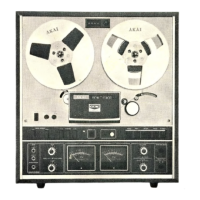
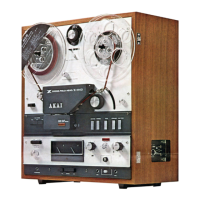
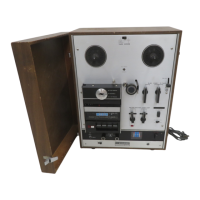
The Akai GX-221 is a stereo tape recorder designed for high-fidelity audio recording and playback, featuring a 4-track, 2-channel stereo/monaural system. This model is also applicable to the GX-221D stereo tape deck.
Function Description:
The GX-221 allows for recording and playback of audio on magnetic tape at various speeds. It supports both stereo and monaural recording, with a 4-track system that enables multiple recordings on a single tape. The device is equipped with Glass & Crystal Ferrite Recording and Playback Heads, which are designed to provide a wide frequency response and excellent signal-to-noise ratio. It also includes features for automatic and manual reverse playback, sound-on-sound recording, and tape dubbing.
Important Technical Specifications:
- Track System: 4-track, 2-channel stereo/monaural system.
- Reel Capacity: Up to 7" reel.
- Tape Speed: 7-1/2, 3-3/4, and 1-7/8 ips (±0.7%).
- Wow & Flutter:
- Less than 0.08% RMS at 7-1/2 ips.
- Less than 0.12% RMS at 3-3/4 ips.
- Less than 0.20% RMS at 1-7/8 ips.
- Equalization: Correct equalization for playback of tapes recorded to NAB curve.
- Frequency Response:
- Using Akai SRT Tape: 30 Hz to 25,000 Hz (±3 dB) at 7-1/2 ips; 30 Hz to 20,000 Hz (±3 dB) at 3-3/4 ips; 30 Hz to 10,000 Hz (±3 dB) at 1-7/8 ips.
- Using regular tape: 30 Hz to 23,000 Hz (±3 dB) at 7-1/2 ips; 30 Hz to 19,000 Hz (±3dB) at 3-3/4 ips; 30 Hz to 9,000 Hz (±3 dB) at 1-7/8 ips.
- Distortion: Less than 1.5% (1000 Hz "0" VU).
- Output Power: 30 W total music power (15 W/15 W) at 8 Ω (GX-221 only); 20 W continuous power (10 W/10 W) at 8 Ω (GX-221 only).
- Signal to Noise Ratio: Better than 50 dB.
- Erase Ratio: Better than 70 dB.
- Cross-Talk: Better than 65 dB (monaural); Better than 50 dB (stereo).
- Bias Frequency: 100 kHz.
- Heads: (3): 4-track GX recording and playback heads, 4-track erase head.
- Motors: (3): One hysteresis synchronous 3-speed motor for capstan drive and two 6-pole eddy-current outer rotor motors for supply and take-up reel drive.
- Fast Forward & Rewind Time: 60/75 sec. using a 1200 ft. tape at 60/50 Hz.
- Recording Capacity: 4 hours stereo recording using a 1200 ft tape at 1-7/8 ips.
- Output Jacks: Line (2): 1.23 V ("0" VU)/100 Ω (Required load impedance: more than 20 KΩ); Phone (1): 30 to 40 mV/8 Ω; Speaker (2): 15 W/8Ω each (GX-221 only).
- Input Jack: Microphone (2): 0.2 mV/10 KΩ; Line (2): 50 mV/150 KΩ.
- Din Jack: 0.4 V/50 mV (High)/2 mV (Low).
- Speaker: Two built-in 4" speakers.
- Semi-Conductors: Transistors: 26 (GX-221D: 24); Diodes: 15 (GX-221D: 14).
- Integrated Circuits: Linear IC: 2; Power IC: 2 (GX-221 only).
- Power Requirements: 100 V to 240 V A.C., 50/60 Hz.
- Power Consumption: 135 W (GX-221D: 90 W).
- Dimensions: 440(W) x 425(H) x 220(D) mm (17.4 x 16.7 x 8.7").
- Weight: 22.5 kg (49.5 lbs.) (GX-221D: 20.2 kg/44.4 lbs.).
Usage Features:
- Voltage & Cycle Conversion: Equipped with a universal voltage selector for worldwide operation (100V to 240V AC, 50/60Hz). Users must confirm and adjust settings according to their area's power source. CEE, CSA, and UL models are pre-set and do not require adjustment.
- Tape Speed Selection: Three speeds are available (7-1/2, 3-3/4, and 1-7/8 ips), selected via the Tape Speed Selector. The Equalizer Switch must be set to correspond with the chosen tape speed for proper equalization.
- Fast Forward & Rewind: A dedicated lever allows for rapid tape transport.
- Automatic Stop & Shut-Off: The unit can automatically stop reel movement at the end of the tape (STOP position) or cut off power to the entire unit (SHUT-OFF position).
- Pause Control: Temporarily suspends tape movement during recording or playback, useful for editing.
- Sound Monitoring: Stereo headphones (8 Ω impedance) can be connected for private listening. The Monitor Switch allows switching between program source and recorded tape.
- Tape Selector Switch: Depress this switch when using Akai SRT (Super Range) Tape or other low noise tapes to optimize recording equalization and frequency response.
- DIN Jack: Provides a single-cord inter-connection with external amplifiers, eliminating the need for multiple separate connections. A High/Low Input Switch adjusts for different amplifier output levels.
- 4-Track Recording/Playback System: Supports both stereo and monaural operation. Track Selector Switches allow easy selection of desired tracks. For stereo, tracks 1 & 3 are used for the first recording/playback, and tracks 2 & 4 for the second (after reversing the machine or inverting reels). For monaural, the sequence is 1-4-3-2, requiring reel inversion for tracks 4 and 2.
- Automatic & Manual Reverse Playback: Sensing foil can be affixed to the tape at desired points for continuous playback in both directions. Manual reverse is also available via front panel buttons.
- Recording Options:
- Microphone Recording: Two microphone jacks are provided. Recording levels are adjusted via the Recording Level Controls while observing the VU Meters.
- External Amplifier Recording: Connects to the tape outputs of an external amplifier.
- Turntable Recording: Crystal or ceramic pick-ups can connect directly; magnetic cartridges require an external amplifier.
- Tape Dubbing: Connects to the output jacks of another tape recorder.
- Sound-On-Sound Recording: Allows accumulating multiple individual recordings on a single track, useful for language study or musical compilations.
Maintenance Features:
- Pinch Wheel & Capstan Cleaning: Regular cleaning with Akai cleaning fluid or alcohol is recommended to prevent foreign matter accumulation, which can deteriorate sound quality and cause irregular tape transport.
- Head Demagnetizing: Periodic demagnetizing with a bulk demagnetizer is recommended to prevent drop-outs and noise in recordings. Power must be off during this procedure.
- Tape Erasing: Signals are automatically erased when a new recording is made. For quick and complete erasure, a bulk tape eraser is recommended.
- Head Cleaning: While GX Heads usually require no cleaning, if old or splicing tape is used, cleaning with a cotton swab stick soaked in Akai cleaning fluid or alcohol is recommended.
- Troubleshooting: The manual provides a list of common issues (loss of sensitivity, irregular tape transport) and their potential causes (wrong tape side, incorrect voltage, magnetized heads, dust, bent reel, improper tape loading).

 Need help?
 General

 To Next Page