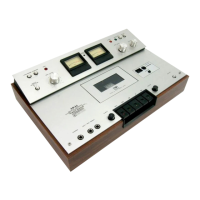
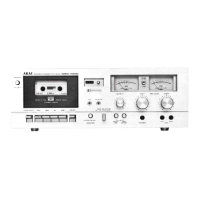
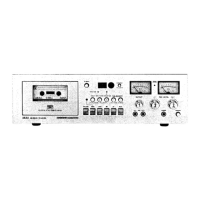
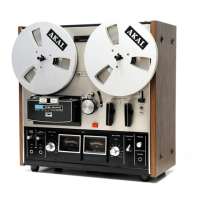
This document is a service manual and parts list for the Akai GXC-510D Cassette Tape Deck, which is also applicable to models GXC-505D, GXC-502D, GXC-500D, and GXC-500.
Function Description:
The Akai GXC-510D is a 4-track, 2-channel stereo cassette tape deck designed for recording and playback of audio cassettes. It features a hysteresis synchronous outer rotor motor for stable tape transport and includes Dolby Noise Reduction for improved sound quality. The deck is equipped with a GX recording/playback head and a 2-track 1-channel erase head.
Important Technical Specifications:
Track System: 4-track 2-channel stereo system
Tape Speed: 1-7/8 ips. (4.75 cm/sec.) ±1% (guaranteed ±3%)
Wow and Flutter: Less than 0.08% W.R.M.S. (guaranteed less than 0.24% W.R.M.S. total, and less than 0.3% W.R.M.S. total)
Frequency Response:
- Chrome Tape: 30 to 16,000 Hz ±3 dB (guaranteed 50 to 14,000 Hz ±4 dB)
- Low Noise Tape: 30 to 14,000 Hz ±3 dB (guaranteed 50 to 13,000 Hz ±4 dB)
Distortion Factor: Less than 1.0% at 1,000 Hz "0" VU (guaranteed less than 5% for Chrome Tape, less than 3% for Low Noise Tape)
Playback Output Level:
- LINE: 0.775V (0±2 dB) using a 333 Hz "0" VU recorded tape
- DIN: 0.775V (0±2 dB) using a 333 Hz "0" VU recorded tape
- (Model GXC-505D): 0.55V (-3±2 dB) using a 333 Hz "0" VU recorded tape
Headphone Output: 30 mV/8Ω using a 333 Hz "0" VU recorded tape
- MIC: More than 0.5 mV
- LINE: More than 60 mV
- DIN: More than 4 mV
Recording Playback Level:
- Chrome Tape: -3 ± 1.5 dB 1,000 Hz "0" VU recording
- Low Noise Tape: 0 ± 2 dB 1,000 Hz "0" VU recording
Signal to Noise Ratio: Better than 50 dB (guaranteed better than 43 dB total, better than 40 dB total)
Cross Talk: Better than 25 dB 1,000 Hz 3 VU recording
Erase Ratio: Better than 70 dB
Recording Bias Frequency: 61 ± 3 kHz
Bias Leak: Less than -20 VU
Recording Capacity: 90 min. stereo recording using a C-90 cassette tape
F.FWD and RWD. Time: 80 sec. using a C-90 cassette tape
Heads:
- Recording/Playback Head: 4-track 2-channel GX recording/playback head (Type: P4-341, Gap: 1.7 microns, Impedance: 1,000Ω ± 20% at 1 kHz, D.C. Resistance: 190Ω)
- Erase Head: 2-track 1-channel erase head (Type: ME-136A, Gap: 0.3 mm, Impedance: 330Ω ± 10% at 50 kHz, D.C. Resistance: 82 ± 30%)
Motor: Hysteresis Synchronous outer rotor motor (Type: HM1-12CS, Revolutions: 1,500/1,800 r.p.m. at 50/60 Hz)
Power Supply: 100 to 240V A.C. 50/60 Hz for Universal Models (100V A.C. 50/60 Hz for JPN Models, 220V A.C. 50 Hz for CEE Models, 120V A.C. 60 Hz for CSA Models). CEE, CSA Models are only available in Model GXC-510D.
Power Consumption: 20W (GXC-510D), 16W (GXC-505D)
Dimensions:
- GXC-510D: 414(W) x 257(H) x 132(D)mm (16.4" x 10.1" x 5.2")
- GXC-505D: 414(W) x 257(H) x 152 (D)mm (16.4" x 10.1" x 6")
Weight: 6.8 kg (15 lbs.) for GXC-510D, 6.3 kg (14 lbs.) for GXC-505D
Usage Features:
The GXC-510D features a comprehensive set of controls for recording and playback, including:
- Input/Output Controls: MIC, LINE, and DIN inputs, along with LINE and Headphone outputs.
- Tape Selector: Allows selection between Chrome and Low Noise tape types, optimizing recording and playback characteristics for different tape formulations.
- Dolby Noise Reduction: An integrated system to reduce tape hiss during recording and playback, enhancing the dynamic range of the audio.
- VU Meters: Provide visual indication of recording and playback levels, aiding in proper level setting to prevent distortion.
- Transport Controls: Standard functions like Fast Forward, Rewind, Play, Stop, and Pause.
- Recording Level Adjustment: Independent controls for adjusting recording levels.
Maintenance Features:
The service manual provides detailed instructions and diagrams for various adjustments and maintenance procedures:
- Dismantling of Unit: Step-by-step photographic guide for disassembling the unit for service.
- Mechanism Adjustments:
- Fast Forward and Rewind Slide Adjustment: Ensures proper separation of the wind pulley from the reel table (0.5 mm gap) during fast forward and rewind operations.
- Recording Micro Switch Position Adjustment: Critical for correct engagement of the recording function.
- Reed Switch Position Adjustment: Ensures accurate operation of the reed switch.
- Flywheel Vertical Loose Play Confirmation: Checks for excessive vertical movement of the flywheel (should be more than 1 mm).
- Take-up Torque Measurement: Method for measuring take-up torque at various modes using a cassette torque meter.
- Pinch Wheel Pressure Measurement: Method for measuring the pressure exerted by the pinch wheel on the capstan using a spring scale (350 to 400g-cm).
- Head Adjustment:
- Recording/Playback Head Azimuth Alignment: Adjusts the azimuth alignment nut using a 10 kHz recorded test tape to maximize line output on both channels. Emphasizes the importance of using non-magnetized tools, new tape, and demagnetizing heads before and after adjustment.
- Amplifier Adjustment: Includes procedures for playback level, recording level (for low noise and chrome tapes), frequency response, recording bias frequency, and recording/erase bias voltage checks.
- Dolby Noise Reduction Adjustments: Detailed instructions for adjusting the Dolby NR circuit, stressing the use of accurate measuring instruments, ensuring level deviation within ±0.5 dB, painting semi-fixed resistors after adjustment, and disconnecting the power supply lead wire from the oscillator circuit before adjustment.
- D.C. Resistance of Various Coils: A table listing the average D.C. resistance values for key components like the motor, stop solenoid, headphone output transformer, oscillator coil, erase head, and recording/playback head.
- Classification of Various P.C. Boards: Provides a P.C. board interchangeability chart, indicating which boards are interchangeable between models and which are not. Also includes composite views of components for identification.
The manual is structured into three main sections: Service Manual, Parts List, and Schematic Diagram, providing comprehensive information for troubleshooting and repair.

 Need help?

 To Next Page
 General