==C
%$$.B>6:$(
0 4:7/&76 4;++6 #
/J19 % $'
I01E#"%
$'I
5%/J19
$'I
!"#%$/"+)$."'
#%!
#3
= -+01#
You can also create a new synth program as detailed in the previous section.
@ 4&;564+;B6)7&87+*
This will bring you into PROGRAM mode where you can edit different parameters of
your program.
!"C-#,%1"&
G 4-=6)(+/0*
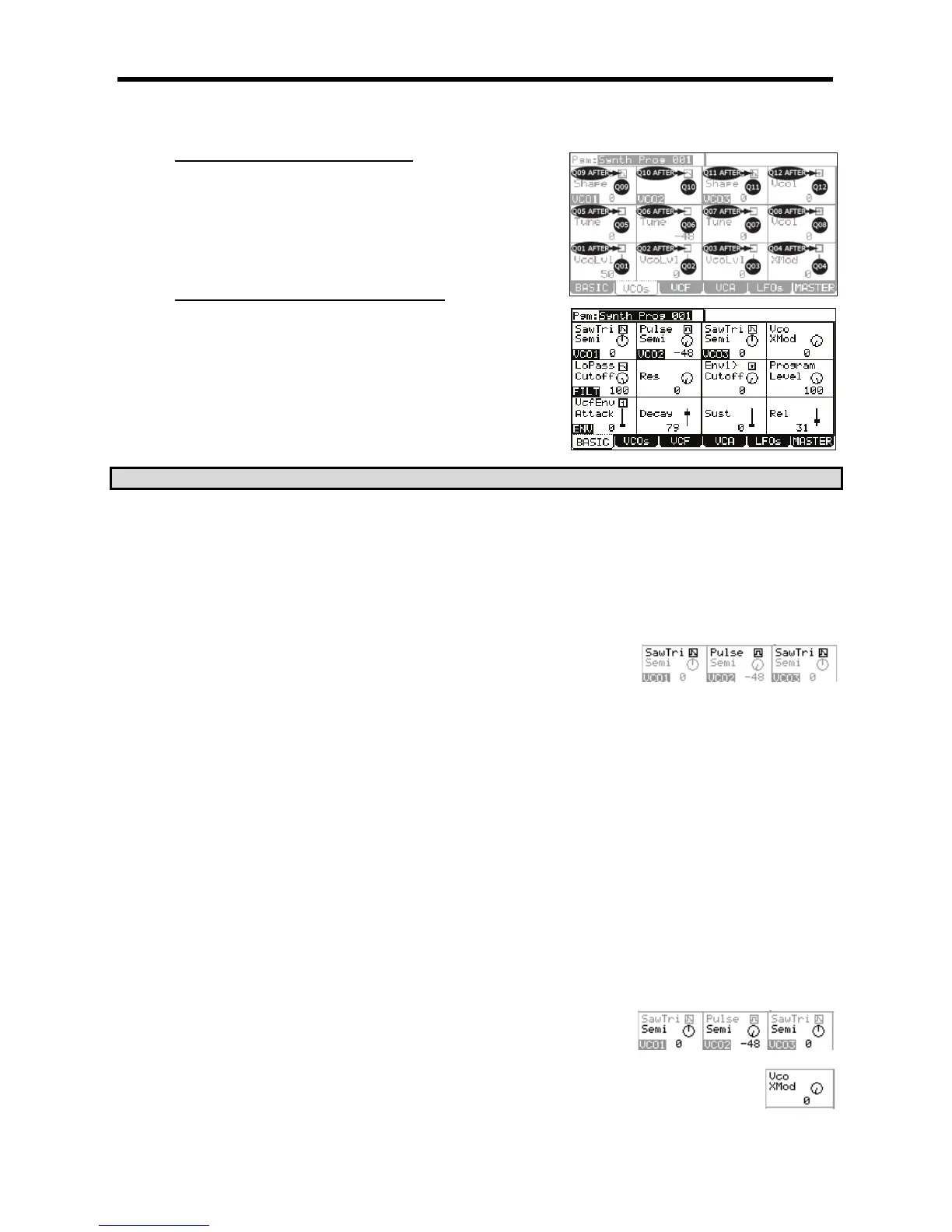
This will display the Basic page. Here, the most commonly used parameters for a synth program can be edited. Each parameter can be selected
by using the [CURSOR] to select each field and turning the [DATA] wheel, or by using the Q-Links, as detailed in the section 'Editing with Q-LINK
Controls' on page 117.
The label in the lower left corner indicates which component of the synth is to be edited.
9>*;
Different aspects of the Oscillators can be adjusted here.
+/+,-
This selects the waveform for each of the three oscillators. The following
shapes are available:
'Sine'
A very pure and simple tone with very little overtones; "mellow" sounding
'SawTri'
This waveform has a shape varying from a triangle wave to a saw wave, depending on the
setting of the 'SHAPE' control, which is located on the VCO page. A Triangle wave has a fuller
sound than a sine wave, but still has very little overtones. A Saw wave a harsh, aggressive
sounding wave, with lots of overtones.
'Pulse'
Ranges from a square wave to varying degrees of pulse widths. Generally a more hollow sound,
approaching nasalness as the wave gets thinner.
'WNoise', 'PNoise', 'RNoise'
Three different flavors of noise are available - White, Pink and Red. Each has it's own sound,
white being the most content rich and 'coldest' sounding, and red being most 'warm' sounding.
'PWM'
PWM stands for Pulse Width Modulation. This waveform is special, in that it is a Pulse wave
whose shape is hard-wired to LFO 2. This gives this waveform a range of sounds from a classic
warbling tone, to a buzzing, harsh sound, rich with overtones.
+!+
Adjusts the tuning of each oscillator in semitones. Each OSC can be tuned
+/- four octaves by semitones.
%4
This parameter controls the amount of oscillator cross modulation that is applied to VCO2 from VCO1.
Cross modulation, also called FM synthesis, is when the output of VCO1 is used to modulate the
frequency of VCO2. From vibrato-like pitch variations, to harsh clanging metallic noises, to bell type
sounds, a broad range of sound is possible with cross modulation.




 To Next Page