EasyManua.ls Logo

Akai Reference Master GX-75 - Page 23

Akai Reference Master GX-75
55 pages
Print Icon
To Next Page IconTo Next Page
To Previous Page IconTo Previous Page
Loading...
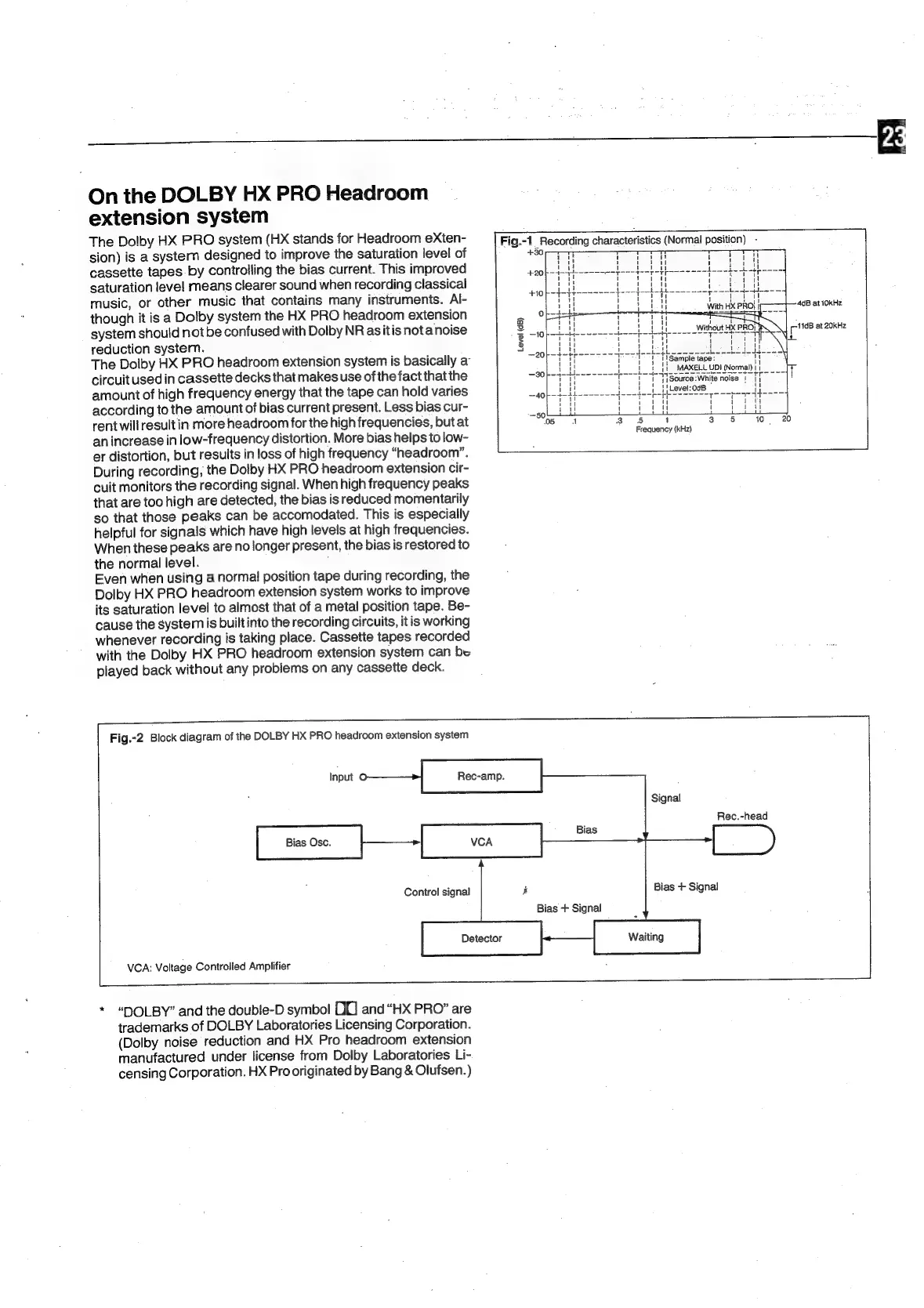
On
the
DOLBY
HX
PRO
Headroom
extension
system
The
Dolby
HX
PRO
system
(HX
stands
for
Headroom
eXten-
sion)
is
a
systern
designed
to
improve
the
saturation
level
of
cassette
tapes
by
controlling
the
bias
current.
This
improved
saturation
level
means
clearer
sound
when
recording
classical
music,
or
other
music
that
contains
many
instruments.
Al-
though
it
is
a
Dolby
system
the
HX
PRO
headroom
extension
system
should
notbe
confused
with
Dolby
NR
asitis
not
anoise
reduction
system.
The
Dolby
HX
PRO
headroom
extension
system
is
basically
a
circuit
used
in
cassette
decks
that
makes
use
of
the
fact
that
the
amount
of
high
frequency
energy
that
the
tape
can
hold
varies
according
to
the
amount
of
bias
current
present.
Less
bias
cur-
rent
will
resultin
more
headroom
for
the
high
frequencies,
but
at
anincrease
in
low-frequency
distortion.
More
bias
helps
to
low-
er
distortion,
but
results
in
loss
of
high
frequency
“headroom”.
During
recording,
the
Dolby
HX
PRO
headroom
extension
cir-
cuit
monitors
the
recording
signal.
When
high
frequency
peaks
that
are
too
high
are
detected,
the
bias
is
reduced
momentarily
so
that
those
peaks
can
be
accomodated.
This
is
especially
helpful
for
signals
which
have
high
levels
at
high
frequencies.
When
these
peaks
are
no
longer
present,
the
bias
is
restored
to
the
normal
level.
Even
when
using
a
normal
position
tape
during
recording,
the
Dolby
HX
PRO
headroom
extension
system
works
to
improve
its
saturation
level
to
almost
that
of
a
metal
position
tape.
Be-
cause
the
systemis
built
into
the
recording
circuits,
itis
working
whenever
recording
is
taking
place.
Cassette
tapes
recorded
with
the
Dolby
HX
PRO
headroom
extension
system
can
be
played
back
without
any
problems
on
any
cassette
deck.
Fig.-2
Block
diagram
of
the
DOLBY
HX
PRO
headroom
extension
system
,
Input
©
Control
signal
VCA:
Voltage
Controlled
Amplifier
Frequency
(kHz)
Fig.-1
Recording
characteristics
(Normal
position)
-
i
g
+30
TTT
ae
a
a
ane
at
bboy
bode
dal
+20
oS
ee
toy
I
soy
)
!
iit
toy
|
10
Popa
pnnnnnpetppn
ep
eFn—
bt
)
I
.
Han
roof
ta
With
HX
PRO!
|
4dB
at
10kHz
a
ma
1
ot
1|
t
:
2
246
ata
Ls
Re
ee
Sore
aie
Without
HX
PROF
411dB
at
20kHz
g
ri
oa
ae
ae
re
3
itt
I
yok
tL
pod
tl
ies
|
ee
a
a
a
tal
1)
bk
MAXELL
UDI
(Normal)
11
—30
b-4--U-~-
--
--
+b
---b
4
n=
i
np
eo
2
7
1}
r
!
Th
ource
:
White
noise
|
TT
i
1
t
!
1!
Level:0dB.
i!
~40
a
ee
Soe
a
aes
131
1
1
tot
}
oy
iol
1
1
1oit
rf
1
oat
—50
ie
23
1 n
=
inns
eee
a
05
es
1
3.5
10
20
Bias
Bias
Osc.
VCA
Bias
+
Signal
Bias
+
Signal
*
“DOLBY”
and
the
double-D
symbol
D0
and
“HX
PRO”
are
trademarks
of
DOLBY
Laboratories
Licensing
Corporation.
(Dolby
noise
reduction
and
HX
Pro
headroom
extension
manufactured
under
license
from
Dolby
Laboratories
Li-
censing
Corporation.
HX
Pro
originated
by
Bang
&
Olufsen.)
Rec.-head
a
24

Related product manuals