EasyManua.ls Logo

Akai Reference Master GX-75 - Page 22

Akai Reference Master GX-75
55 pages
Print Icon
To Next Page IconTo Next Page
To Previous Page IconTo Previous Page
Loading...
On
the
tape
counter
The
digital
tape
counter
shows
the
amount
of
tape
that
has
been
played
back
or
recorded
in
minutes
and
seconds
(up
to
99
minutes
and
59
seconds).
Press
the
RESET
button
to
reset
the
COUNTER
to
“00:00”.
Counter
notes
:
®
Thetape
counter
is
intended
as
a
guide
only
andis
notan
ex-
act
measurement
of
reali
time.
®.
The
tape
counter
will
be
reset
to
“00:00”
when
the
power
is
turned
off
or
if
the
RESET
button
is
pressed.
The
peak
level
meter
The
peak
level
meter
shows
the
peak
(maximum)
level
of
re-
cording
and
playback
signals.
By
monitoring
the
peak
level,
itis
possible
to
set
the
recording
controls
of
this
deck
to
realistically
reproduce
the
dynamic
characteristics
of
the
original
source.
The
standard
recording
level
of
this
meter
is
indicated
at
0
dB
at
a
level
of
250
nWb/m.
The
peak
level
meter
conforms
to
IEC
standards.
Peak
hold
indication
The
peak
level
of
the
recording
signal
can
be
held
to
help
guide
.
you
when
setting
the
REC
LEVEL
controls.
Dolby
NR
system
Set
the
proper
Dolby
Noise
Reduction
system
before
all
recording
and
playback
operations
When
playing
back
a
tape,
set
the
noise
reduction
selector
switch
to
the
setting
that
was
used
when
the
tape
wasrecorded.
Set
the
noise
reduction
selector
switch
to
OFF
for
tapes
that
were
recorded
without
the
use
of
the
Dolby
NR
system.
What
is
the
Dolby
Noise
Reduction
(NR)
System?
The
DOLBY
NR
system
is
anoise
reduction
system
designed
to
reduce
tape
noise
caused
when
high
frequency
soft
sounds
are
recorded.
The
DOLBY
NR
system
does
this
by
lowering
the
noise
floor
in
order
to
increase
the
dynamic
room
in
the
high
fre-
quency
range
above
5.kHz.
During
recording,
the
DOLBY
NR
encoder
circuit
boosts
soft
high
frequency
sounds,
and
then
during
playback
the
DOLBY
|
NR
decoder
circuit
lowers
what
was
boosted
by
exactly
the
same
amount
to
restore
the
high
frequencies
to
their
original
levels.
At
the
same
time,
tape
noise
is
lowered
by
the
same
amount.
The
result
is
reduction
of
up
to
10
dB
in
unwanted
tape
noise
in
the
high
frequencies.
What
is
the
difference
between
Dolby
B-type
and
C-type
NR
systems?
B-type:
This
is
the
conventional
Dolby
NR
system.
It
boosts
or
lowers
the
low-level
signals
at
high
frequencies
only
(more
than
5
kHz)
and
reduces
tape.
noise
by
10
dB.
C-type:
Compared
to
Dolby
B
NR,
it
operates
at
lower
fre-
quencies
(from
500
Hz)
for
uniform
noise
reduction
across
more
of
the
audible
spectrum.
Tape
noise
is
reduced
by
as
much
as
20
cB.
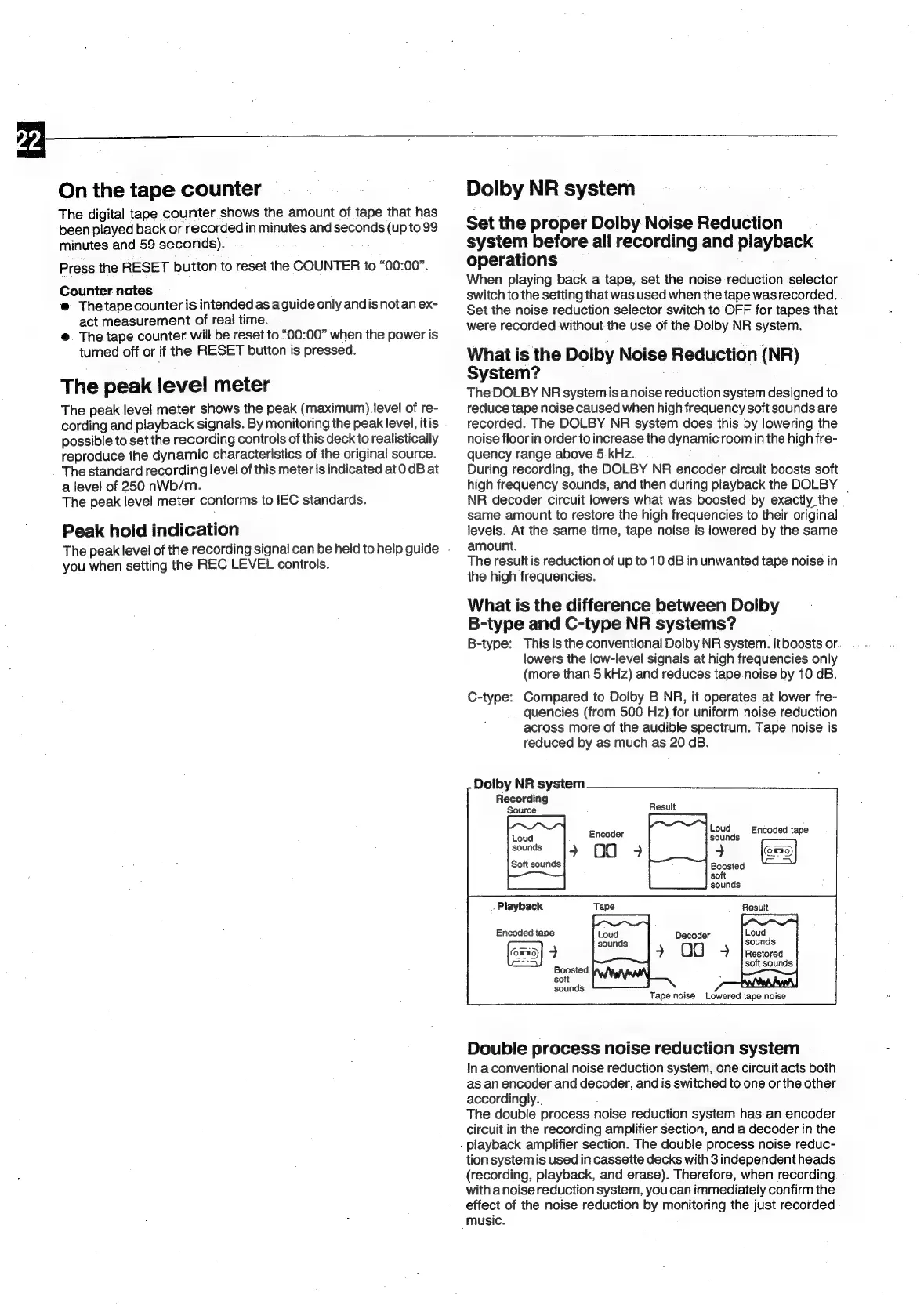
Doiby
NR
system
Recording
Source
Result
Loud
Encoded
tape
sounds
Boosted
soft
sounds
Playback
Loud
sounds
Restored
soft
sounds
Encoded
tape
Decoder
Tape
noise
Lowered
tape
noise
Double
process
noise
reduction
system
In
a
conventional
noise
reduction
system,
one
circuit
acts
both
as an
encoder
and
decoder,
and
is
switched
to
one
or
the
other
accordingly..
The
double
process
noise
reduction
system
has
an
encoder
circuit
in
the
recording
amplifier
section,
and
a
decoder
in
the
.
playback
amplifier
section.
The
double
process
noise
reduc-
tion
systemis
used
in
cassette
decks
with
3
independentheads
(recording,
playback,
and
erase).
Therefore,
when
recording
with
a
noise
reduction
system,
you
can
immediately
confirm
the
effect
of
the
noise
reduction
by
monitoring
the
just
recorded
_music.

Related product manuals