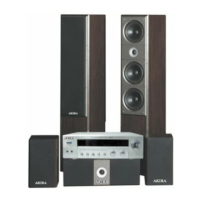
This document is a service manual for the AKIRA Home Theatre System, model HTS-898-266, version 1.0. It provides essential information for safe operation, troubleshooting, and diagrams for the front panel control, amplifier, and circuit.
Function Description
The AKIRA Home Theatre System is designed to provide an immersive audio experience, capable of operating in a 2-channel mode. The system includes various components for audio processing, amplification, and user control. Key functional blocks identified in the circuit diagrams include:
- Audio Input/Output: The system accepts multiple audio inputs (AV6-8.4-7, AC-3) and provides amplified outputs for speakers.
- Audio Processing: Utilizes ICs like PT2253 for volume control and CD4052 (Dual 4-channel Analog Multiplexer) for input signal selection. The PT2399 is also present, likely for digital delay or echo effects, common in home theatre systems.
- Amplification: The amplifier section uses various transistors (e.g., C5196, D1047, 5551, 5401, 9014) and operational amplifiers (e.g., LM324, 4558) to boost audio signals for speaker output. The presence of multiple amplifier stages suggests support for multi-channel audio.
- Power Supply: The system incorporates a robust power supply unit with a transformer, rectifiers (e.g., IN5404, IN4001), filter capacitors (e.g., 1000uF/50V, 2200uF/50V, 3300uF/50V), and voltage regulators (e.g., LM7815CT, LM7915CT) to provide stable DC voltages (+15V, -15V, +30V, -30V, +40V, -40V, +28V, -28V, +5.1V, AC6V, AC22V) to various circuits.
- User Interface: A Front Panel Control Diagram shows a VFD (Vacuum Fluorescent Display) for visual feedback, along with various control buttons and an IR receiver (IC BA5049) for remote control functionality.
Important Technical Specifications
While specific numerical specifications like power output or frequency response are not detailed, the manual highlights several component values and operational parameters:
- Power Supply Voltage: The system is designed to operate with an AC240V 50Hz/60Hz power supply. An optional AC 110V/240V 50Hz/60Hz configuration is also mentioned.
- Internal DC Voltages: Key DC voltages include ±5.1V for ICs like CD4052 and PT2253, and various regulated voltages up to ±40V for the amplifier stages.
- Capacitor Values: Common capacitor values include 47uF/50V, 470uF/50V, 1000uF/50V, 2200uF/50V, and 3300uF/50V in the power supply and audio paths.
- Resistor Values: A wide range of resistor values are used, from ohms to hundreds of kilohms, for biasing, current limiting, and signal conditioning.
- Diodes: Various diodes like IN4001 and IN5404 are used for rectification and protection.
- Fuses: The power supply section includes fuses (e.g., 6A250V, 5A/40A250V) for overcurrent protection.
Usage Features
The manual implicitly suggests several usage features:
- Multi-channel Audio: The presence of "SURR R CHANNEL," "CENT CHANNEL," and multiple amplifier stages indicates support for surround sound configurations.
- Multiple Audio Inputs: The "AUDIO AV6-8.4-7" and "AC-3" inputs suggest compatibility with various audio sources, including digital surround sound formats.
- Remote Control: The inclusion of an IR remote receiver (IC BA5049) implies convenient control from a distance.
- Volume Control: The PT2253 IC is specifically identified for volume control.
- Input Selection: The CD4052 (Dual 4-channel Analog Multiplexer) facilitates selection between different audio input sources.
- VFD Display: A Vacuum Fluorescent Display provides visual feedback on the system's status and settings.
Maintenance Features
The "Trouble Shooting" section outlines several maintenance and repair procedures:
- Safe Operation Guidelines:
- Protect voltage lines and ensure correct voltage connection (AC240V 50Hz/60Hz or optional AC 110V/240V 50Hz/60Hz).
- Operate in an airy area, away from direct sunlight and high temperatures.
- Ensure sufficient air circulation and do not operate from within its box.
- Protect the power cord from heavy objects or excessive force.
- Avoid dropping metal objects (pins, needles, coins) into the equipment to prevent short circuits.
- Keep the equipment away from water, dust, and moisture.
- Do not use volatile solutions for cleaning.
- Troubleshooting Common Issues:
- Cracking, Small Sounds: Diagnose by checking for direct current in the input signal, invalidation of 47uF/50V capacitors, and testing power supply to ICs like CD4052 and PT2253. Solution involves changing damaged parts.
- Hum Sounds: Diagnose by checking for invalidation of the 3300uF/50V filter capacitor due to high voltage or temperature/humidity. Solution is to change the damaged capacitor.
- VFD Display Damage: Diagnose by checking for high working voltage from the transformer, physical shock to the filament, and testing power from the transformer to the front panel controller (AC22V and AC6V). Possible damaged parts include the VFD display, 470uF/50V capacitor, and IN4004 diode. Solution is to replace damaged parts and observe for abnormality.
- Front Panel Loses Control/Cannot Choose Input Signal: Diagnose by checking for strong electromagnetism interference, wavy power supply, high working voltage, or IC (BA5049/LM324) losing control due to temperature/humidity. Possible damaged parts include IC BA5049, CD4052, and LM324. Solution involves testing IC working voltage (+5.1V), changing damaged parts, placing the player away from electromagnetism, and operating at a steady voltage.
- Big Power Transistor C5196 Burnout: Diagnose by referring to the Amplifier Diagram to identify and test possible damaged parts using a digital multimeter. A specific repair technique involves series-connecting a 40W bulb at the wavy power supply (220V/240V) to indicate short circuits during repair. The bulb will shine brightly if a short circuit persists and dim slowly if the player is working normally. This method helps ensure all damaged parts are replaced before full power-on.

 Need help?
 General

 To Next Page