EasyManua.ls Logo

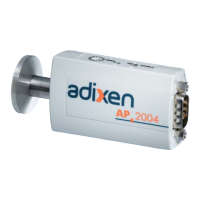
Alcatel Vacuum Technology adixen AP 2004 - User Manual

Alcatel Vacuum Technology adixen AP 2004
16 pages
Print Icon
To Next Page IconTo Next Page
Loading...
1/15
Alcatel Vacuum Technology France - User’s Manual AP/APN 2004
2/15
Alcatel Vacuum Technology France - User’s Manual AP/APN 2004
3/15
Alcatel Vacuum Technology France - User’s Manual AP/APN 2004
4/15
Alcatel Vacuum Technology France - User’s Manual AP/APN 2004
7/15
Alcatel Vacuum Technology France - User’s Manual AP/APN 2004
Pirani Gauges AP/APN 2004
Manual Reference:
113158
Edition: 03 - Date: 09/2010
6/15
Alcatel Vacuum Technology France - User’s Manual AP/APN 2004
5/15
Alcatel Vacuum Technology France - User’s Manual AP/APN 2004
Safety . . . . . . . . . . . . . . . . . . . . . . . . . .p. 2
Responsibility and Warranty . . . . . . . . . .p. 3
Accessories . . . . . . . . . . . . . . . . . . . . . .p. 3
Technical Data . . . . . . . . . . . . . . . . . . . .p. 4 and 5
Installation . . . . . . . . . . . . . . . . . . . . . . .p. 6
Operation . . . . . . . . . . . . . . . . . . . . . . .p. 7 to 11
Gauges Removal . . . . . . . . . . . . . . . . . .p. 11
Maintenance . . . . . . . . . . . . . . . . . . . . .p. 12 and 13
Returning the Products . . . . . . . . . . . . . .p. 13
Decontamination and Product Recycling . .p. 14
Declaration of Conformity . . . . . . . . . . . .p. 15
The end-user assumes the responsibility in conjunction with the
process gases used.
- fails to observe the instructions in this document,
- uses these products in a way that is not consistent with the
manufacturer’s intended use,
- modifies these products in any way whatsoever,
- uses the products with accessories not listed in the product
documentation,
Failures due to contamination, as well as expendable parts
(filament), are not covered by the warranty.
Specifications
AP 2004 APN 2004
Measurement principle Thermal conductance by the Pirani method
Measurement range 5x10
–4
…1000 mbar
Accuracy 5x10
–4
…1x10
–3
mbar, ±50%
1x10
–3
…100 mbar ±15%
100…1000 mbar ±50%
Repeatability (with ambiant temperature 25 °C) 1x10
–3
…100 mbar ± 2%
Supply Voltage range 14…30 V DC
Tolerance ripple > 2 Vpp
Power consumption 2 W (current <150 mA)
Protection IP40
Gauge identifi cation resistance 13 k
Ω
Nominal fi lament resistance
(ambiant temperature from 20 to 25 °C)
85 Ω 54 Ω
Analog output (models 0-10V and 0-10V+ SP) 0-10 V ; 8.5 V = 1000 mbar
2.2 V = 5x10
–4
mbar
Set point (models 0-10V + SP and RS485 + SP) 2 dry contacts - 1 A 30 V DC
Interface (model RS485 + SP) RS485
Electrical connection D-sub 9 Pin (Male)
Max. cable length 200 m - 0.34 mm
2
Temperature range Operation +5 to +60 °C
Storage –20 to +70 °C
Filament temperature 120 °C
Relative humidity 70 % without any condensation
Vacuum connection DN16 ISOKF, DN16CF-F, 1/8NPT
Operating position Any orientation
Internal volume 0.85 cm
3
Recevable maximum pressure 10 bars (conform to connection
accessories)
Materials exposed to vacuum SUS304, SUS316,
Fe / Ni+Au-plant-
ing, Glass,Kovar
®
SUS304, SUS316,
Fe / Ni, AL
2
O
3
Filament material Tungsten Nickel
Pirani Gauges
AP/APN 2004
User’s Manual
Alcatel Vacuum Technology France - 98, avenue de Brogny - BP 2069 - 74009 Annecy cedex - FRANCE
Tel. (33) 4 50 65 77 77 - Fax. (33) 4 50 65 77 89
Web site: www.adixen.com
Realization : Axess - www.axess-groupe.com - Publication: Alcatel - P/N. : 113158 - Ed 03 - Date: 09/2010
1 - Safety
General instructions
Contents
2 - Responsibility and Warranty 4 - Technical Data
65
40
23
X
Connecting flange DN 16 ISO KF X = 18.5 mm
Connecting flange DN 16 CF-F X = 28.5 mm
Connecting flange 1/8NPT X = 30 mm
Gauges dimensions
4 - Technical Data (ctd)
The Pirani gauges AP/APN 2004 have been designed for vacuum
measurements of gases in the pressure range of 1000 mbar to
5x10
-4
mbar.
They are active gauges. The gauges of 0/10V type can be oper-
ated with an Adixen controller (ACS 2000 or ACM2000) or as a
stand alone gauge sending a signal directly to other equipment. The
gauges of RS485 type can be operated only with RS485 customer’s
equipment.
These gauges must not be used for measuring fl ammable or
combustible gases which react in air.
Electrical Connections
Pin Signal AP 2004 AP/APN 2004 AP 2004
0/10 V 0/10 V +SP RS485 + SP
1 Analog outputl 0-10 V (+)
XX
RS485 signal (+)
X
2 Set point (COM)
XX
3 Not used
4 DC power input (+)
XXX
5 Gauge ID
XXX
6 Set point (1)
XX
7 Set point (2)
XX
8 Analog output 0-10 V (–)
XX
RS485 signal (–)
X
9 DC Power input (O V) (–)
XXX
1
2
3
4
5
6
7
8
9
Analog out (+)
Gauge
identificate
resistance
Protective earth
+
Analog out (–)
24 V DC
1
2
3
4
5
6
7
8
9
Gauge
identificate
resistance
Protective earth
+
SP1
SP COM
SP2
24 V DC
Analog out (+)
Analog out (–)
1
2
3
4
5
6
7
8
9
RS485 (+)
+
RS485 (–)
SP1
SP COM
SP2
24 V DC
Gauge
identificate
resistance
Protective earth
AP 2004 - 0/10 V AP/APN 2004 - 0/10 V + SP AP 2004 - RS485 + SP
Connect the gauge to the installation using appropriate fitting
accessories conform to using maximum pressure (1) (from the
Adixen product catalog).
Connect the cable (2). Use cable ties or other methods to support
the cable so that its weight does not put excessive strain on the
connector (3).
5 - Installation
Connection
Do not touch the inside surfaces of this gauge with bare hands,
especially the inlet flange. Fingerprints will increase outgassing in
the gauge and cause erroneous pressure readings.
Install this gauge on the vacuum system with care. If it is
necessary to reposition it, do not twist or bend the sensor by the
electronic enclosure. Disconnect the gauge, position it in the correct
position, and connect it again.
Install this gauge away from vibration. High vibration can cause
the gauge to malfunction.
These gauges are designed to operate in any orientation. Install
the gauges horizontally for higher accuracy.
Install this gauge away from drastic temperature changes (away
from any heat sources or fans) for higher accuracy.
6 - Operation
3 - Accessories
Description P/N
Gauge cable length (5 m)
112752
Gauge cable length (10 m)
112753
Gauge cable length (20 m)
112754
“D-Sub“ 9P (female)
connector (for custom
equipment connections)
114848
Do not use or apply voltage or ground to the pins marked “not used”.
Select the correct wire size for voltage if you use your own cable
( 4 p. 4)
(1)
.
Always connect the protective ground wires or an electric shock can result.
Install a circuit breaker on the power source. Disregarding these
instructions can cause damage and/or injury.
(1) ”D-Sub” 9P (female) connector is available to allow the gauge
to be connected directly to customer equipment. (
3 p. 3).
Do not exceed the receivable maximum pressure ( 4 p. 4). If
the maximum pressure of the gauge is exceeded, it can lead to gas
leakage and cause injury.
Do not open the installation on which a gauge is installed when
the internal pressure is above 1 bar. Internal components may be
ejected and cause personal injury.
Do not use these gauges with corrosive, toxic, flammable or
explosive gasses.
Do not heat these gauges beyond 70 °C. Disregarding this
instruction can cause damage to the gauge circuits or a vacuum
leak.
Symbols used
This type of warning is used to indicate a potential risk that can
cause serious injury or death if instructions are not followed.
This type of warning is used to indicate an imminent risk that can
cause serious injury or death if instructions are not followed.
This type of warning is used to indicate a potential risk that can
cause significant damage to the equipment and/or installations if
instructions are not followed.
Use an Appropriate Power Source
Do not use this gauge with a power supply over 30V DC.
Disregarding this maximum voltage can cause product damage or
personnel injury.
Use appropriate grounds
An appropriate protective ground connection is mandatory to
avoid electric shock in the event of a fault. Make sure there is no
difference in protective ground potential between gauge head and
controller device/power supply.
Use Caution when installing this gauge.
Check that there are no harmful gasses or vapors within the lines
or chambers before opening them to install this gauge. Clean and
purge with a clean dry gas to remove these harmful gasses or
vapors if necessary.
Do not over pressure
Do not pressurize the inside of this gauge beyond the receivable
maximum pressure. Disregarding this can lead to either damage to
this gauge, or a gas leakage which may cause personnel injury.
Do not use these gauges for corrosive or toxic gasses
Do not use this gauge with corrosive, toxic, flammable or explosive
gasses, as this can lead to gas leakage and cause injury.
Maintenance of the product
Do not disassemble the gauge head or electronics sub-assembly.
Refer to section 8 for sub-assembly replacement Instructions.
Do not modify the product
Do not modify the electrical or mechanical components of these
gauges. Any modification could cause damage or personnel injury.
Skilled personnel
All work described in this document should be carried out only
by qualified persons who have suitable technical training and the
necessary experience.
Lighting display: Off - Steady - Flashing
State
Description
Power LED
green power ON / normal operation
orange adjustment in progress
or
red
fault (see error catalog)
SP1 LED set point 1 opened
green set point 1 closed
orange or orange
adjustment in progress (
6 p. 10)
SP2 LED
set point 2 opened
green set point 2 closed
orange or orange
adjustment in progress (
6 p. 10)
Switch Description
VAC/ATM atmosphere and zero adjustment
SP SEL set point adjustment
Switch selector AP/APN 2004 0/10 V + SP
use to enter set point data (
6 p. 10)
AP 2004 - RS485 + SP use to enter network address
(refer to RS485 communication Manual)
Control Panel
description
AP 2004 - 0/10 V
AP/APN 2004 - 0/10 V + SP AP 2004 - RS485 + SP
1
2
3
Intended Use: The Pirani AP/APN 2004 have been designed for
vacuum measurement of gases in the pressure range of
5x10
–4
…1000 mbar. The gauge must not be used for measuring fl am-
mable or combustible gases which react in air. .
English original version
Question and Answer IconNeed help?

Do you have a question about the Alcatel Vacuum Technology adixen AP 2004 and is the answer not in the manual?

Overview

The Pirani Gauges AP/APN 2004 are active gauges designed for vacuum measurements of gases within a pressure range of 1000 mbar down to 5x10⁻⁴ mbar. These gauges are intended for use with an Adixen controller (ACS 2000 or ACM2000) when they are of the 0/10V type, or they can function as standalone gauges, sending a signal directly to other equipment. For RS485 type gauges, operation is exclusively with RS485 customer equipment. It is crucial to note that these gauges are not suitable for measuring flammable or combustible gases that react in air.

Safety and General Instructions:

The intended use of the Pirani AP/APN 2004 gauges is strictly for vacuum measurement of gases within the specified pressure range. They must not be used for measuring flammable or combustible gases that react in air. When operating these gauges, it is imperative to use an appropriate power source, ensuring the DC power supply does not exceed 30V. Exceeding this voltage can lead to product damage or personnel injury. Proper grounding is mandatory to prevent electric shock in case of a fault, and there should be no difference in protective ground potential between the gauge head and the controller device/power supply.

During installation, caution is advised. Users must verify that no harmful gases or vapors are present within the lines or chambers before opening them. If necessary, the system should be cleaned and purged with a clean, dry gas to remove any harmful substances. The internal pressure of the gauge must not exceed the maximum receivable pressure, as doing so can cause damage or gas leakage, potentially leading to injury. These gauges are not designed for use with corrosive, toxic, flammable, or explosive gases, which could result in gas leakage and injury. Maintenance of the product should be limited to sub-assembly replacement; the gauge head or electronics sub-assembly should not be disassembled. Any modifications to the electrical or mechanical components are prohibited, as they could cause damage or personnel injury. All work described in the manual should only be performed by qualified personnel with suitable technical training and experience.

Responsibility and Warranty:

The end-user bears responsibility for the process gases used. The warranty does not cover failures resulting from non-observance of instructions, use inconsistent with the manufacturer's intended purpose, modifications, or use with unlisted accessories. Failures due to contamination or expendable parts (like the filament) are also not covered.

Installation:

Connecting the gauge to the installation requires appropriate fitting accessories that conform to the maximum pressure specifications. The cable should be connected and supported using cable ties or other methods to prevent excessive strain on the connector due to its weight. It is critical not to exceed the maximum receivable pressure to avoid gas leakage and injury. The installation should not be opened if the internal pressure is above 1 bar, as internal components could be ejected, causing injury. The gauges should not be heated beyond 70 °C, as this can damage circuits or cause vacuum leaks.

When installing, avoid touching the inside surfaces of the gauge, especially the inlet flange, with bare hands, as fingerprints can increase outgassing and lead to erroneous pressure readings. The gauge should be installed carefully on the vacuum system. If repositioning is necessary, avoid twisting or bending the sensor by the electronic enclosure; instead, disconnect the gauge, reposition it, and reconnect. Installation away from vibrations is recommended to prevent malfunctions. While these gauges are designed to operate in any orientation, horizontal installation provides higher accuracy. They should also be installed away from drastic temperature changes, heat sources, or fans for optimal accuracy.

Operation:

The gauge features a control panel with LEDs and switches for various functions. The Power LED indicates the operational status: green for power ON/normal operation, orange for adjustment in progress, and red for a fault. SP1 and SP2 LEDs indicate the status of set points (opened, closed, or adjustment in progress). Switches include VAC/ATM for atmosphere and zero adjustment, and SP SEL for set point adjustment or entering the network address for RS485 models.

The analog signal output (0-10V) is available on Pins 1(+) and 8(-). This signal can be converted to pressure using a specific formula, with defined measurement limits. For gases other than Air, O2, N2, or CO, a conversion factor from a provided table should be applied to the pressure reading, especially for pressures under 1 mbar. RS485 communication is available on Pins 1(+) and 8(-) for RS485 models, with details found in the RS485 Communication Manual.

Gauge readings can be adjusted at two points: atmospheric pressure (ATM) and the low-pressure limit (VAC). The gauge automatically determines the conditions. Before adjustment, the gauge must be mounted in the same orientation and conditions as it will be used, and allowed to stabilize for at least 10 minutes. For zero adjustment, the current pressure must be below 1 x 10⁻⁴ mbar. The ATM and VAC adjustments allow restoring stored values. The ATM stored value can be changed, but the VAC value cannot. For AP2004-RS485+SP models, adjustments can also be made via the RS485 interface.

Set points 1 and 2 are modified using a switch selector. The mantissa is set using digits 1 to 9, the exponent value (from +6 to -9) using specific values, and measurement units (mbar, torr, or Pascal) are also selected via the switch. The set point relay output has a fixed 10% hysteresis. For AP2004-RS485+SP models, set points are modified exclusively via the RS485 interface.

Gauges Removal:

Before removing the gauge, it is essential to confirm whether the vacuum processing system parts are contaminated with materials detrimental to health and the environment. If contaminated, the gauge and equipment must be thoroughly purged and cleaned. Necessary precautions should be taken when handling contaminated parts. When removing the gauge, avoid touching the inside of the connecting flange with bare hands to prevent outgassing and erroneous pressure readings. The vacuum system should be vented to atmospheric pressure, power to the gauge turned off, and the electrical connector removed. After removal, a protective cap should be placed on the fitting to prevent foreign substances from entering the gauge. For storage, the gauge should be kept away from heat, moisture, and dust.

Maintenance:

Dirt and damage can impair vacuum component function, leading to increased outgassing and negative effects on the vacuum process. The gauge must be kept clean. Only the connecting flange should be cleaned, and only denatured alcohol should be used for cleaning the outside of the gauge.

For sub-assembly replacement, a small Philips screwdriver and an Ohmmeter are required. The sensor and/or electronics can be replaced by loosening the set screw, pulling out the sensor, replacing it, carefully aligning the holes in the electronics with the sensor pins, pushing the sensor into the electronics, and securing it with the set screw. After assembly, the sensor must be adjusted.

To check the filament, the sensor should be removed from the electronics, and an ohmmeter used to check the filament resistance. If the measured value is out of range, the sensor should be replaced. The manual also includes an error catalog to assist in troubleshooting, detailing probable errors and corresponding actions based on the power LED and voltage readings.

Return the Products:

Contaminated products (e.g., with radioactive, toxic, caustic, or microbiological hazards) can be detrimental to health and the environment. Products returned to the manufacturer must be cleaned and free of harmful substances. Shipping regulations of all involved countries and forwarding companies must be followed, and a duly completed "Safety Questionnaire" (available on the Adixen website) must be enclosed before shipping. Products not clearly declared as "free of harmful substances" will be decontaminated at the customer's expense. Products without a completed "Safety Questionnaire" will be returned to the sender at their expense.

Decontamination and Product Recycling:

In compliance with European Directives 2002/96/CE (WEEE) and 2002/9/CE (RoHS), Adixen products that have reached the end of their service life must be returned to the manufacturer for decontamination and reuse. This obligation applies only to complete items that have not been modified or retrofitted and have used only spare parts sold by Alcatel Vacuum Technology. The cost of transporting the product to a reprocessing center and the service cost will be invoiced to the customer. All returned equipment must include a properly filled safety questionnaire.

Contaminated parts can be detrimental to health and the environment. Before working on any parts, users must determine if they are contaminated and adhere to relevant regulations and precautions. Substances detrimental to the environment, such as mechanical and electric components or operating fluids, must be disposed of according to relevant local regulations. When disassembling the product, components should be separated based on contamination. Contaminated components (radioactive, toxic, caustic, or biological hazard) must be decontaminated according to local regulations, separated by material, and disposed of. Other components should be separated by material and recycled.

Alcatel Vacuum Technology adixen AP 2004 Specifications

General IconGeneral
Supply Voltage24 VDC
TypePirani Gauge
Measurement Range1E-4 to 1000 mbar
Output Signal0-10 VDC (Logarithmic)
Inlet PortDN16KF
Storage Temperature Range-20 to +60 °C
Relative Humidity0 to 80 % non-condensing

Related product manuals