Your First Session with the MIDIVerb 4 – Chapter 1
MidiVerb 4 Reference Manual 11
Changing Effect Settings
When you dial up a Program, its Configuration is shown in the display to the right of
the Program’s name.
RoomVerb REAL ROOM
The Configuration will either be a single reverb type effect (as in the example above),
or a combination of two or three effects (like Reverb+Delay, or Chorus>Delay>
Reverb). Once you have identified what effects are used in the Program’s
Configuration, you can then find the effect parameters more easily.
To edit a Program’s effect settings, you must first enter Edit mode. This is done by
pressing either the [PAGE] button or any one of the [A], [B], [C] or [D] buttons, as
long as the [PROG] button is lit (Note: Pressing these buttons in other modes
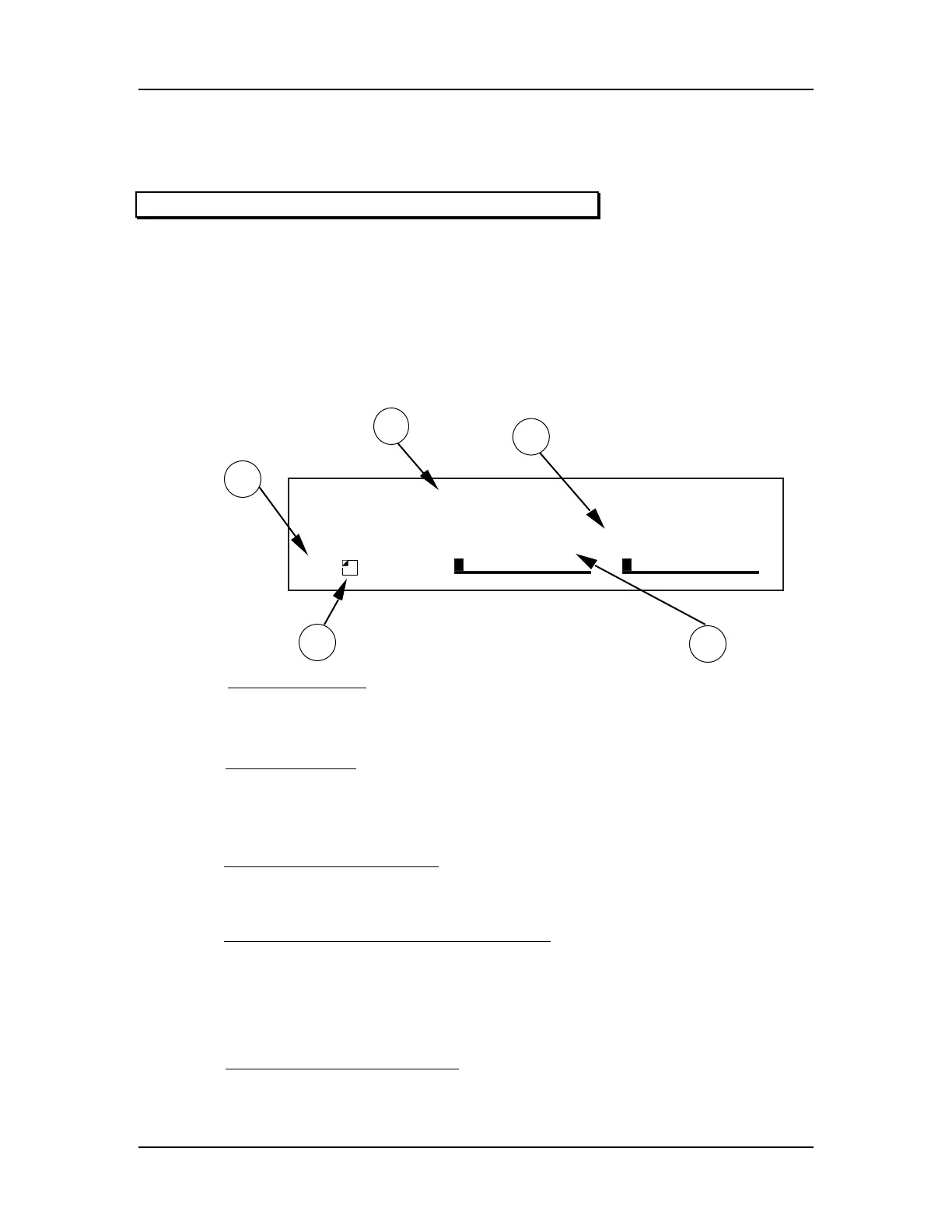
performs different functions). Once in Edit mode, the display will look something
like this:
L R
PRESET
Decay LPF PDly PMix
4
5
1
3
2
PAGE 1 2 3
80 22.8 150 000
A B C DEDITED
➀
Page Numbers
. Depending on the Configuration, there will be
up to four pages available in Edit mode. In this example, only three
pages are available.
➁
Selected Page
. The currently selected page will be indicated by
a box around its number. In this example, page 1 is currently
selected. Each time you press the [PAGE] button, the display will
advance to the next page.
Parameter Name Strip
. Each page in Edit mode contains up to
four parameters. whose names will appear at the top of the display,
above their value settings.
Parameter Values and Bar Graphs
. Each parameter is shown
with both a numerical value and a bargraph. As you adjust a
parameter, both its numerical value and bargraph will change in
➂
➃
relation to the [VALUE] knob’s position. The type of units a parameter
uses will be shown as well (dB, mSec, kHz, etc.).
A, B, C, D and EDITED Indicators
. Each parameter in the selected page is
➄
or [D]) should be pressed to select the desired parameter for editing. Once a
parameter has been edited, the word “EDITED” will appear below it.
designated by a letter (A, B, C or D), which indicates which button ([A], [B], [C]





 To Next Page