The Alesis Prolinear 720/820 DSP (AS1/AS3) is a sophisticated active monitor system designed for professional audio applications. This service manual provides comprehensive details on its operation, technical specifications, and maintenance procedures.
Function Description:
The Prolinear DSP series are active monitor speakers that integrate digital signal processing (DSP) for precise audio control and optimization. They are designed to provide accurate sound reproduction for monitoring in studios, broadcast facilities, and other critical listening environments. The DSP functionality allows for real-time adjustment of various audio parameters, ensuring optimal performance tailored to specific acoustic conditions and user preferences. The system includes both low-frequency (LF) and high-frequency (HF) amplification, making them self-powered and eliminating the need for external amplifiers. The DSP module is the core of the system, handling signal processing, control, and communication with other components.
Important Technical Specifications:
- Nominal input level: +4dBu (-15dBFS)
- Maximum input level: +20dBu (7.0 Vrms)
- Input impedance: 10kΩ
Output:
- Sound Pressure Level (SPL): ~110dB at 1 meter at max input below clipping
- Low Frequency (LF) power: 80 watts RMS, ~130 watts peak
- High Frequency (HF) power: 40 watts RMS typical, ~130 watts peak
- Frequency response: 50Hz-20kHz +/-1.5dB (Bass level -3dB @ 43Hz typical)
- Signal To Noise ratio: >90 dB A-weighted (Analog In to Analog Out)
Power Requirements:
- Input voltage: 100v-230v
- Input frequency: 47-63Hz
- Power consumption: 20W (idle), 130W (typical, at maximum volume)
Environmental Requirements:
- Temperature range: 0-40 degrees C
- Relative humidity (non-condensing): 30-85%
Cabling Requirements:
- Mixer to Speaker: Balanced or unbalanced, shielded; XLR or 1/4" TRS connector.
- Speaker to PC: Standard 9-pin, RS-232 serial cable (male-female).
- Speaker to Speaker: Standard 9-pin, RS-232 serial cable (male-female).
Mechanical (Proliner 720 DSP):
- Size: 15"H x 9" W x 12" D
- Weight: 12 kg
Mechanical (Proliner 820 DSP):
- Size: 17.5"H x 11" W x 14" D
- Weight: 15 kg
Usage Features:
The Prolinear DSP features a front panel with a Liquid Crystal Display (LCD) and six buttons for parameter access and modification. The LCD shows various information, including the program number, EQ band, boost/cut amount (Gain), and the assigned channel. A unique feature is the LCD backlight flashing, which serves as an alert for two conditions:
- Edit Propagation: When multiple Prolinear DSP speakers are set to the same channel, an edit on one speaker will "propagate" to others. The backlights on the "slave" speaker LCDs will flash to indicate this.
- Signal Clipping: If the input level is too high, causing the speaker amplifier to clip, the LCD backlight will flash red, warning the user of potential distortion.
The DSP allows users to adjust EQ curves, gain, and assign channels, providing flexibility for different audio setups. The speaker-to-speaker cabling allows for synchronized control across multiple units.
Maintenance Features:
The manual outlines detailed disassembly procedures for various components, facilitating repair and maintenance. These include:
- Removal of Rear Panel: Involves detaching the rear panel and disconnecting the 10-pin and 3-pin connectors from the main PCB.
- Removal of Waveguide/DSP Module/20 Pin Cable: Requires unscrewing the DSP module from the waveguide and disconnecting the 20-pin cable.
- Removal of Trim Ring: Different procedures for Prolinear 720 DSP (AS1) and Prolinear 820 DSP (AS3) involving 4 or 6 screws to remove the trim ring and woofer from the front baffle.
- Removal of DSP PCB: Involves unscrewing the DSP PCB and rubber keypad from the DSP bezel.
- Removal of Tweeter: Requires removing 4 screws and brass nuts to detach the tweeter from the waveguide.
- Removal of I/O Cup: Involves detaching the sealing cup, grounding cable, and various pin cables from the AC switch, AC socket, and I/O PCB.
- Removal of I/O PCB Ass'y: Involves unscrewing the I/O PCB assembly and detaching the AC switch and AC socket.
- Removal of Power Supply: Requires disconnecting the 4-pin cable and unscrewing the power supply from the rear panel.
- Removal of Main PCB Ass'y: Involves unscrewing the main PCB from the rear panel.
The manual also includes an ECN (Engineering Change Notice) history, detailing modifications and updates to the product. For instance, ECN D19701 describes a phase reversal modification involving the removal of SMD resistors and soldering of thru-hole resistors to address high levels of distortion due to phase inversion. ECN D19902 details firmware updates to add a phase changing feature, improve EEPROM revision display, and fix a diagnostic bug related to the red LED during flash tests. ECN D22301 addresses a woofer replacement due to supplier issues, requiring an EEPROM update. ECN D25901 outlines a power amp mute noise fix, involving the addition of ceramic capacitors to eliminate voltage spikes. These detailed procedures and change notices are crucial for authorized service personnel to perform accurate repairs and ensure the continued optimal performance of the Prolinear DSP monitors.

 Need help?
 General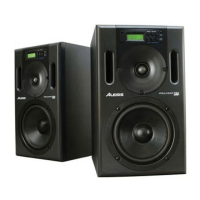

 To Next Page