28
Appendix A: Assembly instructions
Become comfortable using the handbrake and parking brake.
Find the balance point of the Alinker by sitting with your full weight on the saddle and leaning to the
right to see where it feels like it might start to tip.
Try leaning to the left until it feels like to might want to tip. For your safety when using the Alinker
you will want to sit upright, staying in between these two extremes.
6. Using the Alinker-beginner
For initial use of the Alinker have someone with you as a spotter.
Select a level location with few obstructions and other traffic, preferably indoors.
Pick your route, a clear straight away in which you can walk in a straight line.
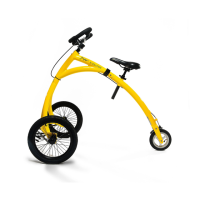
The Alinker is a walking bike; 3mph is the average walking speed. Be aware that increasing speed
also increases the risk of tipping, falling or other accident.
Begin walking slowly. Have your full weight on the saddle, using your feet and legs to create forward
momentum.
Keep your walking stride within the frame of the device (between the two wheels).
Try using short and long strides to see how they feel different and accomplish different things.
Keep your hands on the handle-bars at all times. Be ready to use the hand brake if necessary.
Lean to the right and to the left carefully, but without tipping, to explore the stability of the device.
Once you are comfortable walking in a straight line forward, try taking a few steps backward using
small steps.
Turning the device in a circle slowly, taking smaller steps. See how tight the turning radius is.
When you get off, engage the parking brake.
7. Check in and see how you feel!
What muscles did you use? Do you feel like you’ve exercised? Are your sore anywhere?
If you experience any pain or discomfort during or after a walk on the Alinker, contact you physician,
physiotherapist or occupational therapist. They can give you advice on using the Alinker in a pain
free, healthy way.
When you start walking with the Alinker, you might discover that you use muscles you haven’t used
for a while. This can cause muscle pain. Also, saddle sore may occur in the beginning. Like the mscle
pain, it is inconvenient, but harmless.
8. Using the Alinker-advanced, going outside:
Stay in control when using the Alinker. Use caution always, especially when you get tired: 3 mph
is a sensible speed limit. Slow down when you make a turn, going down a slope or when you are
navigating obstacles.
Preferably, stay on the sidewalk when using the Alinker as you are considered a pedestrian.
Consider other pedestrians and cyclists. People cannot hear you approaching on the Alinker. It is easy
to bump into pedestrians because you may be moving more quickly than they are.
Before taking the Alinker into busy areas in mixed traffic, master these skills:


 To Next Page