
 Need help?
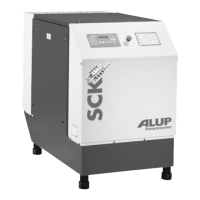
Do you have a question about the ALUP Kompressoren SCK 21 and is the answer not in the manual?
Essential operational information for the screw-type compressor.
Critical safety guidelines for operation, maintenance, and commissioning.
Guidelines for the safe transportation of the compressor.
Explains how the electric motor drives the compressor stage via V-belts.
Details the flow of air from the suction filter through the compressor stage to the outlet.
Describes the lubricating oil flow for cooling, sealing, and operation within the compressor.
Explains how cooling air is circulated over components by the fan.
Provides general guidelines for the proper installation and placement of the compressor.
Details the requirements for connecting the compressor to the compressed air piping system.
Specifies that electrical connections must be made by skilled electricians.
Advises on the proper handling and disposal of oily condensate water.
Explains the compressor's display panel, showing pressure, temperature, and status.
Details the function of each button on the Air-Control unit.
Lists and explains various warning indicators and their meanings.
Lists and explains error codes displayed on the Air-Control unit.
Describes how to change factory settings and parameters via the control unit.
Information on draining preservative oil after storage before commissioning.
Instructions on how to check and refill the compressor oil level.
Recommendations for suitable lubricating oils and warranty considerations.
Procedure for initial lubrication of the compressor stage after standstill.
How to check and correct the motor's direction of rotation.
Steps and precautions for starting the compressor.
Procedure for safely shutting down the compressor.
General guidelines for maintenance and the procedure for pressure relief before work.
Instructions for checking and maintaining the V-belt drive system.
Procedure for replacing the suction filter for SCK 21-42 and SCK 52 models.
Steps for replacing the oil filter, including confirmation and reset.
Procedure for replacing the oil separator, including confirmation and reset.
Information on the formation, draining, and handling of condensate water.
Procedures for checking oil level and performing oil changes.
Guidance on regreasing motor bearings or replacing sealed bearings.
Procedure for checking the safety valve every 2,000 operating hours or annually.
Instructions on how to set pressure switch points using Code 11.
Guidance on performing comprehensive general maintenance on the compressor.
Troubleshooting for machine shutdown due to compressor discharge temperature issues.
Diagnosing and resolving issues related to falling line pressure.
Troubleshooting when the machine blows off through the safety valve.
Interpreting and resolving errors indicated by red lamp and specific codes.
Troubleshooting the absence of automatic start or load switching.
Diagnosing why the machine fails to start when the start key is pressed.
Addressing issues of high oil content in compressed air, indicating excess oil consumption.
Troubleshooting compressor shutdown before reaching the set cut-out pressure.
Interpreting the information lamp indicating low power voltage.
Suitability of the compressor for high ambient temperatures up to 45 °C.
Information for compressors operating with non-standard voltage or 60 Hz frequency.
Preventing damage from incorrect electrical polarity using rotation control.
Functionality of the electric heating system for the oil tank.
Forwarding compressor errors or status via floating contacts.
Controlling the compressor on and off using a floating contact.
Adjusting delivery rate to actual compressed air consumption.
Indicates when filter or separator elements need replacement.
Information for systems fitted with or prepared for heat recovery.
Diagrams and data related to performance and physical installation requirements.
Table detailing weight, cooling air, supply air, oil tank capacity, and connections.
Table showing motor ratings and current consumption at different voltages/frequencies.
Diagram showing the layout and part numbers for control and electrical components.
Illustration of main unit components with associated part numbers.
Illustration of motor, drive train, and cooling system parts with numbers.
Illustration of lines, hoses, and gasket components with part numbers.
Illustration of lines related to the motor drive and cooling system.
Illustration of components for suction control and temperature regulation.
Illustration of the separator box and its internal components with part numbers.
List of part numbers for compressor stage and motor pulleys across SCK models.
List of part numbers for electric motors, fuses, and relays.
List of part numbers for emergency buttons, sensors, and safety valves.
List of V-belt sets and their compatibility with SCK models.
List of part numbers for various couplings, elbows, and adaptors.
List of part numbers for sealing rings, oil tank O-rings, and oil separators.
List of part numbers for oil filter cartridges and injection nozzles.
List of part numbers for various lines, hoses, and sensors.
List of part numbers for oil tank support and elastic supports.
List of part numbers for ventilators, hubs, and the operation panel.
List of part numbers for operating instructions manuals and special oils.
List of part numbers for various service kits and filter kits.
List of part numbers for side boards, sound cover hood, and service board.
List of part numbers for compressor pulleys across SCK models.
List of part numbers for oil tanks.
List of part numbers for compressed air connection sockets and support distance.
List of part numbers for suction control, proportional control, and separator components.
List of part numbers for temperature control units, housings, and valves.
List of part numbers for the exhaust air grid.
List of part numbers for air intake plates and electric boxes.
List of part numbers for frames, cooler side boards, and compressor flanges.
A log for recording completed servicing work, dates, and signatures.
 General
| Model | SCK 21 |
|---|---|
| Category | Air Compressor |
| Max Pressure | 10 bar |
| Voltage | 400 V |
| Frequency | 50 Hz |

 To Next Page
