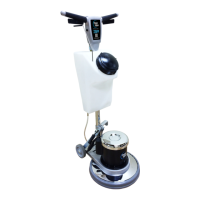
This document is an operator's manual for the Pioneer Eclipse 225FP16TR Floor Polisher, manufactured by Amano Pioneer Eclipse Corporation.
Function Description
The Pioneer Eclipse 225FP16TR is a floor polisher designed and manufactured for commercial use on hard floor surfaces. It is intended for indoor use and can clean most modern types of floors, including composition tile, stone, marble, terrazzo, resilient floor covering, and some coated wood floors. The machine is primarily used for wet grinding and polishing concrete and other silica-containing materials. It is crucial to use it only for wet grinding to avoid increased exposure to crystalline silica dust, which can be hazardous.
Important Technical Specifications
- Voltage (V): 120
- Frequency (Hz): 60
- Current (A): 15
- Pad / Brush Speed: 175 rpm
- Power: 1.5 hp (1.1 kW)
- Gearbox: 3-Planet
- Pad/Brush Size: 16" (41 cm)
- Cord: 12/3 Yellow SOOW
- Cord Length: 50' (15 m)
- Height w/ Handle: 46" (117 cm)
- Width: 16.6" (42 cm)
- Length: 23" (59 cm)
- Weight w/ cord: 90 lbs (41 kg)
- Handle Tube: Tubular Steel
- Main Frame: Die Cast Aluminum
- Tank Capacity: 2.50 gal (9.5 L)
Usage Features
The floor polisher is designed for ease of operation with several user-friendly features:
- Operator Handle Grips: These grips are used to operate and move the machine. The switch levers located on the underside of the grips turn the motor on and off. Operators should find a comfortable operating position and lock the handle release lever in place. Slight adjustments to the handle's height (raising or lowering) help control the machine's movement.
- Switch Levers: These levers activate the switch module to turn the motor on and off. The switch module requires the switch lever safety lock to be pressed first. Only one switch lever needs to be engaged to operate the machine, allowing operators to alternate hands. Releasing the switch levers stops the motor.
- Switch Lever Safety Lock: This safety feature prevents accidental activation of the machine. To turn the machine on, the handle must be lowered to the operator's position, and the handle release lever must be locked. The safety lock is pushed and held with one hand while engaging a switch lever. Once the machine starts, the safety lock can be released.
- Water Tank / Fill Cap: The machine includes a 2.50-gallon (9.5 L) water tank, which should only be filled with clean water. Flammable, corrosive, and/or toxic liquids and powders must not be placed in the tank. The fill cap must be replaced after filling to prevent splashing water onto electrical components. Any remaining water should be drained before storage.
- Handle Release Lever: This lever allows the operator's handle to move freely when pulled up, and locks it in place when pushed down horizontally. The handle should always be locked during use, transport, or storage.
- Cord Hook: To prevent damage, the power cord should be wrapped around the cord hook and the top of the operator's handle when not in use.
- Water Release Handle: Pulling up on this handle opens a valve in the tank, allowing water to flow to the pad driver. Water flow stops when the handle is released, and the amount of flow can be varied by how far the handle is raised. To drain the tank, the machine should be placed over a drain, the fill cap removed, and the water release handle used.
- GFCI (Ground Fault Circuit Interrupter): This safety device protects against electrical shock by monitoring current flow. If a discrepancy is detected, the GFCI interrupts power. Operators should check the machine and power cord for faults if the GFCI trips and press the reset button to continue. If it repeatedly trips, the machine requires servicing. A test button is provided to verify GFCI functionality.
- Power Cord: The machine uses a supplied 12 AWG, 50-foot (15 m) power cord. It connects to a female receptacle on the back of the handle; pins must be aligned, pushed together, and twisted to lock.
- Grounding Instructions: The machine is equipped with a three-conductor cord and a three-contact grounding plug for protection against electrical shock. It must be connected to a properly grounded 120-volt outlet. No adapters should be used. Extension cords, if used, must be approved, three-conductor, 12 AWG, and no longer than 50 feet. Joining two extension cords is prohibited.
Maintenance Features
The manual outlines a scheduled maintenance plan to ensure the machine remains in good working condition:
Daily Maintenance:
- Empty the water tank.
- Remove the driver/pad holder.
- Check for loose or lost fasteners.
- Inspect hoses and connections.
- Inspect the driver/pad holder for damage.
- Clean the machine and accessories.
- Test the GFCI.
Weekly Maintenance:
- Check the power cord for damage.
Monthly Maintenance:
- Check machine wiring for fray or cut.
Troubleshooting Guide:
The manual provides a troubleshooting guide for common issues:
- Machine will not start: Check main power supply, cord connection, ensure switch lever safety lock is depressed and switch levers engaged, check motor and cord interlock connections, reset GFCI, or contact an authorized APEC distributor for bad motor start capacitor or defective motor start switch.
- Motor runs sluggish: Replace 12/3 extension cord if using one with smaller wire size or if using more than one extension cord. Contact an authorized APEC distributor for bad motor run capacitor or defective handle switch.
- Fuse / circuit breaker repeatedly trips: Eliminate extension cord and use a power source closer to the work site, have voltage checked by a qualified electrician, ensure no other items use power on the circuit, try a less aggressive driver/head, do not add weight to the machine, or contact an authorized APEC distributor for bad connection or defective motor.
- Machine wobbles during operation: Replace a defective pad, replace a pad that has taken "a set," replace a warped block on brush or padholder, or remove and install the block properly.
General Maintenance Guidelines:
- Operators are responsible for daily maintenance and checkups.
- Service mechanics or supervisors must be informed when recommended maintenance procedures are required.
- Only parts and supplies from an Authorized Amano Pioneer Eclipse Distributor should be used.
- The machine should be stored in a clean, dry building.
- Electrical components must be kept dry to prevent short-circuits.
- The machine is heavy (90 lbs / 41 kg without cord); two people should lift it using a firm grip and proper lifting technique.
- Always disconnect the power supply before performing maintenance or service, changing the brush, pad, or other attachments, or leaving the machine.
- Damaged power cords should not be used and must be replaced by an authorized service person.
- When draining liquids, local and federal waste disposal standards must be followed.
- Unauthorized modifications or alterations to the machine are prohibited as they can lead to injury, damage, and void all warranties.


 To Next Page
 General