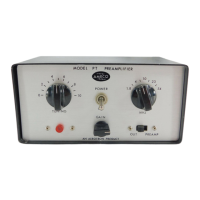
OPE RATION
With
the
P0WER switch
in the
on
(up)
position
and
sition,
the transceiver
should
work
in the
normal
the PREAMP
position,
the
pre-ampl
ifier
section
of
of
the receiving
system
and,
therefore,
since it
as
fol lows:
the
PREAMP
swi
tch i n
the OUT
po-
fashlon.
With the PREAMP
switch in
the
PT
then
will increase
the
gain
is in
operation,
it
should be
used
l.
Turn
the
MHz switch
to a
position
that includes
the desired
frequency.
For
ex-
ample, the
2O-meter amateur band
is'14
to 14.35 MHz. This
is between
the l0
and
23,
therefore
the
switch
must
be
at the
line
between
l0
and
23.
2.
When a signal
is
received,
peak
it by
"alrrting
the TUNING
control for
maximum
swing
on the
receiver S meter or maximum
volume if
no meter
is used. ln
tuning
over a
band, the
tuning
knob
of the PT
should be adjusted
fairly
frequently.
For
example,
at
AMHz, it may
have
to be
adjusted every
50
kHz. At
50
MHz,
it may
have
to
be adjusted
every
200
kHz.
l.
When
the
PREAMP switch
is left in the
OUT
position,
the unit is in
standby con-
dition with
power
applied
and its
frame
grid
tube warmed
up. lnstantaneous
pre-amplification
is available when
the
switch is
placed
in the PREAMP
position.
4. Because the PT adds considerable
amplification
(approximately
20
db)
to the re-
ceiver section
of the transceiver,
which may
often
have
sufficient
gain, partic-
ularly on the
lower frequency
bands,
overloading
resulting
in
cross
modulation
or
desensitization, or both, may
occur. For
this reason,
a manual
GAIN control
is
in-
cluded on the
front
panel.
Normally,
this control
should
be
turned fully
clock-
wise; however,
under
strong Iocal
signal conditions;
it
may often be
found de-
sirable to reduce this control
to a
point
where
the
local
signals
tune considera-
bly
sharper and,
therefore,
occupy less
space
on the
band. Although
this
will
re-
duce
the
sensitivity,
it will be
very often found, particularly
when desired
signals
are strong, that reduction
will
provide
an
over-all
and more
usable
sig-
nal
than when
the
pre-amplifier
was not
in the circuit.
This
is
particularly
true
in
those transceivers having
considerable
front-end gain
without
provisions
for
separate RF
gain
and lF
gain
controls.
When
switching
the
tuning control
,
or
under
certa i n cond
i
ticularly with the
PT in
and out
of the
circuit
both,
at i ncorrect
sett
i
ngs
,
t ions, an appreciable
s
i
gnal
GA
I
N
control at max imum. Th
i s
with
the band
switch or the
i
t wi I
I be not
iced
that,
will
still come
through,
par-
is normal
.
Some'transceivers, having
especially
good
AVC
action,
will
tend to make
tuning
the
PT
difficult,
particularly
on strong signals. This
can be
overcome by watching the
S meter
very carefully
while
peaking
the
PT,
peaking
up
on
a
weak signal,
or
peaking
up
on the
background noise in
the absence
of a
signal.
The
true
worth
of the
PT will
be more
fully realized
under
extremely
poor
band
conditions
whenever
signals
are
very weak.
NOTE.
lf the receiver
sensitivity
appears to be
very
Iow,
regardless
of
the
setting of
the
band
switch and
the tuning
control,
the fuse/resistor
in
the
antenna
circuitry
should
be
checked.
(ffre
fuse/resistor
in
the
antenna circuitry is
located
on the
underside
of the
chassis,
at the
right
front.)


 To Next Page
 Loading...