EasyManua.ls Logo

Amerex A384T - User Manual

Amerex A384T
7 pages
Print Icon
To Next Page IconTo Next Page
Loading...
PN 14425 04/2020
PART TITLE DATE CREATED CREATED BY REV.
14425 MANUAL OWNERS SERVICE HALO PORTABLES 3/23/98 MS E
THIS DRAWING IS THE EXCLUSIVE AND CONFIDENTIAL PROPERTY OF AMEREX
CORPORATION. IT SHALL NOT BE DUPLICATED, USED OR DISCLOSED TO OTHERS
REV DRAWING CHANGE BY ECN# DATE
E PUBLISHER FILE CREATED; REFRESHED LAYOUT DESIGN CT B002026 4/29/20
COVER SHEET
DO NOT PRINT THIS PAGE FOR ACTUAL MANUAL. INTERNAL USE ONLY.
# NOTES
1 THIS COVERSHEET FOR INFORMATIONAL PURPOSES ONLY - DO NOT PRINT THIS PAGE IN MANUAL.
2 DESCRIPTION: MANUAL OWNERS SERVICE FOR HALOTRON PORTABLE EXTINGUISHERS
3 ACTUAL PRINTED MATERIAL TO CONSIST OF ATTACHED
4 OVERALL SIZE OF PRINTED DOCUMENT PAGES: 8-1/2” X 11” ON 20 LB PAPER
5 PRINTED MATERIAL TO MATCH ATTACHED IN SADDLE STITCHED BOOKLET FORM
6 PRINT MATERIAL IS TO BE HOLE PUNCHED 3 EACH 1/4HOLES DOWN LEFT SIDE FOR STD 3-RING BINDER
7 CURENT REVISION DATE: 4/20

Questions and Answers

Summary

Introduction

Physical Properties of Halotron I

Details the physical characteristics of the Halotron I fire extinguisher agent.

Mounting Instructions

Mounting Bracket

Guidance on secure installation of the extinguisher mounting bracket.

Operation

Operation Instructions

Step-by-step procedure for using the Halotron I fire extinguisher.

Over-Exposure Warning

Symptoms and first aid for over-exposure to Halotron I agent.

Inspecting the Extinguisher

Inspection Definition

Defines 'quick check' inspection as per NFPA 10.

Periodic Inspection Procedures

Lists items to check during regular monthly inspections.

Maintenance

Maintenance Schedule

Requirements for extinguisher inspection and maintenance intervals.

Maintenance;Service Procedure

Steps for cleaning, inspection, and checking extinguisher components.

Recharge

Recharge Procedure

Steps for recharging the Halotron I fire extinguisher.

Trouble Shooting Guide

Leak Troubleshooting

Common leak problems and their corrective actions.

Overview

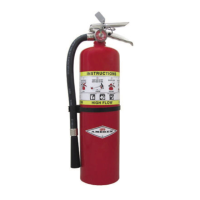
This document is the Owner's Service Manual for Amerex Halotron I Portable Extinguishers, specifically models A384T, B385TS, B386T, B394TS, 397, and 398. It provides installation, operating, and servicing instructions for these fire extinguishers.

Function Description:

The Amerex Halotron I "Clean Agent" extinguishers are designed to combat Class-A, -B, and -C hazards, which were previously addressed by Halon 1211 extinguishers. They utilize dichlorotrifluoroethane (R-123), also known as HCFC-123, as the extinguishing agent. This agent is designated for streaming fire extinguisher applications and is listed by the U.S. Environmental Protection Agency (EPA) under the "Significant New Alternative Policy" (SNAP) as acceptable for nonresidential applications. Halotron I has acceptable toxicity and cardiac sensitization levels for use in occupied spaces when used according to the instructions on the nameplate and rules of the EPA SNAP Program. The manual emphasizes that these are pressure vessels and mechanical devices requiring periodic maintenance to ensure proper and safe operation.

Important Technical Specifications:

  • Primary Component: Dichlorotrifluoroethane (R-123) or (HCFC-123)
  • Boiling Point: 80.6°F [27°C]
  • Liquid Density: 92.3 lb./ft³ (1.48 kg / liter)
  • Gas Density: 0.385 lb./ft³ (6.17 kg/m³)
  • Molecular Weight: 150.68
  • Physical State: Pressurized Liquid
  • Vapor Pressure @ 68°F [20°C] (liquid alone): 11.2 psi [77 kPa]
  • Pressure of mixture in Container @ 68°F [20°]: 95 psi in bulk container
  • Operational Temperature Range: -40°F to +120°F (-40°C to +60°C). Protection is required if temperatures fall outside this range.
  • Mounting Requirements: Hand-portable extinguishers with a gross weight less than 40 lbs. (18.14 kg) should be hung with the top not more than 5 feet (1.53 m) above the floor. Extinguishers greater than 40 lbs. (18.14 kg) should be installed with the top not more than 3½ feet (1.07 m) above the floor. The hanging device must withstand a vertical force of five times the weight of the charged extinguisher, but not less than 100 pounds.
  • Hydrostatic Testing: Cylinders must be hydrostatically (proof pressure) tested every 12 years to the test pressure indicated on the nameplate.
  • Maintenance Frequency: Extinguishers shall be emptied and subjected to complete maintenance every 6 years, as per NFPA 10.

Usage Features:

  • Accessibility: Extinguishers must be in an accessible location and near an exit. Avoid locations where potential hazards could prevent easy access.
  • Operation Procedure:
    1. Remove extinguisher from wall hanger bracket.
    2. Hold upright, twist, and pull ring pin.
    3. Start back a minimum of 8 feet from the fire.
    4. Aim the nozzle at the base of the fire nearest you.
    5. Keep upright, squeeze the lever to discharge.
    6. Sweep the agent stream from side to side.
    7. Evacuate and ventilate the area immediately after extinguishing the fire.
  • Safety Warnings:
    • Users must be aware of confined-space limitations and trained in proper fire fighting technique.
    • The concentrated agent can produce toxic by-products; avoid inhalation by evacuating confined spaces. Do not use in confined spaces smaller than the minimum stated on the extinguisher label.
    • Symptoms of over-exposure to pure Halotron I may include dizziness, drowsiness, anesthesia, or unconsciousness. Persons suffering from over-exposure should be immediately removed to fresh air, artificial respiration applied if necessary, and a physician contacted.
    • Never throw an extinguisher into a fire due to rapid heat buildup causing pressure expansion and exceeding cylinder limitations.
    • Halotron service must be performed in a well-ventilated room by a properly trained service technician wearing eye protection and rubber gloves.
    • Before recharging, ensure the extinguisher is completely depressurized into a proper collection area.
    • Use a regulated pressurizing source with ARGON ONLY, set to no more than 25 psi higher than the extinguisher gauge operating pressure.
    • Never leave an extinguisher connected to a high-pressure source regulator for an extended period, as a defective regulator could cause cylinder rupture.

Maintenance Features:

  • Inspection (NFPA 10): A "quick check" performed when initially placed in service and at regular intervals (monthly or more often if circumstances dictate) to ensure readiness. This includes checking location, access, visibility, legible operating instructions, intact tamper seal, fullness (by weighing or "hefting"), physical damage, corrosion, leakage, clogged nozzle, and pressure gauge reading in the operable range.
  • Maintenance (Annual or as indicated by inspection/electronic notification): A thorough examination to ensure effective and safe operation, including mechanical parts, extinguishing agent (for cartridge-operated, pump tanks, and certain stored-pressure types), and expelling means. Stored-pressure Halotron I extinguishers require a thorough external examination during annual maintenance, but not internal examination of the cylinder or agent.
  • Maintenance/Service Procedure:
    1. Clean extinguisher, check nameplate and UL manifest, inspect cylinder for damage (corrosion, abrasion, dents, weld damage). Hydrostatically test if integrity is doubted. Avoid solvents around the plastic gauge face.
    2. Inspect for damaged, missing, or substitute parts. Only factory replacement parts are approved.
    3. Weigh extinguisher and compare to nameplate weight; recharge if outside tolerances.
    4. Check manufacture date and last maintenance date. Hydrostatically test cylinder every 12 years. Perform complete maintenance every 6 years.
    5. Visually inspect pressure gauge: replace if bent/damaged/improper; check for leaks if low; depressurize and recharge if low/high pressure is not temperature-related.
    6. Remove and inspect nozzle/hose assembly for damage; blow air through to ensure clear passage. Replace components as needed.
    7. Check pull pin for freedom of movement; replace if bent or difficult to remove.
    8. Inspect discharge lever and carrying handle for dirt, corrosion, damage, or distortion; replace parts as needed.
    9. Inspect valve assembly for corrosion or damage to hose thread connection; replace parts as necessary.
    10. Install nozzle or hose assembly.
    11. Install new tamper seal and record service data on the inspection tag.
    12. Rehang extinguisher on the wall hanger bracket.
  • Recharge Procedure (for EMPTY Halotron I extinguishers):
    1. Complete maintenance steps 1-9.
    2. Verify no pressure remains.
    3. Remove valve assembly, disassemble downtube assembly, spring, and valve stem.
    4. REMOVE AND DISCARD COLLAR O-RING AND VALVE STEM ASSEMBLY. Inspect and clean spring, valve body surfaces, and threads. Install new (green) collar O-ring and valve stem assembly (green seal). Lubricate collar O-ring and small O-ring on valve stem with V-711 (do not lubricate valve stem seal). Inspect and install downtube.
    5. Inspect cylinder interior per CGA Visual Inspection Standard, C-6.
    6. Install valve assembly to cylinder, install recharge adapter, draw a vacuum of 27" mercury, place extinguisher on scale, and tare weight.
    7. Connect to Halotron I supply cylinder using Amerex PN 14538 Recharge Kit or equivalent.
    8. Depress operating lever and fill with specified amount of CLEAN, UNCONTAMINATED HALOTRON I AGENT. Avoid liquid Halotron I contact with cylinder; wipe dry immediately.
    9. Pressurize to operating pressure with ARGON only. Rock extinguisher to mix gas until pressure stabilizes.
    10. Check for leaks at gauge, valve outlet, and valve/cylinder connection using a halogen-type leak detector or leak detection fluid (DO NOT USE SOAPY WATER). Remove all leak detection fluid residue. For accurate halogen leak detection, set aside extinguisher for 24 hours after recharging.
    11. Place nozzle/hose on scale with extinguisher. Weigh and confirm total weight is within tolerances.
    12. Install nozzle/hose assembly.
    13. Install pull pin with ring facing front, new tamper seal, and record recharge date on a new recharge tag.
  • Troubleshooting Guide: Provides corrective actions for common issues like leaks at collar O-ring, through valve, around gauge threads, defective gauge, and leaks in cylinder. Special instructions are given for removing epoxy-coated pressure gauge threads.
  • Replacement Parts: Refer to the Amerex Portable and Wheeled Parts Book PN 27277, available at http://www.amerex-fire.com under Manuals of the Resource Selection.

Amerex A384T Specifications

General IconGeneral
BrandAmerex
ModelA384T
CategoryFirefighting Equipment
LanguageEnglish

Related product manuals