
 Need help?
Do you have a question about the Amewi DRF AFX-135 PRO Brushless and is the answer not in the manual?
Introduction to the import and wholesale company AMEWI Trade GmbH.
Product meets EU/RED guideline requirements, with full text available online.
Warnings about warranty, modifications, small parts, age suitability, and moisture.
Instructions on battery mixing, charging, usage, and storage for safety.
Guidelines for proper disposal of electronics and batteries according to regulations.
Standard message thanking the customer for purchasing the helicopter.
Product is not a toy, requires adult supervision, and warns about hot motors.
Prohibits disassembly, modification, improper or illegal use of the product.
Provides operating frequency and maximum radio frequency power.
Manufacturer not liable for misuse or accidents; operate safely and responsibly.
Avoid rain, snow, thunderstorms, poor visibility, and signal interference areas.
Do not operate when tired/unwell, avoid hot parts, learn operation, check screws, power off sequence.
Read manual, keep away from children, do not reverse battery connections, avoid public roads.
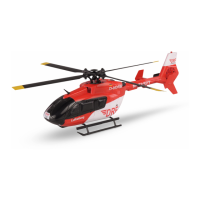
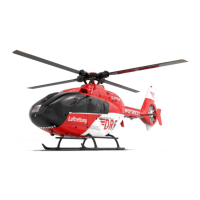
Details the DRF EC135 replica, its features, and suitability for beginners.
Lists all items included in the package with their corresponding numbers.
Lists dimensions, weight, rotor diameters, battery, flight time, and motors.
Recommends using the included charger and warns about voltage drops below 7.4V.
Step-by-step guide on how to charge the battery using a USB cable.
Connect USB, connect battery, monitor charging, disconnect when complete.
Never leave charging unattended; ensure adult supervision for children.
Explains LED indicators for battery level (100%, 75%, 50%, 25%, Low Battery).
Turn off battery after use; remove from cabin after flying to prevent over-discharge damage.
Identifies and labels various controls on the transmitter.
How to switch between modes and calibrate the transmitter.
Adjusting sensitivity for beginner or advanced flight.
Visual representation of control layouts for Mode 1 and Mode 2.
Steps to establish a connection between the transmitter and receiver if needed.
Detailed steps for activating bind mode and confirming successful binding.
Explains what different LED colors and blinking patterns indicate during flight.
Steps to calibrate the gyroscope using the transmitter joysticks.
Importance of a flat surface and when recalibration is needed.
Instructions on how to start the motor and initiate takeoff.
Two methods described for safely stopping the motor after landing.
Labels and identifies components on the main control board.
Explains the optical sensor's function and emphasizes user judgment and control.
Details scenarios where the optical sensor may not function correctly.
Deactivates optical mode, removes altitude restriction, increased speed.
How to initiate and abort the auto-landing sequence.
Instructions for 3D aerobatic inverted flight, control changes, and return to normal.
Steps to adjust servo and rotor blade angle for stable flight.
Emphasizes that pitch setting should be done by an experienced person.
Lists common problems and their corresponding solutions.
Lists spare parts for the rotor head, blades, and shaft.
Lists spare parts for motors, frame, and landing gear.
Lists spare electronic parts like receiver, ESC, sensor, and battery.
Lists spare parts for lights, fuselage, screws, transmitter, and charging cable.



 To Next Page
 General