8
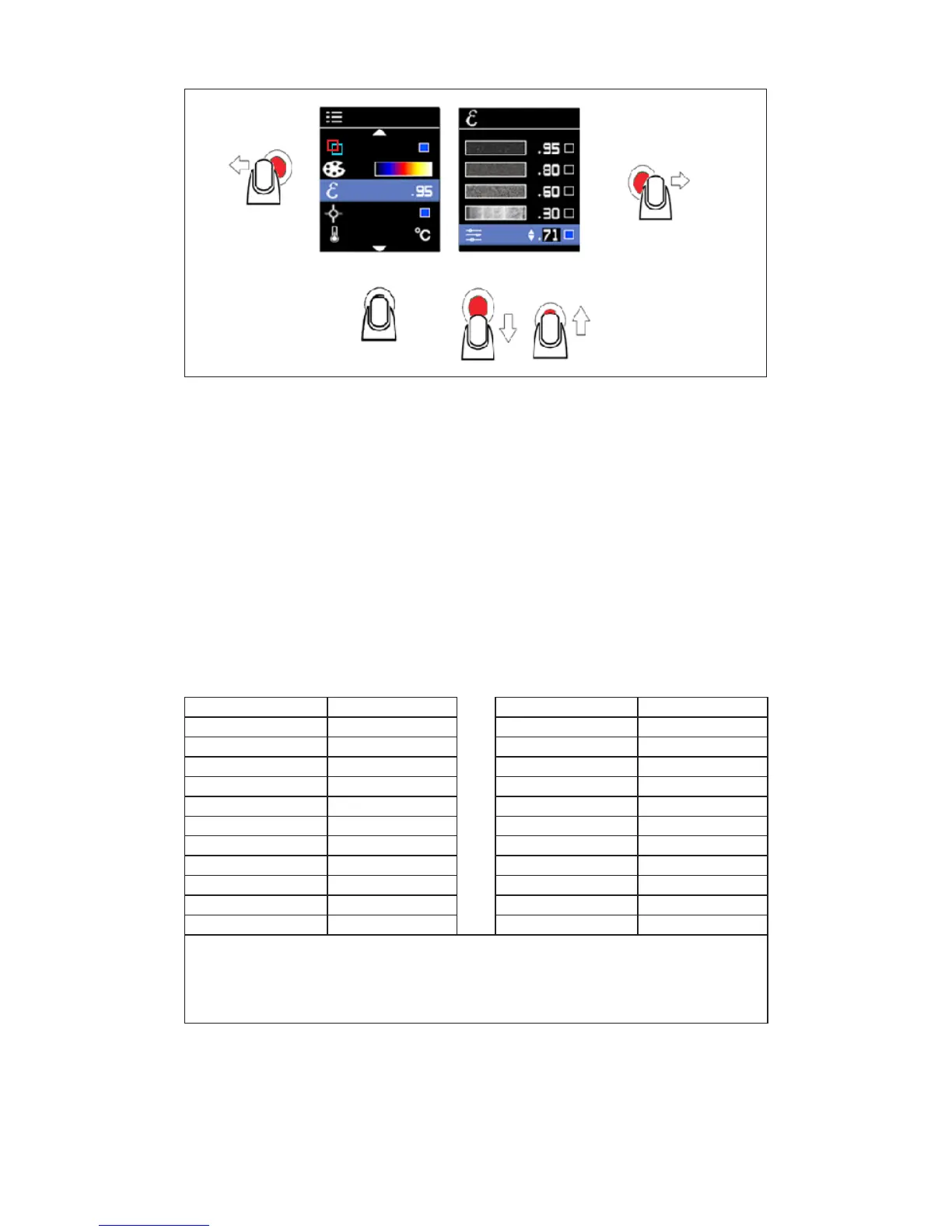
Emissivity
Figure 2.3
BACK TO
MEASUREMENT
MENU
DOWNENTER UP
The emissivity of the surface of a material describes its effectiveness in
emitting energy as thermal radiation. Quantitatively, emissivity is the ratio
of the thermal radiation from a surface to the radiation from an ideal black
surface at the same temperature as given by the Stefan–Boltzmann law. Refer
to Table 1 for the emissivity adjustment.
In measurement mode, emissivity level is shown on the bottom right of the
screen. Emissivity can be changed to values between 0.10-1.00 in menu.
Note: Surfaces with an emissivity <0.60 make reliable and consistent
determination of actual temperatures problematic. The lower the emissivity,
the more potential error is associated with the temperature measurement
calculations of the product, even when emissivity and reflected background
adjustments are attempted and performed properly.
Table 1. Nominal surface emissivity for an accurate non-contact infrared
temperature measurement.
Material Value Material Value
Default**** 0.95 Glass (plate) 0.85
Aluminum* 0.30 Iron* 0.70
Asbestos 0.95 Lead* 0.50
Asphalt 0.95 Oil 0.94
Brass* 0.50 Paint 0.93
Ceramic 0.95 Plastic** 0.95
Concrete 0.95 Rubber 0.95
Copper* 0.60 Sand 0.90
Food-frozen 0.90 Steel* 0.80
Food-hot 0.93 Water 0.93
Wood*** 0.94
*Oxidized
**Opaque, over 20 mils
***Natural
****Factory Setting


 To Next Page