Need help?
Do you have a question about the Anest Iwata SLE-2 and is the answer not in the manual?
Read all important information and safety precautions before use for knowledgeable operation.
Explains the meaning of WARNING and CAUTION symbols and their potential consequences.
Provides visual examples of common safety warnings like electric shock and grounding.
Lists essential safety warnings related to installation and operation.
Lists essential safety warnings related to operation and maintenance.
Lists essential safety cautions related to operating environment and parts.
Check the delivered product against the order and for any shipping damage, and verify included accessories.
Details crucial warnings and cautions regarding installation environment and conditions.
Specifies the required clearance around the compressor for safe operation and maintenance.
Recommends installing a fan for ventilation in enclosed rooms.
Instructions on how to install base covers using tapping screws.
Provides guidance on exhaust piping diameter, connection methods, and drain valve installation.
Safety precautions and steps for electrical wiring, including grounding and using qualified electricians.
Chart detailing required cable sizes and circuit breakers for different models and voltages.
Step-by-step guide for operating the compressor and checking pressure increase.
Lists common compressor problems, their causes, and recommended remedies.
Schedule for regular maintenance and inspection of the compressor based on hours or years.
Schedule for regular maintenance and inspection for specific models (SLE-2H, 3H, 5H).
Details specific maintenance tasks like intake filter cleaning, safety valve check, and belt tension adjustment.
Technical specifications for 2 HP models (SLE-2, SLE-2H).
Technical specifications for 3 HP models (SLE-3, SLE-3H).
Technical specifications for 5 HP models (SLE-5, SLE-5H).
Provides diagrams showing the external dimensions of the compressor units.
Electrical circuit diagrams for various models and voltage configurations.
Details the warranty terms, coverage, exclusions, and claim procedures.
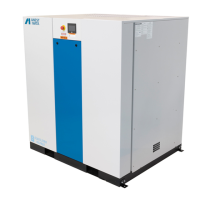
The ANEST IWATA OIL-FREE SCROLL COMPRESSOR, available in models SLE-2/2H, SLE-3/3H, and SLE-5/5H, is designed to provide oil-free compressed air for various applications. This instruction manual serves as a comprehensive guide for safe, efficient, and long-lasting operation of the compressor.
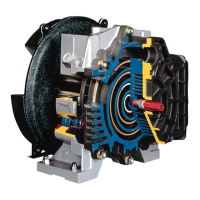
The ANEST IWATA OIL-FREE SCROLL COMPRESSOR is an air compressor that generates compressed air without the use of oil in the compression chamber. This design ensures that the output air is free from oil contamination, making it suitable for applications where air purity is critical. The compressor operates by using scroll technology, which involves two interleaved spiral-shaped scrolls—one fixed and one orbiting—to compress air. This method is known for its quiet operation, smooth performance, and energy efficiency.
The compressor is designed to deliver consistent air pressure, with specific maximum and minimum control pressures depending on the model (e.g., 116 psi for SLE-2, SLE-3, SLE-5 models, and 145 psi for SLE-2H, SLE-3H, SLE-5H models). It is equipped with a control system that manages the compression process, ensuring that the unit operates within specified pressure ranges. The system includes a pressure switch that monitors and regulates the discharge pressure.
For electrical safety and proper operation, the compressor requires a specific electrical source (e.g., 1Phase, 208-230V, 60HZ with VFD soft starter; 3Phase, 208-230V, 60Hz with VFD soft starter; 3Phase, 460V, 60Hz with Magnetic starter). It also features protection mechanisms, such as an overcurrent protector (thermal protector for magnetic starter, VFD Equipped for VFD soft starter), to prevent damage from electrical faults.
The compressor is designed for indoor installation in a safe, clean, and well-ventilated area, free from flammable gases, organic solvents, corrosive gases, excessive dirt, and dust. Proper grounding is essential to prevent electric shock. The unit is intended solely for compressing air and must not be used with respiratory equipment or for life support applications.
The compressor is designed for straightforward operation, with clear instructions provided for installation and test run procedures. Before initial use, users are advised to inspect the product for any shipping damage and verify that all accessories, including the instruction manuals, base covers, rubber mats, and ball valve, are present.
Installation involves securing the unit on a level floor to minimize vibration and noise. Adequate space around the compressor is required for safe inspection and maintenance. Proper ventilation is crucial, especially when operating in enclosed spaces, to dissipate heat and prevent overheating. The manual provides guidelines for British Thermal Unit (BTU) output for different models to assist in selecting appropriate ventilation.
Piping connections should be made with a rubber hose and flexible tube to prevent vibration transfer to the main piping, which could affect the compressor's print board. It is also recommended to install drain valves at low points in the piping system to remove condensate.
Electrical wiring must be performed by a qualified electrician, adhering to specified cable sizes and breaker requirements to prevent electric shock, fire, or serious injury. The main electric source must always be turned off before any inspection or wiring work. The unit must be securely grounded.
During the test operation, users are guided to check for proper air receiver piping connection and open the compressor air outlet ball valve. The compressor's start-up and pressure increase should be monitored. If reverse rotation or abnormal sounds are detected, the unit must be stopped immediately, the main electric source turned off, and two of the three phases changed to correct the rotation. The maximum and minimum control pressures are to be verified by operating the unit with the ball valve closed and then gradually reducing pressure.
The compressor is designed to operate within an ambient temperature range of 36°F to 104°F. Operating outside this range can lead to unit failure, freezing, or a shorter lifespan.
Regular maintenance and inspection are critical for ensuring the safe, efficient, and long operating lifetime of the ANEST IWATA OIL-FREE SCROLL COMPRESSOR. The manual provides a detailed maintenance schedule based on operational hours or years, whichever comes first. These intervals are based on an ambient temperature of 86°F, with recommendations to shorten maintenance periods in warmer or more severe operating conditions.
Key maintenance tasks include:
The manual emphasizes the use of genuine parts for maintenance to prevent equipment failure and ensure optimal performance. Air intake filters are not covered under warranty, and users are advised to keep extra filters on hand. For items marked with an asterisk (*) or those requiring specialized knowledge, users are instructed to contact the shop where the compressor was purchased or a qualified electrician.
The document also includes a troubleshooting guide to help users identify and remedy common problems, such as the compressor not starting, caution/condition displays, lack of exhaust pressure increase, safety valve activation, and abnormal sounds. This guide provides potential causes and corresponding remedies, with a clear distinction between tasks users can perform and those requiring professional assistance.
 General
| Tank Capacity | 2 gallons |
|---|---|
| Weight | 44 lbs |
| Power Source | Electric |
| Maximum Pressure | 8 bar |
| Max Pressure | 0.8MPa (8 Bar) |
| Air Flow Rate | 210 l/min |
| Free Air Delivery | 210 l/min |
| Voltage | 230V |


 To Next Page