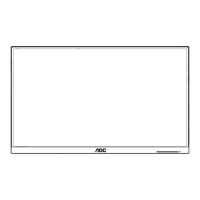
Need help?
Do you have a question about the AOC U32P2CA and is the answer not in the manual?
Describes notational conventions like notes, cautions, and warnings used in the document.
Details safe power source usage, grounded plugs, and precautions against power surges.
Provides guidelines for safe monitor placement, ventilation, and tilt angle to prevent damage.
Explains how to clean the monitor safely, using soft detergent and disconnecting power.
Covers safety precautions related to unusual smells, vibration, power cords, and headphone usage.
Lists all items included in the product package, including monitor, cables, and documentation.
Step-by-step instructions for setting up or removing the monitor's stand and base.
Guides on how to adjust the monitor's viewing angle for optimal comfort, with safety notes.
Details the cable connections on the monitor and steps to connect it to a PC.
Provides instructions for attaching the monitor to an optional wall mounting arm, including VESA compatibility.
Explains the functions of the monitor's physical buttons (hotkeys) for navigation and control.
Describes the Clear Vision function for improving image quality and how to activate its demo mode.
Basic instructions for navigating the OSD menu, adjusting settings, and locking the OSD.
Explains luminance settings like contrast, brightness, gamma, DCR, and HDR mode.
Details color setup options including color temperature, DCB mode, and low blue light adjustment.
Explains Picture Boost features like bright frame, frame size, brightness, contrast, and position.
Details specific OSD settings such as language, timeout, DP capability, position, transparency, and USB selection.
Explains Picture-in-Picture (PIP) and Picture-by-Picture (PBP) settings, including source, size, position, and audio.
Covers game-specific settings like game mode (FPS, RTS, Racing), shadow control, overdrive, and adaptive sync.
Details miscellaneous settings including input select, off timer, DDC/CI support, and menu reset function.
Explains how to exit the main OSD menu after making adjustments.
Lists general specifications of the monitor, including model, panel, physical characteristics, and environmental data.
Lists standard and IBM/MAC modes with their respective resolutions and frequencies.
Explains the monitor's VESA DDC2B capabilities for identity and display capability communication.
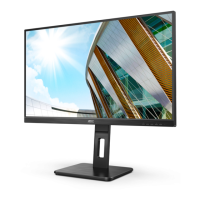
This document serves as the user manual for an AOC LCD Monitor, model U32P2CA, providing comprehensive instructions for its setup, adjustment, and maintenance, along with safety guidelines and troubleshooting information.
The primary function of this device is to serve as a visual display unit for computers and other compatible devices. It is designed to provide clear and vivid images for various applications, from general computing to gaming and multimedia consumption.
The monitor offers a range of features designed to enhance user experience and adaptability. For initial setup, the manual details how to assemble the stand and base, which involves securing the base to the stand using a screw, and then attaching the assembled stand to the monitor. The process is illustrated with clear diagrams showing the steps for both setup and removal of the base.
Once assembled, the monitor's viewing angle can be adjusted to optimize comfort and visibility. The manual specifies a tilt range of -5° to 22° and a height adjustment of 150mm. Users are advised to hold the stand firmly when adjusting the angle to prevent the monitor from toppling. A crucial warning is provided against touching the LCD screen during angle adjustments to avoid damage, such as panel peeling, and to grasp only the bezel.
Connectivity is a key aspect of the U32P2CA. The back of the monitor features multiple ports, including Power, HDMI, DP (DisplayPort), USB-C, USB-PC (USB upstream), USB 3.2 Gen1, USB 3.2 Gen1+charging, and an Earphone jack. The manual provides a step-by-step guide for connecting the monitor to a PC, emphasizing the importance of securing the power cord, unplugging the computer's power cable before connecting signal cables, and ensuring all connections are firm. It also highlights the need to turn off both the PC and the LCD monitor before making any connections to protect the equipment.
For alternative mounting options, the monitor supports wall mounting. The manual outlines the procedure for installing an optional wall mounting arm, which includes removing the base, following the arm manufacturer's instructions, aligning the arm with the monitor's holes, inserting and tightening screws, and reconnecting cables. A note clarifies that VESA mounting screw holes may not be available for all models, and users should check with their dealer. Similar to stand adjustments, warnings are given regarding screen damage during wall mounting, particularly concerning downward tilt angles beyond -5°.
The monitor's functionality is controlled through a series of hotkeys located on the bottom bezel. These include buttons for Source/Exit, Clear Vision/<, Volume/>, Menu/Enter, and Power. The Power button turns the monitor on or off. The Menu/Select button activates the On-Screen Display (OSD) menu and confirms function adjustments. The Volume buttons adjust headphone output volume when the OSD is closed. The Source switching/exit button allows users to cycle through input sources and acts as an exit key when the OSD is active.
The OSD menu provides extensive customization options, categorized into Luminance, Color Setup, Picture Boost, OSD Setup, PIP Setting, Game Setting, and Extra.
The manual also describes the LED Indicator's behavior: White for Full Power Mode and Orange for Active-off Mode.
Maintaining the AOC U32P2CA involves simple cleaning procedures and adherence to safety guidelines. The manual advises regular cleaning of the cabinet with a soft cloth and a mild detergent, cautioning against strong detergents that could damage the product. When cleaning, users must ensure no detergent leaks into the product and that the cleaning cloth is not too rough to avoid scratching the screen surface. Crucially, the power cord must be disconnected before cleaning the product.
Safety is paramount, and the manual details several "Other" maintenance-related points. If the product emits a strange smell, sound, or smoke, the power plug must be disconnected immediately, and a Service Center contacted. Ventilating openings should never be blocked by tables or curtains to prevent overheating. The monitor should not be subjected to severe vibration or high impact conditions during operation or transportation. Power cords must be safety approved, with specific requirements for Germany (H03VV-F, 3G, 0.75 mm2, or better) and suitable types for other countries. A warning about excessive sound pressure from earphones and headphones causing hearing loss is also included, advising against maximizing equalizer adjustments.
Troubleshooting information is provided to help users resolve common issues. For instance, if the Power LED is not ON, users are advised to check the power button and cord connection. If no images appear on the screen, checks include power cord connection, signal cable connection (VGA, HDMI, DP), and rebooting the computer. The manual also addresses issues like fuzzy pictures, flickering, missing colors, incorrect screen centering/sizing, color defects, and horizontal/vertical disturbances, offering solutions such as adjusting controls, checking cable integrity, and installing AOC Monitor Drivers. For more complex issues or regulation and service information, users are directed to the CD manual or the AOC website.
The monitor is equipped with VESA DDC2B capabilities, allowing it to communicate its identity and display capabilities to the host system. This Plug & Play feature simplifies setup and ensures compatibility with various computer systems.
 General
| Panel type | VA |
|---|---|
| Color depth | 8 bit |
| Pixel pitch | 0.18159 x 0.18159 mm |
| Aspect ratio | 4:3, 16:9 |
| Screen shape | Flat |
| Backlight type | W-LED |
| Display surface | Matt |
| Display diagonal | 31.5 \ |
| Surface hardness | 3H |
| Anti-glare screen | Yes |
| Adobe RGB coverage | 88 % |
| Display technology | LED |
| Native aspect ratio | 16:9 |
| Vertical scan range | 40 - 60 Hz |
| Maximum refresh rate | 60 Hz |
| Horizontal scan range | 30 - 140 kHz |
| Supported video modes | 1080p, 1440p, 2160p |
| Viewable size, vertical | 392.234 mm |
| sRGB coverage (typical) | 119 % |
| Contrast ratio (dynamic) | 50000000:1 |
| Contrast ratio (typical) | 3000:1 |
| Display number of colors | 16.7 million colors |
| Display diagonal (metric) | 80 cm |
| Viewable size, horizontal | 697.306 mm |
| Display brightness (typical) | 350 cd/m² |
| Supported graphics resolutions | 1920 x 1080 (HD 1080), 2560 x 1440, 3840 x 2160 |
| USB hub version | 3.2 Gen 1 (3.1 Gen 1) |
| DisplayPort version | 1.2 |
| Headphone connectivity | 3.5 mm |
| USB Power Delivery up to | 65 W |
| VGA (D-Sub) ports quantity | 0 |
| USB Type-A downstream ports quantity | 4 |
| Tilt angle range | -5 - 21.5 ° |
| Height adjustment | 150 mm |
| Cable lock slot type | Kensington |
| Number of OSD languages | 16 |
| Panel mounting interface | 100 x 100 mm |
| On Screen Display (OSD) languages | CHI (SIMPL), CHI (TR), CZE, DEU, DUT, ENG, ESP, FIN, FRE, ITA, JPN, KOR, POL, POR, RUS, SER |
| Certification | ISO |
| Product color | Black |
| Heavy metals free | Hg (mercury) |
| Market positioning | Business |
| AC input voltage | 100 - 240 V |
| AC input frequency | 50 - 60 Hz |
| Energy efficiency scale | A to G |
| Power consumption (max) | 110 W |
| Power consumption (off) | 0.3 W |
| Power consumption (standby) | 0.5 W |
| Power consumption (typical) | 57 W |
| RMS rated power | 3 W |
| Compatibility | VESA-P2 |
| Operating altitude | 0 - 5000 m |
| Non-operating altitude | 0 - 12192 m |
| Storage temperature (T-T) | -25 - 55 °C |
| Operating temperature (T-T) | 0 - 40 °C |
| Storage relative humidity (H-H) | 5 - 93 % |
| Operating relative humidity (H-H) | 10 - 85 % |
| Cables included | AC, DisplayPort |
| DisplayPort cable length | 1.8 m |
| Package type | Box |
| Package depth | 224 mm |
| Package width | 810 mm |
| Package height | 538 mm |
| Package weight | 12800 g |
| Exterior finish type | Textured |
| Harmonized System (HS) code | 85285210 |
| Sustainability certificates | WEEE |
 Weight and Dimensions
| Depth (with stand) | 275.1 mm |
|---|---|
| Height (with stand) | - mm |
| Weight (with stand) | 10100 g |
| Depth (without stand) | 55.7 mm |
| Width (without stand) | 714.8 mm |
| Height (without stand) | 425.2 mm |
| Weight (without stand) | 9800 g |

 To Next Page