EasyManua.ls Logo

Apple IIe - Page 58

Apple IIe
320 pages
Print Icon
To Next Page IconTo Next Page
To Previous Page IconTo Previous Page
Loading...
58
Apple
lie
Users
Handbook
A
relational
operation
evaluates
to
either
true
or
false. For
example,
if
the
constant
1.0
was
compared
to
the
constant 2.0
to
see
whether
they
were
equal
,
the
expression
would
evaluate'
to
false.
In
Applesoft
BASIC, a
non-zero
value
represents a
condi-
tion
of
true
,
while
a
value
of
0
represents false.
The
only
values
returned
by
a
comparison
in
BASIC
ar~
1
(true)
or
0 (false).
These
values
can
be
used
as
any
other
integer
would
be
used. The
following
results
are generated
by
the
following
relational
expressions.
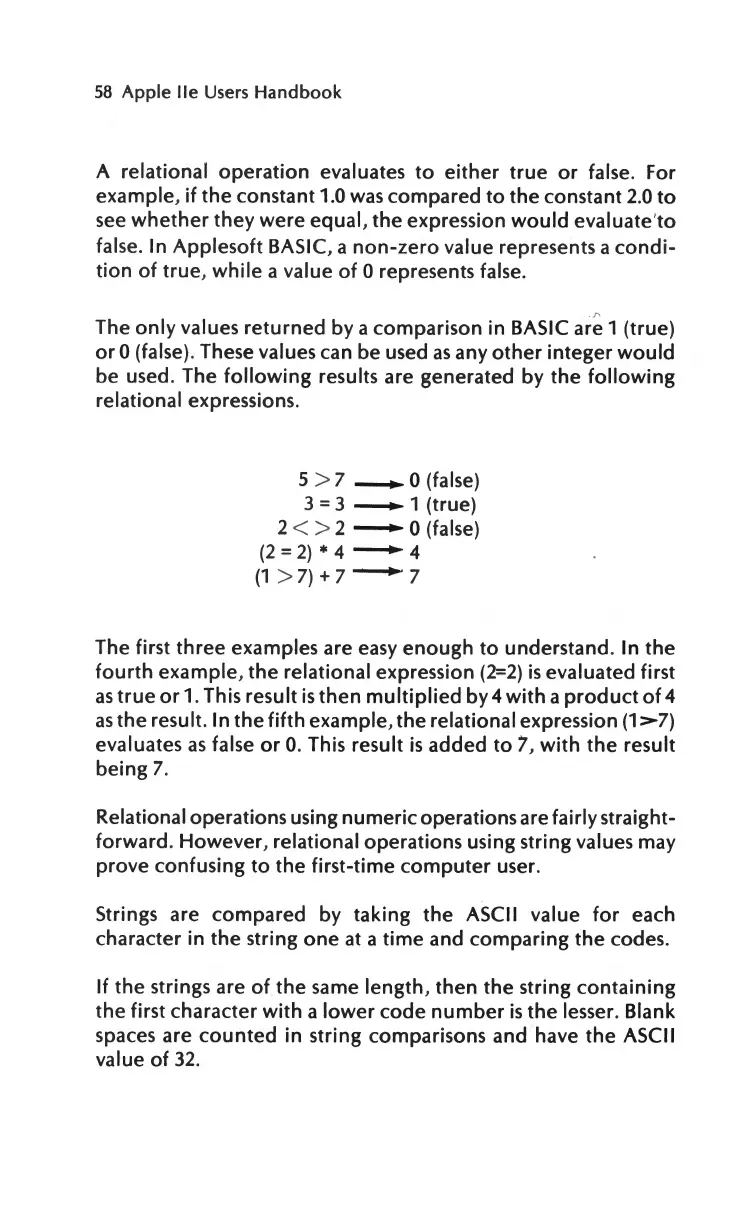
5
> 7
-o
(false)
3
=
3 - 1 (true)
2
< >
2 - 0 (false)
(2
=
2)
* 4
-4
(1
>
7)+7-7
The first
three
examples
are easy
enough
to
understand.
In
the
fourth
example,
the
relational
expression (2=2)
is
evaluated
first
as
true
or
1. Th
is
resu
It
is
then
multiplied
by
4
with
a
product
of
4
as
the
result.
In
the
fifth
example
,
the
relational
expression
(1
>7)
evaluates
as
false
or
0. This result
is
added
to
7,
with
the
result
being
7.
Relational
operations using
numeric
operations are fairly
straight-
forward
.
However
,
relational
operations
using string
values
may
prove
confusing
to
the
first-
time
computer
user.
Strings are
compared
by
taking
the
ASCII value
for
each
character
in
the
string
one
at a
time
and
comparing
the
codes.
If
the
strings are
of
the
same
length
,
then
the
string
containing
the
first character
with
a
lower
code
number
is
the
lesser. Blank
spaces are
counted
in
string
comparisons and have
the
ASCII
value
of
32
.

Other manuals for Apple IIe

Related product manuals