Material Eciency
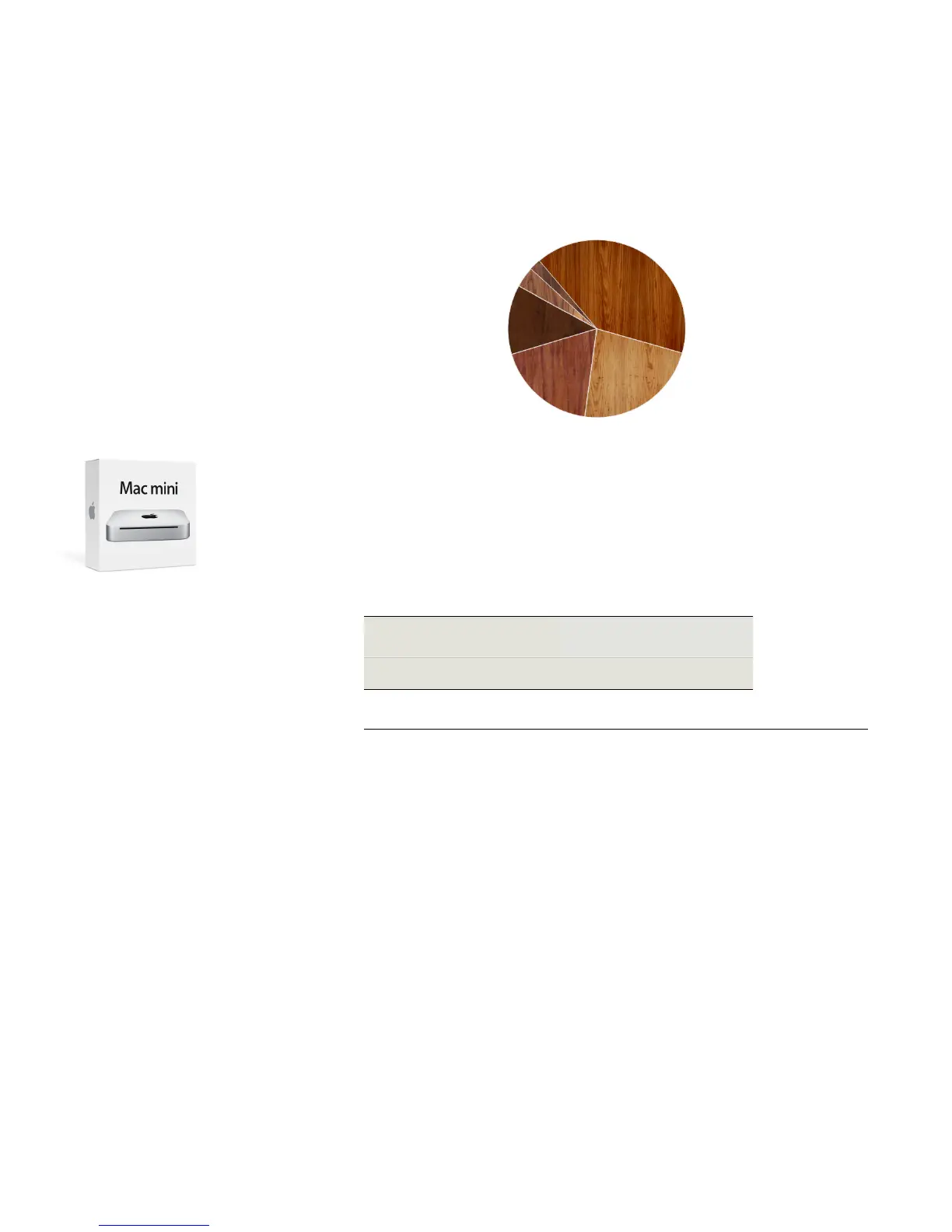
Apple’s ultracompact product and packaging designs lead the industry in material
eciency. The Mac mini uses 68 percent less plastic than the previous generation as well
as a compact and highly recyclable aluminum enclosure, making it one of the most
material-ecient desktop computers available. The chart below details the materials
used in Mac mini.
2
Material Use for Mac mini
Packaging
The corrugate and paperboard packaging for Mac mini is made from at least 50 percent
recycled content, derived primarily from post-consumer sources. The following table
details the materials used in its packaging.
Packaging Breakdown for Mac mini (U.S. Configurations)
Material Retail box
Retail and
shipping box
Paper (corrugate, paperboard,
molded fiber)
214g 655g
Other plastics
9g 9g
Restricted Substances
Apple has long taken a leadership role in restricting harmful substances from its
products and packaging. As part of this strategy, all Apple products comply with the
strict European Directive on the Restriction of the Use of Certain Hazardous Substances
in Electrical and Electronic Equipment, also known as the RoHS Directive. Examples of
materials restricted by RoHS include lead, mercury, cadmium, hexavalent chromium, and
the brominated flame retardants (BFRs) PBB and PBDE. Mac mini goes even further than
the requirements of the RoHS Directive by incorporating the following more aggressive
restrictions:
•
Brominated flame retardant (BFR)-free
•
Polyvinyl chloride (PVC)-free internal cables
2
Aluminum, 595g
Plastics, 185g
Other, 56g
Hard drive and
optical drive, 266g
Circuit boards, 333g
Mac mini exceeds the ENERGY STAR
Program Requirements for Computers
Version 5.0 with an 80 percent margin.
The Mac mini retail packaging uses
35 percent less volume than the previous
generation Mac mini and includes no
expanded polystyrene (EPS).
Copper, 30g



 To Next Page