Need help?
Do you have a question about the AQUAMAXX cTech Nano Calcium Reactor and is the answer not in the manual?
Attaching the bubble counter/prefilter assembly to the reactor lid using the thumbscrew.
Push-connecting the flow control valve to the reactor's water inlet.
Push-connecting the bubble counter to the reactor's CO2 inlet.
Securing the recirculation pump to the reactor with zip ties.
Loosening the reactor lid by finger-twisting thumbscrews counter-clockwise.
Filling the reactor with media, leaving space, and rinsing it beforehand.
Filling with water, ensuring the o-ring is in place, and tightening the lid.
Connecting CO2 tubing to the bottom of the CO2 bubble counter.
Connecting a CO2 check valve to the other end of the CO2 tubing.
Using a feed pump for freshwater and connecting the check valve to the CO2 regulator.
Cutting tubing for water inlet and outlet lines.
Connecting outlet tubing to the reactor outlet and inlet tubing to the prefilter inlet.
Routing tubing to sump/feed pump and securing it, ensuring proper positioning.
Opening the flow control, turning on pumps, and running for 20-30 min to check for leaks.
Adjusting the flow control valve for a drip rate of approximately 2 drips per second.
Slowly opening the CO2 tank valve and adjusting the needle valve for 1 bubble every 3-4 seconds.
Fine-tuning CO2 flow and drip rate, making small adjustments, and monitoring internal pH.
Checking for blockages, replacing media annually, and proper tubing disconnection.
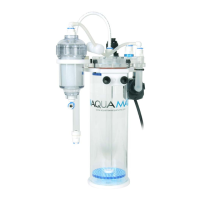
The AquaMaxx cTech Nano Calcium Reactor is a specialized device designed to maintain stable calcium and alkalinity levels in saltwater aquariums, particularly those up to 75 gallons. It achieves this by dissolving calcium media using carbon dioxide (CO2) to create a calcium-rich effluent that is then returned to the aquarium. This process is crucial for the health and growth of corals and other calcifying organisms in a reef tank environment.
The core function of the cTech Nano Calcium Reactor revolves around a controlled chemical reaction. Aquarium water is fed into the reactor chamber, which is filled with calcium media. Simultaneously, CO2 is injected into the chamber. The CO2 lowers the pH of the water within the reactor, making it acidic enough to dissolve the calcium media. This dissolution releases calcium and alkalinity into the water, creating a highly concentrated solution. A recirculation pump within the reactor ensures that the water and CO2 are thoroughly mixed with the media, maximizing the efficiency of the dissolution process. The calcium-rich effluent then slowly exits the reactor and is returned to the aquarium, replenishing essential elements that are consumed by corals and other invertebrates. The precise control over CO2 injection and effluent drip rate allows aquarists to fine-tune the output to match their aquarium's specific demands, preventing both deficiencies and excesses of calcium and alkalinity.
Setting up and operating the AquaMaxx cTech Nano Calcium Reactor involves several key steps designed for user control and efficiency.
Assembly: The initial assembly is straightforward. The bubble counter/prefilter assembly is attached to the reactor lid using a thumbscrew. The flow control valve is push-connected to the reactor's water inlet, and the bubble counter is push-connected to the CO2 inlet. Finally, the recirculation pump is attached to the reactor, with an option to secure it with zip ties for added stability.
Adding Calcium Media: Before operation, the reactor chamber needs to be filled with calcium media. This begins by loosening and removing the reactor lid by finger-twisting five thumbscrews counter-clockwise. It's important to temporarily block the top of the central tube while filling to prevent media from entering it. The reactor should not be overfilled; at least 1 inch of space should be left between the media and the top of the reactor. The manual strongly recommends rinsing the media thoroughly before use, regardless of manufacturer claims, to remove any dust or fine particles that could foul the system. After filling with media, the reactor is filled with aquarium water, ensuring the o-ring is properly seated before replacing the lid. The lid is then secured by tightening the thumbscrews in a star pattern to ensure even pressure, but care must be taken not to overtighten.
CO2 Inlet Installation: The CO2 system requires careful setup. A short length of CO2 tubing is cut and connected to the bottom of the CO2 bubble counter. A CO2 check valve (sold separately) is then connected to the other end of this tubing. To prepare the bubble counter, a feeding pump (such as an AquaLifter pump) is used to feed freshwater into its bottom until it is about 3/4 full. The check valve prevents this water from leaking out. Finally, the CO2 check valve is connected to a CO2 regulator (sold separately). Crucially, the CO2 tank valves should remain closed at this stage.
Water Inlet Installation: The water inlet and outlet lines are prepared by cutting two suitable lengths of the included white tubing. The outlet tubing is connected to the reactor water outlet, and the inlet tubing is connected to the water prefilter inlet. The outlet tubing is then routed to the sump and secured using the included tank mount. The inlet tubing is connected to a feed pump (sold separately). The water inlet should be positioned several inches below the sump water line in a calm area to prevent air or micro-bubbles from being drawn into the reactor, which could impair its function.
Running the Reactor: With all connections made, the reactor can be started. First, the flow control valve is opened. Then, both the feed pump and the reactor pump are turned on. The system is allowed to run for 20-30 minutes, or until the water inside the chamber runs clear, providing an opportunity to check for any leaks. After several minutes, the user should verify that water is exiting the flow control valve and flowing back into the sump. Once a steady flow is established, the flow control valve is adjusted to achieve an effluent drip rate of approximately 2 drips per second. For CO2, the needle valve on the CO2 regulator is opened slightly, followed by slowly opening the main valve on the CO2 tank. The needle valve is then adjusted while observing the bubble counter to achieve an initial CO2 injection rate of 1 bubble every 3-4 seconds.
Fine-Tuning and Monitoring: Over the first one to two weeks, the CO2 flow and drip rate will need to be fine-tuned to match the aquarium's specific calcium and alkalinity demands. Since every tank is unique, regular testing of water chemistry is essential to determine the optimal settings. Changes to CO2 bubble rate or drip rate should be made in small increments, with several hours (or overnight) allowed for the changes to take effect before further adjustments. The cTech Nano Calcium Reactor operates most efficiently when the internal pH is maintained between 6.5 and 6.8, with a recommended range of 6.4 to 6.9.
The AquaMaxx cTech Nano Calcium Reactor is designed with consideration for ongoing maintenance to ensure its longevity and efficient operation.
Regular Checks: Due to the very slow flow rate, the water inlets and outlets can easily become blocked. Regular checks of both water and air inlets and outlets are recommended during routine maintenance to prevent blockages. If a pH controller is not being used, the effluent pH from the water outlet should be checked regularly to monitor the reactor's performance and ensure it is within the desired range.
Media Replacement: The calcium media within the reactor will gradually dissolve and be consumed. It is recommended to replace the media annually, or as needed, depending on the aquarium's consumption rate and the reactor's efficiency.
Tubing Disconnection: For maintenance or troubleshooting, if a piece of tubing needs to be disconnected from the reactor, a specific procedure must be followed to prevent damage to the fittings. First, the blue clip on the fitting should be removed. Then, the small white collar on the fitting should be pressed down before pulling out the tubing. Attempting to pull out the tubing directly without following these steps will damage the fittings.
By adhering to these usage and maintenance guidelines, aquarists can effectively utilize the AquaMaxx cTech Nano Calcium Reactor to maintain stable and healthy conditions for their reef inhabitants.
 General
| Type | Calcium Reactor |
|---|---|
| Model | cTech Nano |
| Manufacturer | AQUAMAXX |
| Category | Water Filtration Systems |
| Material | Acrylic |
| Reactor Size | Nano |
| CO2 Input | Standard CO2 tubing |
| Pump | Sicce Syncra Nano |
| Inlet/Outlet Size | 1/2 inch |

 To Next Page