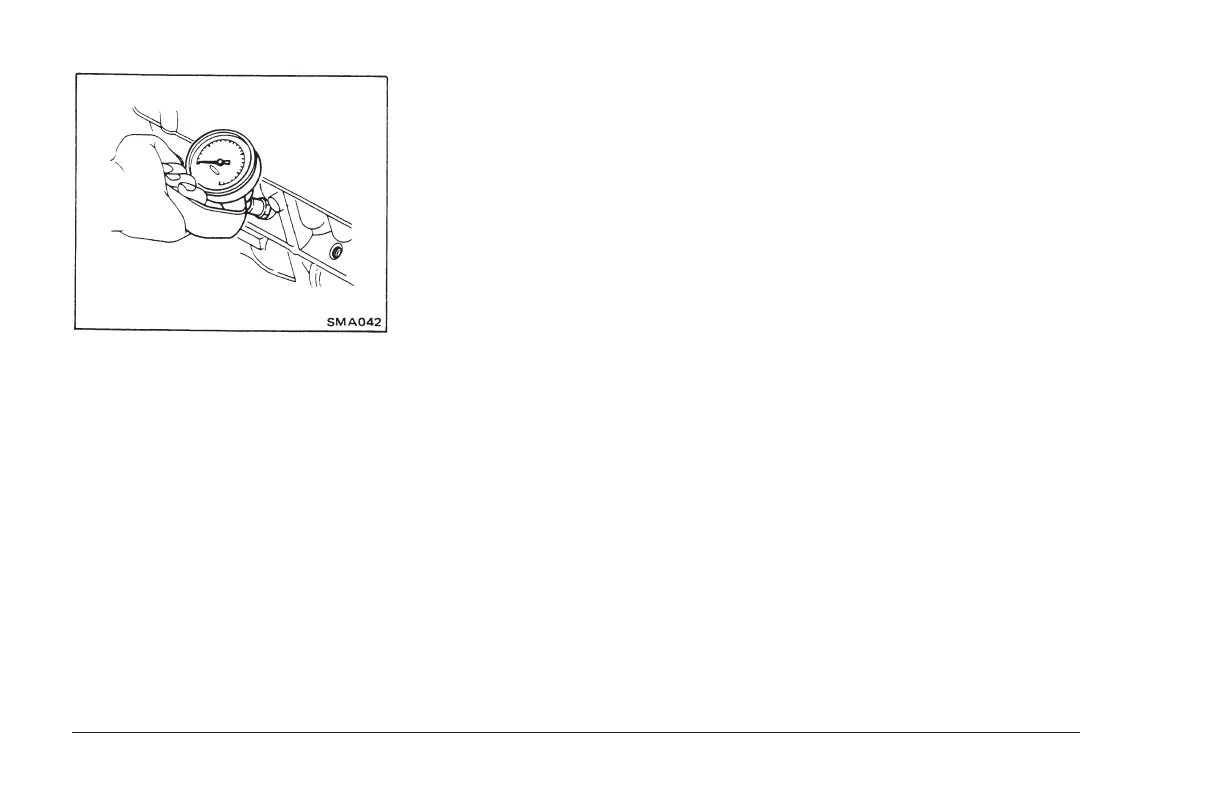
Checking engine compression
pressure
1. Warm up engine sufficiently, then stop
engine.
2. Remove all spark plugs.
3. Properly attach a compression tester to
spark plug hole in cylinder being tested.
4. Set carburetor throttle valve at fully-open
position.
5. Crank engine and read gauge indiction.
Engine compression measurement should
be made as quickly as possible.
Compression pressure:
Standard
1,275 kPa (12.75 bar,
13.0 kg/cm
2
,
185 psi)/300 rpm
Minimum
1,079 kPa (10.79 bar,
110.0 kg/cm
2
,
158 psi)/300 rpm
6. Cylinder compression in cylinders should
not be less than 80% of the highest read-
ing.
If cylinder compression in one or more cylin-
ders is low, pour a small quantity of engine oil
into cylinders through the spark plug holes
and retest compression.
If adding oil helps the compression pres-
sure, chances are that piston rings are worn
or damaged
If pressure stays low, valve may be sticking
or sealing improperly
If cylinder compression in any two adjacent
cylinders is low, and if adding oil does not
help the compression, there is leakage past
the gasketed surface.
Oil and water in combustion chambers can
result from this problem.
Checking fuel lines (Hoses,
piping, connections, etc.)
Check fuel lines for proper attachment, leaks,
cracks, damage, loose connections, chaffing
and deterioration. If necessary, replace any
damaged or defective parts.
18



 To Next Page