Need help?
Do you have a question about the ARCTIC WIND R-AP8018 and is the answer not in the manual?
Key safety and operational warnings before using the portable air conditioner.
Diagrams illustrating the front and back parts of the portable air conditioner.
Details on the digital display, buttons, and indicators of the control panel.
Important warnings regarding safe electrical connections and power usage.
Explanation of buttons like Mode, Timer, Fan Speed, Temp, and On/Off on the remote.
Step-by-step guide to setting the current time on the remote controller.
Instructions on signal transmission, points of attention, and battery replacement for the remote.
Steps to follow when the internal water tank is full and needs draining.
Using a hose for continuous water drainage in high humidity environments.
Guidelines for cleaning the air filter and the unit's exterior surfaces.
Checks and preparations required before starting operation seasons.
Procedures for maintenance after the operational season ends.
Important warnings about usage, power sources, and general safety.
Table listing common problems, checks, and corrective actions for the air conditioner.
Guidance on selecting an installation location and connecting the air exhaust hose.
Detailed steps for installing and removing the air exhaust hose and adapter.
Instructions for installing the window kit for vertical and horizontal windows.
Best practices for air exhaust hose mounting and interchangeable air outlet functions.
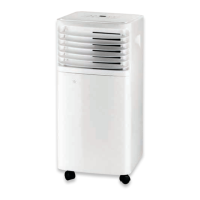
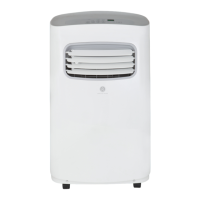
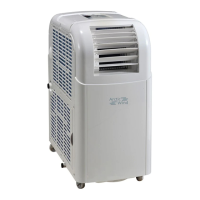
This document describes a portable air conditioner, specifically refurbished models R-AP8018, R-AP10018, and R-AP12018, under the brand Arctic Wind. This appliance is designed to adjust temperature and humidity in a room, offering flexibility for use in various settings like family homes or offices. Its compact design distinguishes it from other units with similar cooling capacities.
The portable air conditioner serves multiple functions including cooling, dehumidifying, and fanning ventilation. It is recommended for use when the ambient temperature is between 18°C (65°F) and 35°C (95°F). The unit operates by evaporating condensed water and discharging moisture through its hot air outlet. In situations where the internal water tank becomes full, a "FULL" lamp will illuminate, and the unit will cease operation until the water is drained.
The control panel features a digital display that shows room temperature in FAN mode, setting temperature in COOL or DRY mode, and timer settings during timer operation. If the room temperature sensor fails, it defaults to displaying 25°C (77°F). Users can adjust the setting temperature from 17°C (63°F) to 31°C (88°F) using the TEMP button. The unit also includes a TIMER button to set timed switch-on or switch-off operations, ranging from 1 to 12 hours. The FAN SPEED button allows users to select air rates (HIGH, MED, LOW). The MODE button cycles through operation modes: COOL, DRY, FAN, and HEAT (for cooling and heating models). A POWER button turns the unit on and off, with an indicator light showing its status.
For remote control operation, the device includes a remote controller (though not all models are supplied with one). The remote features buttons for MODE, TIMER, FAN SPEED, ON/OFF, HOUR, MIN, and a HOLD button to lock/unlock the keyboard. It also has indicators for set temperature, cooling, drying, heating, faning, timed time/present time, fan speed, lock key, and air flow. The remote transmits signals to the air conditioner, which acknowledges receipt with a "dee-" sound.
Before initial use, it is crucial to read the instruction manual carefully to ensure optimal performance. Professional technicians are recommended for installation to ensure proper setup and to safeguard user rights and interests. The appliance should be installed in accordance with national wiring regulations and must be accessible after installation. It is not suitable for installation in laundries. If the supply cord is damaged, it must be replaced by the manufacturer or a qualified service agent to prevent hazards. After a power interruption, a three-minute wait is advised before restarting the unit. The appliance requires a minimum clearance of 1m from combustible surfaces.
When handling the unit, especially if it has been moved, it's important to do so gently and cautiously to prevent any water saved in the bottom base from splashing out.
For water drainage, if the internal water tank becomes full, the unit will stop running. To drain, unplug the air conditioner, disconnect the exhaust hose, and move the unit to a suitable drain location. Remove the base stopper from the base water outlet to drain the water, then reinstall the stopper securely. The unit can then be reconnected and operated normally. Approximately 1.5L of water is typically present when the "FULL" indicator illuminates.
Continuous drainage is an option for high-humidity environments, which can reduce the frequency of manual water pouring. This involves pulling out the partition plate stopper and connecting a hose (not provided) to the partition plate joint, leading it to a floor drain or suitable area. However, continuous drainage may reduce the machine's efficiency. When using this method, the hose must be placed horizontally below the drainage hole and kept free from folds or uneven surfaces.
The portable air conditioner should be placed on a flat surface, ensuring that air outlets are not covered. A minimum clearance of 50cm from walls or other obstacles is required. The air exhaust hose, which ranges from 20cm to 160cm in length, should be kept as short as possible to maximize energy efficiency. Bends in the hose, especially near the exhaust air outlet, should be avoided, with at least 50cm clearance from the outlet to any bending point. The hose should maintain smoothness throughout its length, avoiding abrupt steep-angled bends. The air outlet and exhaust air outlet can be interchanged to direct cooling air to an outdoor or desired location.
Regular maintenance is essential for the longevity and efficient operation of the air conditioner. Before any cleaning or maintenance, always unplug the unit from the socket to prevent electric shock.
Cleaning of Air Filter: The air filter should be cleaned every two weeks, or more frequently if it becomes blocked with dust, as this can reduce airflow. To clean:
Cleaning of Air Conditioner: The surface of the unit should be cleaned with a damp cloth and then dried with a duster or similar. Avoid using chemical solvents like benzene, alcohol glazer, as these can scratch, damage, or deform the casing.
Prior to Operation Seasons: Before operating the machine for a new season, perform the following checks:
After Operational Seasons: At the end of an operational season, follow these steps:
Safety Cautions:
Troubleshooting: The manual provides a troubleshooting guide for common issues, including:
In case of major malfunctions, unplug the unit immediately and call for service. This includes frequent fuse/switch breaks, superheated or broken power cords, or any other abnormal behavior.
 General
| Type | portable |
|---|---|
| Color | white |
| Operating Area Size | 340.1 square feet |
| Cooling Settings | 3 |
| Seasonally Adjusted Cooling Capacity | 5000 british thermal units |
| Heater | no |
| Fan Airflow Rate | 206 cubic feet per minute |
| Filter | mesh |
| Hose | single |
| Remote Control | yes |
| Wireless Connectivity | none |
| Timer | yes |
| Sleeping Mode | no |
| Current | 8.9 amperes |
| Depth | 21.3 inches |
| Height | 25 inches |
| Width | 12.2 inches |
| Net Weight | 54.89 pounds |

 To Next Page