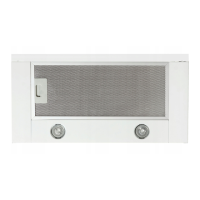
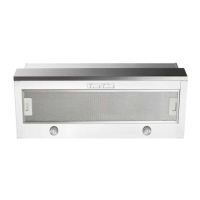
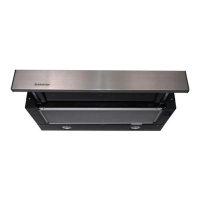
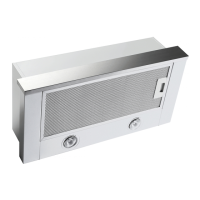
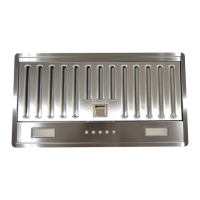
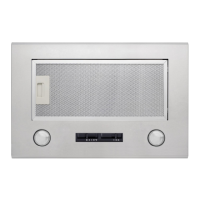
This document is a user manual for Ariston cooker hoods, specifically models AHBS 9.3F LL X and AHF 9.5F LM X. It provides instructions for use, maintenance, and installation in multiple languages.
Function Description
The Ariston cooker hood is designed to extract fumes and vapors produced during cooking. It can operate in two modes:
- Ducting version (extraction mode): Fumes are conveyed outside the building through a special pipe connected to the hood's connection ring.
- Filtering version (recirculation mode): Aspirated air is degreased and deodorized before being fed back into the room. This mode requires the installation of an additional activated charcoal filtering system.
The hood is equipped with a control panel for selecting aspiration speed and controlling the cooking area lights. Some models feature a mechanical control panel, while others have a Soft Button panel with an LCD display.
Control Panel Features (Mechanical):
- T1: ON/OFF light switch
- T2: Speed 1/OFF switch
- T3: 2-speed selection
- T4: 3-speed selection
Control Panel Features (Soft Button + LCD Display):
- T1: ON/OFF suction motor button
- T2: Selection button for medium, high, and intensive operating suction speed (power). The intensive speed (LED L1 flashing) lasts for approximately 5 minutes, then automatically reverts to medium speed.
- T3: Selection button for 'silent' suction speed (power)
- T4: ON/OFF lighting button
- L1: Status icon for suction speeds (powers)
- L2: Status icon for grease filter saturation
- L3: Status icon for low (silent) suction speed (power)
- L4: Status icon for charcoal filter saturation
- L5: Status icon for lighting
Automatic Operation at High Temperature:
The hood includes a temperature sensor. If the temperature becomes too high, the sensor automatically activates the medium suction speed. The hood switches off when the detected temperature significantly lowers.
Important Technical Specifications
The manual provides a table with technical data for the two models:
| Model |
Height (cm) |
Width (cm) |
Depth (cm) |
Ø of exhaust tube (cm) |
| AHBS9.7FALX |
61.9 - 114 |
89.8 |
45 |
15-12.5-12 |
|
70.4 - 114 |
|
|
|
| AHF 9.5F LM X |
60 - 112.5 |
89.8 |
45 |
15-12.5-12 |
|
68.5 - 112.5 |
|
|
|
Electrical Connection:
The mains power supply must match the rating indicated on the plate inside the hood. If the hood has a plug, it should be connected to a socket compliant with current regulations and located in an accessible area. If not fitted with a plug (direct mains connection) or if the plug is not in an accessible area, a double pole switch compliant with standards for complete disconnection under over-current category III must be installed.
Air Vent (Ducting Version):
The hood and discharge holes on the walls should have a diameter equivalent to the air outlet (connection flange). Using smaller diameter tubes or discharge holes will reduce suction performance and increase noise. The exhausting pipe is not supplied and must be purchased separately. The diameter of the exhausting pipe must be equal to that of the connection ring.
Usage Features
General Safety:
- Disconnect the hood from the mains before any cleaning or maintenance.
- Always wear work gloves for installation and maintenance.
- The appliance can be used by children aged 8 and above, and persons with reduced physical, sensory, or mental capabilities, or lack of experience and knowledge, if supervised or instructed on safe use and understanding of hazards.
- Children should not tamper with controls or play with the appliance.
- Cleaning and user maintenance should not be done by children without supervision.
- The premises where the appliance is installed must be sufficiently ventilated when the hood is used with other gas or fuel-burning devices.
- Do not flambé under the range hood.
- Fry with care to prevent oil from overheating and igniting.
- Accessible parts of the hood can become hot when used with cooking appliances.
- Do not connect the appliance to the mains until installation is fully complete.
- Follow local regulations for fume discharge.
- Air must not be discharged into a flue used for other combustion devices.
- Do not use the hood without correctly mounted lamps or grids.
- The hood should never be used as a support surface unless specified.
- Use only supplied fixing screws or purchase the correct type.
Filter Saturation Indicator Reset (Soft Button + LCD Display):
After filter maintenance, press and hold button T3. The saturation icon will switch off. Repeat if both grease and charcoal saturation icons are on.
Charcoal Filter Saturation Icon Activation/Disabling (Soft Button + LCD Display):
- To activate: With the hood off, press and hold T1 and T3 simultaneously. L4 will flash, then light up steadily.
- To disable: Repeat the above. L4 will light up steadily, then flash, and finally switch off.
Maintenance Features
Cleaning:
- Clean using ONLY a cloth dampened with neutral liquid detergent.
- DO NOT use tools, instruments, abrasive products, or alcohol.
- Clean the perimeter aspiration panel with the same frequency as the anti-grease filters, using a cloth and non-concentrated liquid detergent.
Anti-Grease Filters:
- These filters trap cooking grease particles.
- Clean once a month (or when the filter saturation indicator shows it) using non-aggressive detergents, either by hand or in a dishwasher (low temperature, short cycle).
- Dishwasher washing may cause slight discoloration, but this does not affect filtering capacity.
- To remove, pull the spring release handle.
Charcoal Filter:
- These filters absorb unpleasant cooking odors.
- Saturation depends on cooking type and grease filter cleaning regularity.
- Replace the cartridge at least every four months (or when the filter saturation indicator shows it).
- Charcoal filters CANNOT be washed or regenerated.
- Assembly: Hook the charcoal filter at the back onto the metal tongue of the hood, then at the front with the two knobs.
- Disassembly: Remove by turning the fixing knobs 90 degrees.
Replacing Lamps:
- The hood is equipped with LED lighting technology, offering optimum lighting, up to 10 times longer duration than traditional lamps, and 90% electrical energy savings.
- For replacement, contact technical service.
Disposal:
- The appliance is marked according to European directive 2012/19/EC on Waste Electrical and Electronic Equipment (WEEE).
- Dispose of the product correctly to prevent negative environmental and human health consequences.
- The symbol on the product indicates it should not be treated as household waste.
- Take it to an appropriate collection point for the recycling of electrical and electronic equipment.
- Follow local environmental regulations for waste disposal.

 Need help?
 General

 To Next Page