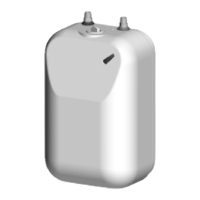
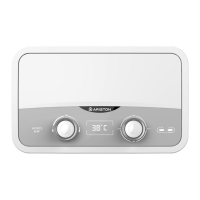
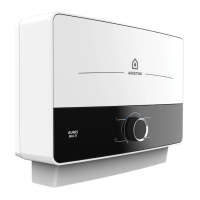
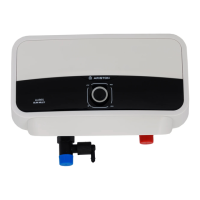
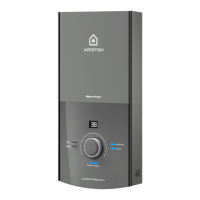
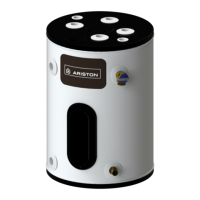
This document serves as a comprehensive Use and Care Manual for Ariston Glass-Lined Residential Electric Water Heaters, providing essential information for installation, operation, maintenance, and troubleshooting. It is designed for use by qualified installers and service technicians, with specific sections also relevant for the owner/user.
Function Description:
The Ariston Glass-Lined Residential Electric Water Heater is designed for indoor installations to provide potable hot water. It operates by heating water within a glass-lined tank, ensuring durability and resistance to corrosion. The heater is equipped with a combination thermostat and high-limit control (ECO) to regulate water temperature and prevent overheating. The ECO acts as a safety mechanism, breaking the circuit to the heating element if the water temperature becomes excessively high, requiring a manual reset after the cause of the over-temperature condition has been corrected. The unit is designed for vertical installation and must be properly grounded to ensure safe operation. It is not intended for use as a pool heater or for heating anything other than potable water. The water heater's design incorporates an anode rod, a sacrificial component that counteracts water chemistry to minimize tank corrosion and prolong its life.
Usage Features:
Before initial use, the water heater must be completely filled with water, and all air must be purged from the tank and piping by opening hot water faucets until water flows freely. The power supply should only be turned on after the tank is full to prevent damage to the heating element from "dry-firing." The thermostat allows for water temperature adjustment, but users are cautioned about the risk of scalding, especially for households with small children, disabled, or elderly persons. A temperature setting of 120°F or lower is recommended in such cases, and an ASSE 1017 or ASSE 1070 rated mixing valve is advised to prevent severe burns. The manual emphasizes that the water heater should only be used for its intended purpose as described, and any deviation will void the product warranty. It also highlights the importance of proper grounding and adherence to all local, state, provincial, and national codes, laws, regulations, and ordinances during installation and operation. The heater is approved for closet installation and installation on combustible flooring, but direct installation on carpeting is not permitted. Minimum service clearances are specified to ensure accessibility for maintenance: 24" front, 6" top, and 6" sides.
Maintenance Features:
Routine maintenance is crucial for ensuring the safe and efficient operation of the water heater and prolonging its service life. The manual recommends annual inspections by a qualified service technician to check for leaks, assess the heating element, and inspect the Temperature and Pressure (T&P) Relief Valve. The owner/user can perform some maintenance activities, such as monthly (or every two weeks in hard water locations) draining of a few quarts of water from the heater to flush sediment deposits. This flushing should be done with the power turned off to prevent damage to the heating elements. Periodically (at least twice a year), the area around the water heater and related plumbing should be checked for leaks, and any flammable liquids or combustible materials should be removed. The anode rod should be inspected annually and replaced as necessary, as its consumption rate can be influenced by water quality, especially softened or treated water. Operating the water heater without an anode rod will shorten the tank's life and void the warranty. For extended shut-off periods, especially in cold weather, it is recommended to turn off electric power, close the supply line, open the drain valve, and drain the water heater to prevent freezing. The T&P relief valve must be tested at least once annually by lifting its lever to ensure waterways are clear and replaced if it fails to operate correctly. Re-inspection of the T&P valve by a licensed plumbing contractor or qualified service technician is recommended at least once every three years to ensure it has not been affected by corrosive water conditions or tampered with. The manual also provides troubleshooting guidance for common issues like no hot water, not enough hot water, water too hot, T&P valve discharges, water leaks, and hot water odor, often suggesting remedies such as checking electrical connections, adjusting thermostat settings, or replacing components.


 To Next Page
 General