
 Need help?
Do you have a question about the Armfield UOP4 MKII and is the answer not in the manual?
Explains the fundamental principles of solid/liquid extraction and its applications in chemical engineering.
Introduces the Armfield UOP4 MkII as a simplified model demonstrating industrial solid/liquid extraction processes.
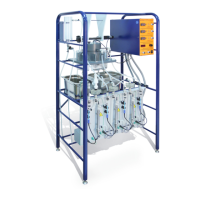
Illustrates the front view of the UOP4 MKII Solid/Liquid Extraction Unit with numbered components.
Shows the side view of the UOP4 MKII Solid/Liquid Extraction Unit, detailing its physical layout.
Presents a schematic diagram of the UOP4 MKII illustrating the 3-stage extraction process.
Details the front view of the UOP4 MkII console, highlighting control panel components and displays.
Illustrates the rear view of the UOP4 MkII console, showing input/output ports and power connections.
Depicts the Printed Circuit Board (PCB) connections within the UOP4 MKII unit.
Identifies the locations of potentiometers for temperature and conductivity calibration on the PCBs.
Alerts users to potential hazards associated with the UOP4 MKII, including misuse and component-related risks.
Provides fundamental safety guidelines for operating laboratory equipment, emphasizing following instructions and supervision.
Details safety precautions for equipment installation, handling, operation, and supervision.
Stipulates that commissioning must be performed by competent staff before allowing student operation.
Covers safety aspects of equipment maintenance, electrical connections, and RCD testing.
Outlines precautions to prevent fires and explosions, especially when handling flammable materials.
Details safety for handling hazardous substances, preventing cuts/burns, and specifying necessary PPE like eye and ear protection.
Advises on appropriate laboratory clothing to prevent injuries from rotating machinery or loose garments.
Emphasizes the importance of guards, safety devices, and readily available first aid equipment.
Explains the Control of Substances Hazardous to Health Regulations and the employer's duty to assess risks and provide information.
Warns about health risks from micro-organisms in water, like Legionella, and outlines necessary precautions.
Details requirements for connecting the equipment to the mains voltage supply and the importance of correct voltage and frequency.
Explains the function of the RCD in protecting against electric shock and the necessity of monthly testing.
The Armfield UOP4 MkII is a Solid/Liquid Extraction Unit designed for educational and laboratory use, demonstrating fundamental chemical engineering principles related to the extraction (leaching) of substances from solid materials using a liquid solvent. This process is common in various industries, from food processing (like making tea or coffee) to chemical manufacturing (extracting sugar from beet or oils from seeds using organic solvents).
The core function of the UOP4 MkII is to facilitate the separation of a soluble component from an insoluble solid matrix using a solvent. The unit is specifically designed to illustrate a simplified version of the moving-bed leaching process, which is a continuous multi-stage operation involving counter-current flow of both the solvent and the solid phase. This setup is highly efficient and commonly employed in large-scale industrial solid/liquid extraction systems.
In addition to continuous multi-stage extraction, the UOP4 MkII also incorporates a batch extraction vessel. This allows for the demonstration of fixed-bed leaching, which can be operated with either open-loop or closed-loop circulation of the solvent. This dual functionality provides a comprehensive understanding of different extraction methodologies.
The recommended process for the UOP4 MkII involves the extraction of Potassium Bicarbonate from a porous polymer pellet carrier using water as the solvent. This specific process is chosen for its safety and ease of handling in a laboratory environment, while still effectively demonstrating the principles of solid/liquid extraction.
The unit operates by introducing a chosen solvent to the solid material. The soluble component then dissolves into the solvent, forming a "miscella." This miscella is subsequently separated from the insoluble solid. The efficiency of this process is influenced by factors such as the preparation of the solid material (crushing, grinding, or cutting to increase surface area for contact), the nature of the solid, and the properties of the solvent.
The UOP4 MkII is designed for ease of operation and clear demonstration of principles. The front panel of the console features various controls and displays, including PID temperature controllers for precise temperature management, which is crucial for many extraction processes. These controllers allow users to set and monitor temperatures at different points within the system.
The unit also includes conductivity conditioning circuits, which are essential for monitoring the concentration of the extracted substance in the solvent. Conductivity probes provide real-time data on the progress of the extraction, allowing users to observe how the concentration changes over time and across different stages of the process.
The system incorporates multiple pumps for circulating the solvent and moving the solid phase, enabling both batch and continuous operations. Flow rates can be controlled, allowing for investigation into the effects of different flow regimes on extraction efficiency.
For enhanced educational value, the UOP4 MkII can be integrated with optional educational software and a data logging accessory. This allows for real-time data acquisition, visualization, and analysis, providing a deeper understanding of the process dynamics. Users can log temperature, conductivity, and other relevant parameters, which can then be used for plotting graphs of concentration, calculating extraction rates, and performing other analytical tasks.
The unit's design facilitates various laboratory teaching exercises, including:
The material hopper and feeder system allows for controlled introduction of the solid material, while the solvent sprinkler bar ensures even distribution of the solvent. The extraction cells, which are part of the rotor, facilitate the movement of the solid phase in continuous operations. Separate tanks are provided for fresh solvent, final miscella, extracted solids, and solvent collection, ensuring a clear separation of components throughout the process.
Routine maintenance is crucial for the safe and efficient operation of the UOP4 MkII. The manual provides detailed instructions for various maintenance tasks, ensuring the longevity and reliability of the equipment.
Key maintenance aspects include:
The design of the UOP4 MkII, with its modular components and accessible internal layout, simplifies maintenance tasks, allowing for easier inspection, cleaning, and replacement of parts when necessary. This contributes to the overall usability and educational value of the unit by ensuring it remains in optimal working condition for extended periods.
 General
| Process | Liquid-liquid extraction |
|---|---|
| Extraction Column Diameter | 50 mm |
| Diameter | 50 mm |
| Extraction Column Height | 1000 mm |
| Packing Type | Raschig rings |
| Raschig Ring Size | 6 mm |
| Material | Stainless steel and glass |
| Description | Liquid-Liquid Extraction Unit |
| Feed Tank Capacity | 10 L |
| Solvent Tank Capacity | 10 L |
| Power Supply | 220-240V, 50Hz |
| Heating System | Electric heater |
| Cooling System | Water-cooled |
| Temperature Control | PID controller |
| Feed System | Peristaltic pumps |

 To Next Page
