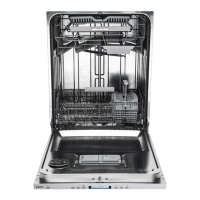
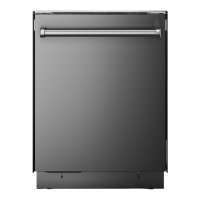
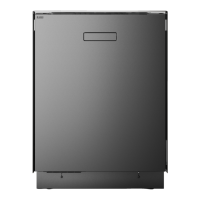
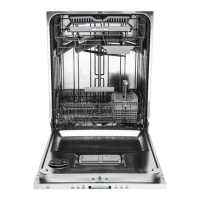
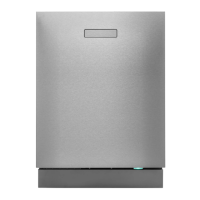
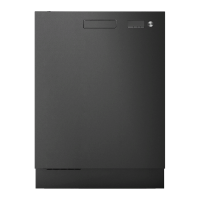
This document provides operating instructions for an ASKO dishwasher, model DB1675 XXLS, covering its functions, usage, and maintenance.
Function Description
The ASKO dishwasher is designed for efficient and convenient dishwashing. It features a main power switch to turn the appliance on and off, and a display that shows program information and settings. The dishwasher includes a program mode selector and navigation buttons for selecting various wash programs and options. A "Start/Stop" button initiates or pauses cycles, and dedicated option buttons are available for features like "Delayed Start" and "Extra Dry."
The appliance is equipped with an overflow guard function that automatically pumps out water and turns off the supply if the water level exceeds normal limits, preventing leaks. In case of a power failure, the interrupted program resumes once power is restored. The dishwasher also features a "Status Light" at the bottom, which uses different colors (blue, red, green) to indicate the program's status, such as "Load more," "Do not load," or "Unload."
For enhanced safety, the dishwasher includes a child lock (Kid Safe™) that prevents unintended operation by children. The appliance is designed for built-in installation under a countertop and can be connected to either a cold or hot water supply, with hot water connection potentially reducing wash times and energy consumption.
Usage Features
The dishwasher offers a range of programs and modes to suit different needs. Upon first use, a "Welcome to your new ASKO. This is a first time set up." message appears, guiding the user through initial settings like language and rinse aid dosage.
Programs:
- Normal wash: Recommended for daily, regular use with a full load of normally soiled dishes.
- ECO wash: The most energy-efficient program.
- Sanitation wash: Effective for daily use with slightly dried leftovers (not for burnt food).
- Time program: Adapts to a specified running or finish time, with options for lightly, normally, or heavily soiled dishes.
- Rinse and hold: Used to rinse dishes while waiting for a full load.
- Plastic wash: Designed for dishwasher-safe plastic items, featuring an extra-long drying cycle.
- Hygiene wash: Recommended for baby bottles and cutting boards, with high temperatures in the main and final rinse.
- Crystal glass: A gentle program with low temperature for fragile crystal/glass items, requiring a small amount of detergent and careful loading to prevent contact between items.
- Self-cleaning: For sanitizing the dishwasher tub, spray arms, and pipes, using regular detergent or citric acid (no dishes).
- Upper half/Lower half: Programs for washing dishes only in the upper or lower basket, respectively.
Program Modes:
- Green mode: Uses less energy and water, with an extended program time.
- Speed mode: Shortens program time but uses more energy.
- Night mode: Lowers noise level during the wash cycle, extending program time.
- Intensive mode (Heat Boost): Improves dishwashing results, uses more energy and water, and extends program time.
Options:
- Extra Dry (Heated drying option): Increases final rinse temperature and extends drying for better results, with a slight increase in energy consumption. This option can be deactivated to save time and energy.
- Delayed Start: Allows the dishwasher to start 1-24 hours after pressing Start/Stop.
- Super rinse: Adds two extra rinses to certain programs like Normal wash, ECO wash, Sanitation wash, Plastic wash, Lower half, and Upper half.
- High temperature: Activates a higher temperature setting to improve dishwashing results, increasing energy consumption. Available in Normal wash.
- Interior light at power off: Controls whether the interior light switches on when the dishwasher is off and the door is opened.
Loading the Dishwasher:
- Dishes should be scraped of large food particles, not rinsed under running water.
- All dirty surfaces should face down.
- Dishes should not touch each other.
- Hollow items like cups should be angled for water runoff.
- Small items should be placed in the cutlery basket to prevent them from falling through.
- The upper basket can be adjusted for height to accommodate larger plates in the lower basket.
- Foldable tines in the baskets allow for flexible loading of pots, bowls, and glasses.
- Cutlery should be placed with handles down, except for knives, and spread out to prevent stacking. The cutlery basket is best positioned in the middle front for optimal cleaning.
- Vase and bottle holders are available for specific items.
- The middle basket's wire basket and utensil basket are suitable for short objects and serving cutlery.
- The lower basket is ideal for plates, serving dishes, pots, and cutlery, with specific areas for pots and pans to utilize rear spray nozzles.
Detergent and Rinse Aid:
- Only dishwasher detergent should be used; liquid hand-washing detergent is not suitable.
- Detergent dosage depends on water hardness and should follow packaging instructions.
- Dishwasher tablets are not recommended for short programs (under 75 minutes); powder or liquid detergent is preferred.
- All-in-one detergents require careful reading of their directions.
- Rinse aid improves wash and dry times, achieving clear and spotless results. The dosage can be adjusted (0-5) based on water marks, sticky film, streaks, or excessive foaming. The rinse aid compartment should be topped up to the "max" level when indicated by the display symbol.
Maintenance Features
Regular maintenance ensures optimal performance and longevity of the dishwasher.
Filters:
- The coarse filter traps larger food particles and should be emptied when necessary. It is lifted by a handle.
- The fine filter automatically rinses debris during each wash but should also be cleaned periodically. It is removed by turning a handle counterclockwise.
- It's crucial to ensure filters are correctly fitted and locked in place, as improper installation can affect dishwashing results. A colored stop in the bottom drain must also be in place.
Spray Arms and Spray Pipes:
- Holes and bearings in the spray arms can become blocked. Debris can be removed with a needle or similar item.
- Spray arms can be removed for cleaning and must be firmly reinstalled. The upper spray arm is unscrewed counterclockwise from its bearings. The middle spray pipes should also be checked for blockages.
Door and Door Seal:
- The sides of the door and the door seal should be regularly cleaned with a slightly damp cloth.
Display Panel:
- Buttons should be kept clean and free from grease, wiped with a dry or slightly damp cloth. Cleaners should not be used to avoid scratching. The main power switch should be turned off before cleaning to prevent unintentional activation.
Dishwasher Tub:
- The stainless steel tub is generally kept clean through normal use.
- For limescale deposits, especially in hard water areas, the Self-cleaning program should be run with two tablespoons of citric acid in the detergent compartment (without dishes). Special dishwasher cleaners are also available. Anti-freeze, Draino®, CLR®, or other chemical cleaners should never be used.
Drain Pump:
- If water remains in the dishwasher after a program, the drain pump may be blocked.
- To clear it, turn off the machine, unplug it, remove coarse and fine filters, scoop out water, remove the colored stop in the bottom drain, and manually turn the pump wheel to remove any items.
- Reinstall all parts and plug the machine back in. If a whirring sound persists, the overflow protection may be triggered, requiring the water supply to be shut off and customer care contacted.
Drain Hose:
- The drain hose should be checked for kinks or sharp bends.
- If blocked, it should be loosened from its termination point and checked for debris. The cone-shaped part of the drain boot should be cut to the maximum size of the fitting where it attaches.
- The drain hose can be extended up to 87 inches (2.2 m), but ideally, it should be replaced with a new hose without joins. No part of the hose should be more than 37 3/8 inches (96 cm) above the dishwasher bottom.
Water Supply:
- The inlet hose supplied with the dishwasher should be used, and old or spare hoses should not be reused.
- A water supply valve must be fitted and easily accessible.
- After installation, the water supply valve should be turned on, and connections checked for watertightness.
Troubleshooting:
The manual provides a comprehensive troubleshooting guide for common issues, including display fault codes (e.g., F10 for overfilling water, F11 for water outlet fault, F12 for water inlet fault) and problems like unresponsive buttons, inability to close the door, programs not starting, dishes not clean, spots on dishes, bad odors, and insufficient drying. Each problem is linked to possible causes and recommended actions, often directing users to specific maintenance steps or settings adjustments. If issues persist, contacting the Customer Care Center is advised.


 To Next Page
 General
 Weight and Dimensions