5
ADVICE AND TIPS BEFORE WASHING
Here are some tips that may help you before washing.
SORTING YOUR LAUNDRY
Sort items according to:
• how soiled they are
• colour
• material
CLOTHING
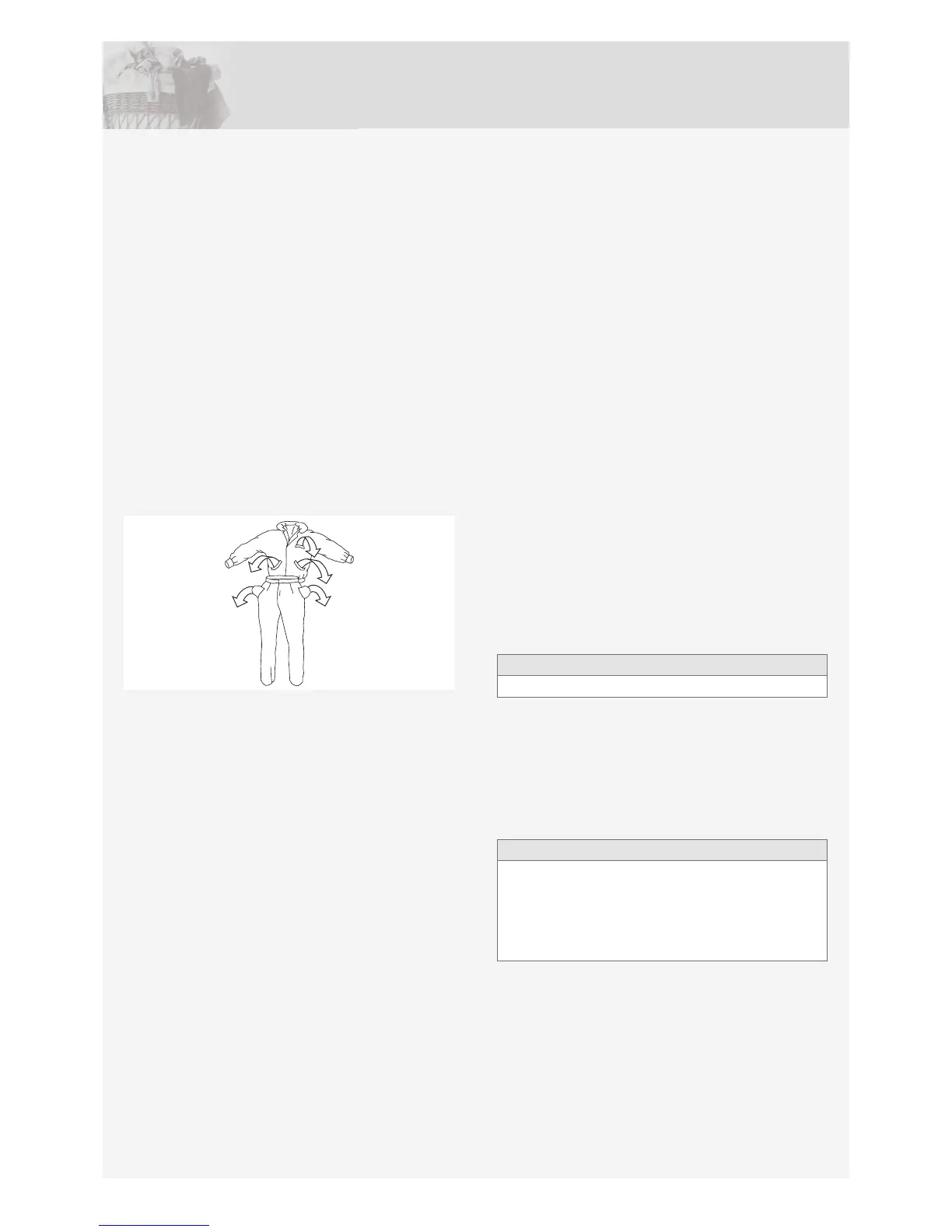
1 Do up zips and close Velcro straps so that they don’t
harm fabrics.
2 New coloured items may contain excess dye and
should therefore be washed separately the fi rst few
times.
3 Turn delicate items inside out. This reduces the risk of
burling and fading.
4 Empty pockets and wash them inside out if possible.
LAUNDRY LABELS
Look at the item’s laundry label. The table below shows
suitable wash programmes for diff erent materials and
wash loads. Using modern washing machines and
detergents, for example compact detergents, you can
usually wash at lower temperatures. It is a good idea
to use trial and error to fi nd out what produces the best
results.
HOT WATER CONNECTION
(depending on the model)
Hot water intake has a positive eff ect on grease stains
and certain pigment stains, such as oil, soot and coff ee.
Note however that diffi cult protein stains with albumen
content (blood, milk, meat and fi sh) fi rst need to be
soaked in cold water as they are diffi cult to dissolve at
temperatures above 40 °C. For the best washing results
we recommend the Super wash option and pre-soaking
the stained items in cold water before washing them in
the machine.
COLOURED COTTON
Coloured cotton garments labelled with washing
instruction 60 °C must be washed at 60 °C initially to
remove any excess dye. Failure to observe this advice
could lead to the colour running. Use detergent without
bleach to preserve the colour of the fabric.
UNBLEACHED LINEN
Unbleached linen fabrics should be washed at 60 °C,
using detergent without bleach or optical brighteners.
Heavily soiled linen can be washed at higher
temperatures, but not too often as the heat may destroy
the sheen and strength of the linen.
WOOL
These fabrics are labelled for either machine wash or for
hand wash. The machine’s Wool/hand wash programme
is at least as gentle as washing by hand.
RAYON FIBRES AND SYNTHETIC
FIBRES
Materials made of rayon fi bres, such as viscose, and
some synthetic fi bres are very delicate and require much
space so as not to crease. Only half fi ll the drum when
washing and choose a spin speed of 800 rpm or lower.
NOTE!
Viscose and acetates are fragile when wet.
DETERGENTS
Eco-labelled detergents are less harmful to the
environment. Detergent overdosing does not give better
washing results; it merely causes a greater impact on the
environment. Try to use less detergent, and increase only
if you are not satisfi ed with the results.
NOTE!
Due to environmental concerns, we discourage the use
of strong chemicals.
When using agents for bleaching or stain removal,
there is a risk of rust (corrosion) and discolouration of
the machine.



 To Next Page